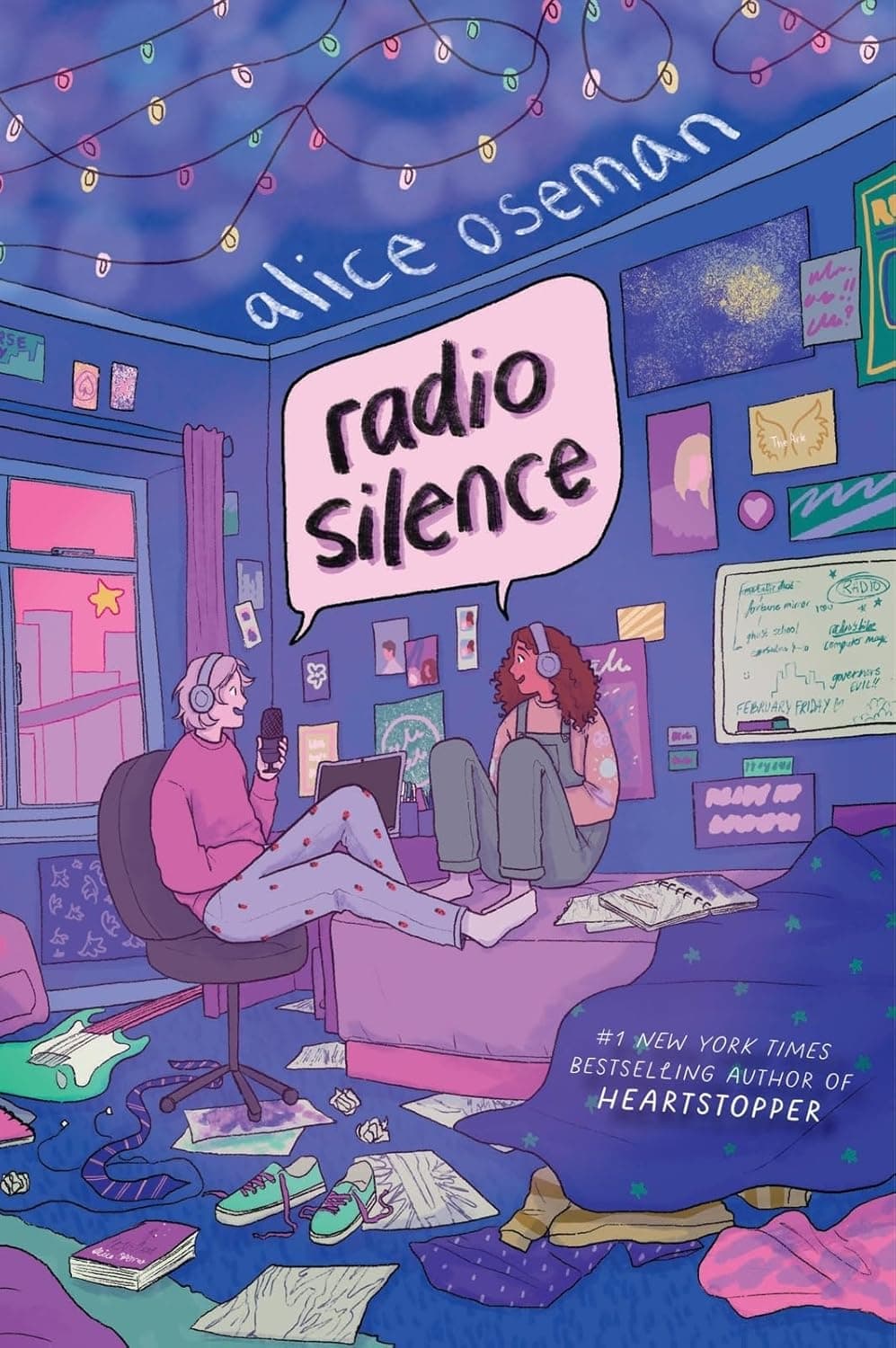
Radio Silence: Full Book Summary
At a Glance
- Genre: Contemporary YA; coming-of-age
- Setting: modern England—sixth form, university halls, and the online world of a cult podcast
- Perspective: First-person narration by Frances Janvier
Opening Hook
Frances has perfected the art of being someone else: Head Girl, Cambridge-bound, the kind of student adults point to with pride. Online, she’s “Toulouse,” a gifted fan artist devoted to a surreal podcast called Universe City. When the show’s anonymous creator taps her to become the official artist, the border between Frances’s public and private selves starts to blur. What begins as a creative partnership with a quiet boy becomes a lifeline—until fame, secrets, and the internet’s harsh glare threaten to tear them apart.
Plot Overview
Act I: School Frances Meets Universe City
Seventeen-year-old Frances is “School Frances” to the world: relentless, polished, and laser-focused on Cambridge. In private, she lives for Universe City, an eerie, imaginative podcast that makes her feel seen, and she creates stunning fan art under her alias “Toulouse.” When the show’s creator, known only as Radio Silence, messages her to become the official artist, encouragement from her supportive mum nudges her to say yes—a small rebellion against the path she’s been told is the only one that matters.
A pre-exam party changes everything. After a drunken prank call from her academic rival Daniel Jun, Frances ends up talking to Daniel’s quiet friend Aled Last. He slips and quotes the podcast’s opening line. At the club, Aled confesses: he is Radio Silence. Their shared secret binds them fast, and through a summer of writing, drawing, and recording, they build Universe City together (see the Chapter 1-5 Summary). Frances discovers Aled’s creativity is hidden from his strict mother Carol Last, and that his twin, Carys Last, ran away years ago—a wound he tiptoes around.
Act II: Fame, Fandom, and Fracture
The trio’s chemistry—Frances, Aled, and sometimes Daniel—produces a messy, tipsy experimental episode that catches the eye of a famous YouTuber. Overnight, the podcast surges, and the fandom turns into an investigation squad, obsessed with unmasking Radio Silence (see the Chapter 26-30 Summary). The attention is intoxicating and terrifying.
First, the internet identifies Frances as Toulouse. At school, she’s stripped of her Head Girl title for being associated with a show openly critical of the education system. Then the fandom connects Aled to Radio Silence using a private Facebook photo and a picture Frances once tweeted of his distinctive shoes. Ambushed by younger students, shaken and scared, Aled wrongly assumes Frances exposed him. The accusation explodes into a devastating club fight where he accuses her of using him for clout and cruelly invokes his missing sister. He leaves for university, and true radio silence falls between them (see the Chapter 36-40 Summary).
Act III: The Aftermath and a New Mystery
Frances tries to salvage the future she thought she wanted. She forces herself through Cambridge interviews and falls apart. Rejected, she watches Universe City falter—episodes arrive erratically, drained of spark. Then Aled uploads “Goodbye,” twenty minutes of white noise, and the podcast flatlines.
Rereading transcripts, Frances follows a breadcrumb trail. Radio’s cryptic, intimate addresses to “February Friday” read like messages in a bottle. The truth clicks: February Friday is Carys, and Universe City was Aled’s years-long attempt to reach his missing twin (see the Chapter 51-55 Summary).
Act IV: The Rescue
Frances decides Aled can’t be left to vanish into the noise. With a plan engineered by her mum, and help from her bold friend Raine Sengupta, she quietly copies Carol’s Filofax and finds Carys’s address. In London, she meets Carys—now going by February—and explains the collapse of Universe City and Aled’s unraveling.
Carys, Frances, Raine, and Daniel drive six hours to Aled’s university. His room is a wreck—food rotting, hate mail piled up. After a frantic scramble across campus, Frances finds him. They reconcile. Carol arrives to drag him home, but Aled, buoyed by his sister and friends, finally stands up to her and leaves with them (see the Chapter 61-65 Summary).
Act V: A New Beginning
Aled drops out and moves in with Carys in London, choosing recovery over appearances. Frances, undone by the Cambridge ordeal and emboldened by the truth about what makes her happy, turns down her university offers and applies to art college. Months later, Aled returns to Universe City with a live performance—no masks, no anonymity. Frances, now studying art, stands in the crowd. Together, they step into lives that finally fit.
Central Characters
A tight, intimate cast anchors the novel, with friendships and family bonds driving the plot as much as any romance would in a traditional YA story.
- Frances Janvier: The high-achieving narrator learns that being “good” at school and being true to herself aren’t the same thing. Her arc dismantles the myth that elite academia is the only measure of worth, as she reclaims her identity as an artist and a fan.
- Aled Last: Gentle, private, and brilliant, he builds Universe City as a beacon to his missing sister and a refuge from control at home. His journey is about accepting help, speaking aloud what hurts, and creating without hiding.
- Carys Last: Aled’s twin, known as “February” in her new life, embodies survival outside the systems that failed her. Reuniting with Aled reframes the podcast as a love letter between siblings separated by abuse and silence.
- Daniel Jun: Framed as Frances’s academic rival, he reveals himself as lonely, proud, and aching under pressure. His complicated, closeted feelings for Aled sharpen the book’s portrait of expectation versus self-knowledge.
- Raine Sengupta: A fearless, funny friend who sees through school status games. Raine’s loyalty and practicality propel the rescue, modeling community as a lifeline.
- Carol Last and Frances’s mum: Two mothers, two models of power. Carol’s emotional abuse isolates and diminishes her children, while Frances’s mum offers the patience and ingenuity that help them find a way out.
Major Themes
The Pressure of Academia and the Education System
The novel indicts a culture that equates grades with identity and funnels teens toward prestige at any cost. Frances’s breakdown and Aled’s collapse show how “success” can become a trap—one that punishes curiosity, creativity, and mental health.
Identity and Authenticity
Frances and Aled each perform a version of themselves that earns approval while burying what matters most. The story argues for choosing the messy, joyful truth—embracing “weirdness,” art, and community over a life curated for other people.
Platonic Friendship and Love
Oseman centers a friendship as intense and transformative as any romance. Frances and Aled’s bond redefines love’s possibilities in YA, suggesting that mutual care, respect, and shared creativity can be soul-shaping without being romantic.
The Power and Dangers of Fandom and Internet Culture
The internet gives marginalized teens a stage, a community, and a voice—Universe City exists because of it. But parasocial entitlement and doxxing turn community into surveillance, revealing how quickly adoration can curdle into harm.
Abusive Family Dynamics
Through Carol’s coercive control, the novel depicts abuse that’s insidious and often invisible to outsiders. Aled and Carys’s fear and secrecy show how abuse isolates—and how found family can create an exit.
Mental Health and Well-being
Depression, anxiety, and burnout are treated with frankness and compassion. The narrative insists that asking for help is not failure, and that rest, distance, and chosen support are essential to survival.
LGBTQ+ Identity and Representation
Frances (bisexual), Aled (demisexual), Daniel (gay), and Carys (lesbian) exist as whole people whose queerness is integrated, not instrumentalized. The book normalizes a spectrum of identities while keeping its focus on friendship, art, and autonomy.
Literary Significance
Radio Silence stands out in contemporary YA for swapping romance-centered plotting for a celebration of platonic love, internet-born creativity, and chosen family. It captures the texture of the online era—DMs, fandom dynamics, parasocial pressure—without condescension, while mounting a clear critique of academic gatekeeping. By giving voice to a demisexual lead and a casually diverse ensemble, Oseman broadens representation with nuance and warmth. The novel’s lasting power lies in its invitation: abandon the performance, choose your people, and build a life that answers you back.