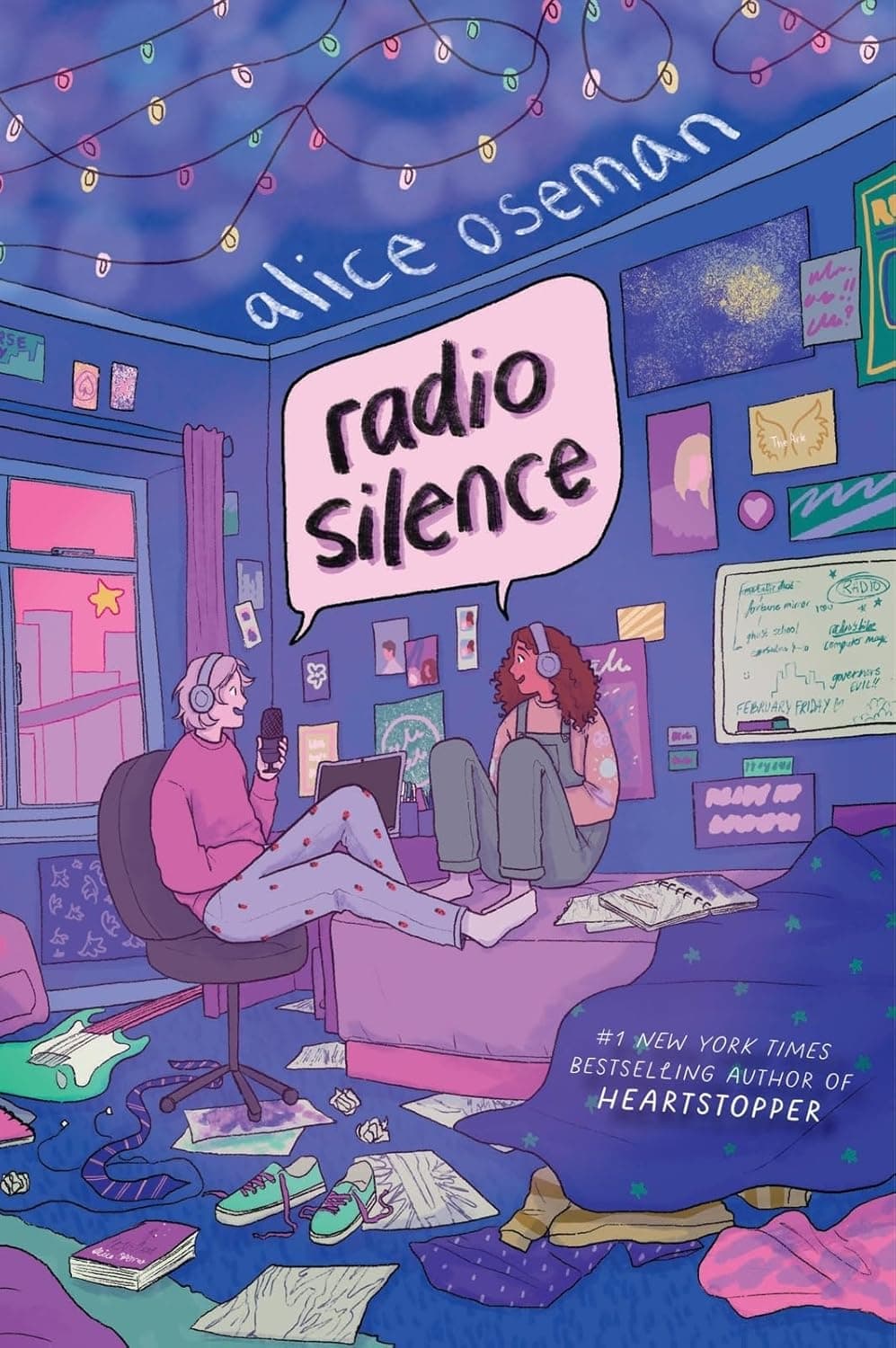
This collection of quotes from Radio Silence traces the novel’s core concerns—identity, friendship, academic pressure, and the courage to speak—showing how Oseman builds meaning through voice, structure, and motif.
Most Important Quotes
These quotes are essential to understanding the core message and emotional heart of Radio Silence.
The Call for Connection
"Hello. I hope somebody is listening."
Speaker: Radio (Aled Last) | Location: Universe City: Ep. 1 – dark blue | Context: This is the opening line of Aled Last's podcast, Universe City, which Frances listens to religiously. It is the first thing the audience hears from the show's narrator, Radio Silence.
Analysis: This line is both a narrative hook and a mission statement, capturing the ache of Loneliness and Connection that defines the book. It introduces Aled Last and Frances Janvier’s parallel isolation while casting the podcast as a lifeline tossed into the dark. The language evokes a transmission sent into space—intimate yet anonymous—mirroring the characters’ tentative bids for understanding. By the novel’s end, the line’s meaning flips from a private plea to a communal rallying cry, dramatizing the shift from silence to voice.
Redefining Love
"You probably think that Aled Last and I are going to fall in love or something. Since he is a boy and I am a girl. I just wanted to say – We don’t. That’s all."
Speaker: Frances Janvier (Narrator) | Location: Chapter: "Something Before We Continue" | Context: Frances directly addresses the reader after she and Aled have established their deep, secret friendship, preempting common narrative expectations.
Analysis: With this meta aside, Frances demolishes a standard genre expectation and centers Platonic Friendship and Love as a legitimate, transformative bond. Oseman’s fourth-wall break teaches the reader how to read the relationship: intimacy without romance is not a consolation prize but an endpoint. The blunt syntax—short lines, controlled pauses—magnifies the confidence of her refusal. It’s memorable because it reframes the novel’s emotional stakes, insisting that soulmates don’t always kiss.
The Formula for Happiness
"I was going to Cambridge, and I was going to get a good job and earn lots of money, and I was going to be happy."
Speaker: Frances Janvier (Narrator) | Location: Chapter: "I Was Clever" | Context: In the opening chapter, Frances reflects on her life plan and reputation as a "ruthless study machine" just before giving a speech at her school's parents' evening.
Analysis: Frances narrates her life as a neat equation—grades beget prestige, which guarantees happiness—laying bare the Pressure of Academia and the Education System. The repetitive, paratactic structure (“and I was… and I was…”) mimics a script she has memorized rather than a dream she owns. It functions as the “before” image of her Coming of Age, the belief the plot will interrogate and dismantle. The line is striking because it sounds airtight until the book proves it isn’t.
Permission to Be Yourself
"I think you work yourself too hard for school anyway and you should take an opportunity for once and do what you want."
Speaker: Frances's Mum | Location: Chapter: "Do What You Want" | Context: Frances's mum says this after Frances expresses excitement about the offer to become the artist for Universe City but immediately dismisses it as unrealistic due to her schoolwork.
Analysis: Coming from a parent, this blessing becomes the novel’s catalyst for Identity and Authenticity. The sentence reframes “opportunity” not as a line on a CV but as a chance to honor desire, pushing Frances to give weight to joy. It counters the myth that discipline and passion are mutually exclusive, opening the door for her to reconcile her public and private selves. The moment matters because it legitimizes wanting as a reason to act.
Thematic Quotes
The Pressure of Academia and the Education System
The Academic Machine
"I’m clever, I’m going to university, blah blah blah grades success happiness. I’m fine."
Speaker: Frances Janvier | Location: Chapter: "The Narrator" | Context: Frances is reassuring her mum that she is prepared for her parents' evening speech, summarizing the key points she is expected to cover.
Analysis: The intrusive “blah blah blah” punctures the glossy narrative Frances is expected to perform, revealing her weariness with a script that reduces life to milestones. By bundling “grades success happiness” into a single rushed breath, the line satirizes how institutions conflate achievement with wellbeing. It exposes how even the model student feels alienated from the goals she’s chasing. Irony turns her “I’m fine” into a warning flare.
The Weight of Potential
"She’s literally a monster... She believes in this so strongly that she would actually rather we died than didn’t do all of that."
Speaker: Carys Last | Location: Chapter: "Golden Child" | Context: Carys explains to Frances the extreme academic pressure their mother, Carol Last, placed on her and Aled, which ultimately drove Carys to run away.
Analysis: Carys’s hyperbole refracts a very real terror: the omnipresent, punitive authority of a parent who equates worth with results, a portrait of Abusive Family Dynamics. Calling her mother a “monster” mythologizes the threat, capturing how inescapable and dehumanizing that pressure feels. The life-or-death framing clarifies the stakes behind her flight and Aled’s anxiety. It’s unforgettable because it makes “potential” sound like a sentence, not a gift.
Identity and Authenticity
Two Different People
"They only like School Frances though. Not Real Frances."
Speaker: Frances Janvier | Location: Chapter: "Awkward" | Context: Frances explains to her mum why she is struggling to be honest with Aled, expressing her fear that her school friends don't know or like her true self.
Analysis: By capitalizing “School Frances” and “Real Frances,” Frances splits herself in two, personifying the mask and the girl underneath. The simple syntax sharpens the sting: her social world values a curated persona, not the person who loves art and fandom. The line crystallizes her isolation and articulates the novel’s central project—integrating public performance with private passion. It resonates because the distinction feels both childish and devastatingly true.
The Fear of Judgment
"yeah i’m always scared people will laugh at me … idk it’s probably silly haha"
Speaker: Aled Last | Location: Chapter: "#specialsnowflake" | Context: Aled admits to Frances over Facebook message why he doesn't wear his more interesting clothes, like his UFO jumper, in public.
Analysis: The lowercase, ellipses, and casual “haha” mimic online hedging, softening a confession that’s anything but silly. Aled’s worry about ridicule explains his cultivated quiet—conformity as armor. The message becomes a trust fall, inviting Frances into the small, tender space where he risks being seen. It’s a microcosm of their bond: privacy, honesty, and the relief of acceptance.
Platonic Friendship and Love
A Different Kind of Love
"And I’m platonically in love with you."
Speaker: Aled Last | Location: Chapter: "Angel" | Context: Aled says this to Frances while she is taking care of him when he is sick with the flu, expressing his deep appreciation for her kindness.
Analysis: Aled names a feeling stories often blur—devotion without romance—and in doing so validates a relationship language rarely honored. The adverb “platonically” is both precise and gently comic, acknowledging norms while refusing to obey them. His candor, answered by Frances’s joke, models an intimacy defined by care, not categories. The line endures because it expands what love is allowed to sound like.
The Irrelevance of Romance
"And realised that I didn’t like him in that way at all. And it didn’t matter."
Speaker: Frances Janvier (Narrator) | Location: Chapter: "Logarithms" | Context: After her mum asks if she "likes" Aled romantically, Frances considers the question and comes to a definitive conclusion about the nature of her feelings.
Analysis: Frances’s epiphany is strikingly calm: no angst, no loss, only clarity. The repeated “And” gives the moment a quiet inevitability, and “it didn’t matter” delivers the thesis—romance is not the measure of value. By refusing the usual narrative escalation, the line protects the sanctity of their friendship. It’s a hinge in the book’s argument that love has many right answers.
Character-Defining Quotes
Frances Janvier
"Being clever was, after all, my primary source of self-esteem. I’m a very sad person, in all senses of the word, but at least I was going to get into university."
Speaker: Frances Janvier (Narrator) | Location: Chapter: "The Narrator" | Context: Frances reflects on her identity and motivations while waiting to give her parents' evening speech.
Analysis: With brutal precision, Frances admits that achievement props up a fragile sense of self. Phrases like “primary source of self-esteem” reveal a transactional identity: grades purchased confidence she couldn’t find elsewhere. The wry self-deprecation can’t hide the emptiness beneath her drive, setting up the central obstacle of her Coming of Age. The quote matters because it names the cost of being “impressive.”
Aled Last
"Sometimes I think if nobody spoke to me, I’d never speak again."
Speaker: Aled Last | Location: Chapter: "Your Art Is So Beautiful" | Context: Aled muses on his own quietness while he and Frances are working on Universe City art in her bedroom.
Analysis: This confession goes beyond shyness to suggest a learned muteness, the result of years of suppression within abusive expectations. The conditional phrasing imagines a world in which he disappears unless summoned, explaining why his podcast becomes a sanctuary for voice. It casts Frances as a catalyst—someone who invites speech rather than demands performance. The line lingers because it sounds like exhaustion and a wish at once.
Carol Last
"Oh, come on, darling, it’s much too long, isn’t it? You’ll be a social reject if you turn up to university like that!"
Speaker: Carol Last | Location: Chapter: "Like This" | Context: Carol says this as she forcibly cuts a chunk of Aled's hair with kitchen scissors, ignoring his protests.
Analysis: The syrupy “darling” and future-oriented warning mask a violation of bodily autonomy, capturing control disguised as care. By policing hair in the name of social success, Carol conflates conformity with safety and love with management. The scene’s domestic details—kitchen scissors, casual chatter—make the violence feel chillingly ordinary. It crystallizes her role as antagonist: the enforcer of a narrow life.
Carys Last
"Family means nothing. You have no obligation to love your family. It wasn’t your choice to be born."
Speaker: Carys Last | Location: Chapter: "Family" | Context: Carys says this to Frances at the train station after Frances insists she should help Aled because he is her brother.
Analysis: Carys’s credo is hard-won: a refusal to sentimentalize bonds that harm. The declarative sentences, stripped of qualifiers, reclaim agency by severing love from obligation. Her stance explains both her disappearance and her survival, prioritizing chosen ties over inherited ones. It challenges readers to accept that “family” without care is just a word.
Daniel Jun
"It’s … all I’ve got. This is the only special thing about me."
Speaker: Daniel Jun | Location: Chapter: "The Only Special Thing" | Context: A distraught Daniel confesses his feelings of inadequacy to Frances after his Cambridge interview, which he feels did not go perfectly.
Analysis: Daniel’s bravado collapses into a fear that mirrors Frances’s: without achievement, there’s no self left. The ellipsis stretches his panic, and the stark “only” exposes how completely he has mortgaged identity to status. The moment reframes him from rival to peer, another teenager drowning in expectations. It’s pivotal because it broadens the novel’s empathy beyond its leads.
Raine Sengupta
"He has no right to complain about anything. He’s literally living the perfect life. Top uni, got a successful YouTube channel, what’s he moping about? ... I’d kill to be him, tbh, his life is perfect."
Speaker: Raine Sengupta | Location: Chapter: "Time Vortex" | Context: Raine expresses her frustration to Frances after hearing that Aled is upset about his identity being revealed online.
Analysis: Raine voices a common misconception: that visible success cancels pain, erasing claims to Mental Health and Well-being. The casual slang and absolutes (“perfect,” “no right”) reveal how seductive that narrative is. Her misread underscores the novel’s insistence that public metrics don’t map private suffering. The line is important because it marks the start of Raine’s growth from judgment to understanding.
Memorable Lines
The Joy of Fandom
"I felt like dying, but in a good way."
Speaker: Frances Janvier (Narrator) | Location: Chapter: "Dying, But In a Good Way" | Context: This is Frances's immediate internal reaction to receiving a direct message from Radio, the creator of Universe City, asking her to be the show's official artist.
Analysis: The oxymoron captures fandom’s ecstatic overload—too much feeling for the body to hold, but bliss all the same. It dignifies online art and community as sites of real emotion and real stakes. Stylistically, the contrast jolts, mimicking the shock of an impossible wish coming true. It sticks because it sounds exactly like a dream breaking into reality.
A Moment of Freedom
"...and then he laughed, and it reminded me of a child’s laugh, and I wished people could always laugh and run like that."
Speaker: Frances Janvier (Narrator) | Location: Chapter: "Laugh and Run" | Context: Frances describes the moment she and Aled are caught in a sudden downpour and run hand-in-hand through a field to find shelter.
Analysis: Rain turns into release here, washing the characters out of their routines and into play. Comparing Aled’s laugh to a child’s restores a lost self—unguarded, present, ungraded. The image of running through a storm doubles as a baptism, a brief cleansing from expectation. The sentence lingers because it bottles a kind of happiness the book fights to protect.
Opening and Closing Lines
Opening Line
"Can you hear that?"
Speaker: Carys Last | Location: Chapter: "Futures" | Context: Carys says this to Frances on a train platform two years before the main story begins, just before they realize their school is on fire.
Analysis: The first question trains readers to listen—to static, to subtext, to what’s wrong. Frances’s earbuds literalize her early self-absorption, while the approaching sirens foreshadow an institution about to burn, figuratively and literally. The economy of the line sets up the book’s motifs of attention and voice. It opens the door to a story about hearing one another at last.
Closing Line
"Hello. I hope somebody is listening …"
Speaker: Aled Last | Location: Chapter: "A New Voice" | Context: This is the final line of the book. Aled is on stage at a live event for Universe City, speaking into a microphone in front of a massive, cheering audience.
Analysis: Repeating the podcast’s opener as the novel’s closer binds beginning to end, but with roles reversed: the whisper has become a performance, the fear a welcome. Public speaking reframes vulnerability as power, turning exposure into connection. The ellipsis invites the audience into an ongoing conversation, not a finished speech. It’s the emblem of Finding Your Voice and Pursuing Passion—not silence broken once, but voice sustained.