Opening Context
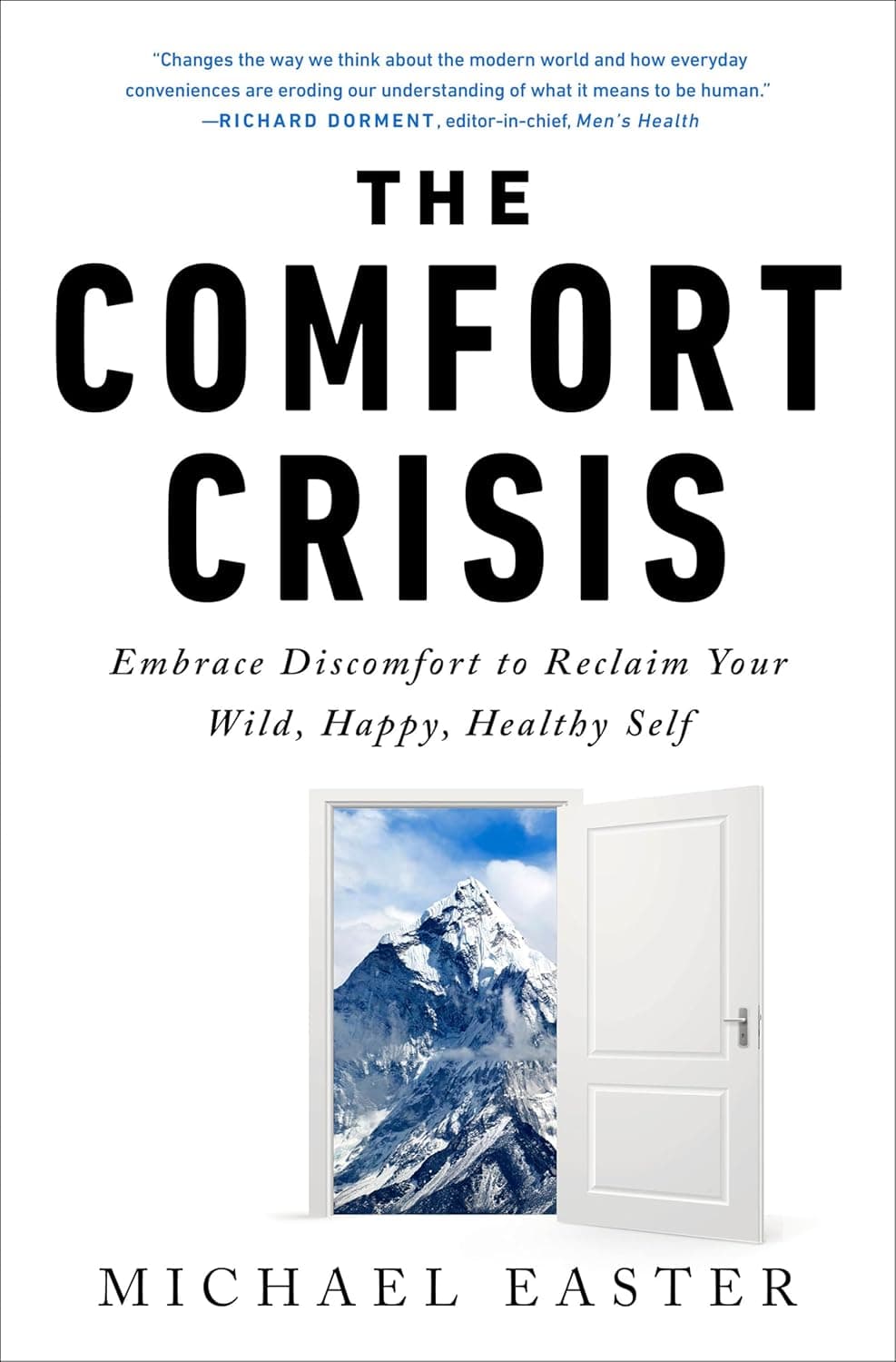
Set between sterile laboratories and the raw, indifferent Arctic, The Comfort Crisis follows a journalist’s quest to understand why a life of ease leaves us unwell—and how deliberate discomfort can restore health, meaning, and grit. The cast ranges from backcountry hunters to Ivy League scientists and a Bhutanese monk, each offering expertise that pushes the narrator beyond convenience and into growth.
Main Characters
Michael Easter
As author and narrator, Michael Easter is the seeker at the story’s center, turning his sobriety hard-won in the past toward a deeper reckoning with the “comfort crisis” hollowing out his present. He commits to a 33-day, unsupported caribou hunt in the Arctic as a personal misogi and a living experiment, testing scientific theories against hunger, cold, boredom, and fear. Not an elite athlete or survivalist, he serves as an accessible surrogate for the reader, documenting how stress, risk, and nature rebuild mental toughness and perspective. His closest ties are to Donnie Vincent, who mentors him in the wild, and William Altman, whose quiet competence steadies the team; in parallel, experts like Dr. Marcus Elliott, Trevor Kashey, Jason McCarthy, and Khenpo Phuntsho Tashi shape his framework for embracing discomfort. By the end, he emerges physically hardier and spiritually clearer, trading a life marinated in comfort for a “pink cloud” of earned appreciation; his journey is detailed in the Full Book Summary.
Donnie Vincent
Donnie Vincent—backcountry bowhunter, filmmaker, and former biologist—embodies the book’s “rewilded” ideal, fusing scientific knowledge with an ethical, deeply spiritual approach to hunting. As Easter’s mentor and expedition leader, he sets the tone: take only mature animals, waste nothing, and accept the wild on its terms. Unflappable and already living the life the protagonist seeks, he remains largely unchanged, functioning as a catalyst for the transformation of others, including Easter and William Altman. His presence makes the expedition possible, and his philosophy reframes the hunt as a way of reentering the ecosystem rather than conquering it; his first appearance is in Chapter 1.
Supporting Characters
William Altman
William Altman, Donnie’s longtime cinematographer and the expedition’s third member, represents a younger generation opting for simplicity and self-sufficiency over modern ease. Stoic and spare with words, he meets cold and scarcity with steadiness and dry humor—“We’re getting into the lean times, boys!”—providing a foil to Easter’s early apprehension. His relationship to Donnie is one of trust earned in hard places, and to Easter, a quiet example of competence under strain.
Dr. Marcus Elliott
A Harvard-trained physician and cutting-edge sports scientist, Dr. Marcus Elliott reframes misogi—once a purification ritual—as a modern, high-stakes challenge with simple rules: make it really hard, and don’t die. As a mentor, he gives Easter the intellectual and practical scaffolding to choose an Arctic ordeal that is transformative rather than reckless. His own path—rejecting a conventional, “caged” career in favor of work that can “affect things”—models the very discomfort-driven growth he advocates.
Trevor Kashey
Dr. Trevor Kashey, a brilliant and unconventional nutrition scientist, teaches Easter to see hunger not as a problem to erase but as a vital physiological signal with health benefits. Through data-driven coaching and plainspoken psychology, he dismantles fad-diet noise and confronts the comfort of constant snacking. He personifies the book’s argument that modern abundance undermines resilience, anchoring themes explored in The Health Benefits of Hunger.
Jason McCarthy
Former Green Beret and founder of GORUCK, Jason McCarthy champions rucking—carrying weight over distance—as a primal human practice that rebuilds community, capacity, and grit. He gives Easter a simple, scalable way to integrate “good hard” effort into daily life. His story translates a warrior skill into a civilian antidote to comfort culture, underscoring The Importance of Physical Work and Carrying Loads.
Minor Characters
- David Levari: Harvard psychologist who explains “problem creep,” showing how comfort shrinks true threats yet keeps our minds hunting for new ones.
- James Danckert: Neuroscientist of boredom who argues that our avoidance of it—via screens and ease—cuts off a key driver of exploration and growth.
- Mark Seery: Psychologist whose “toughening” research demonstrates that manageable adversity increases resilience and performance.
- Khenpo Phuntsho Tashi: Bhutanese Buddhist monk who teaches Easter that contemplating death (mitakpa) clarifies how to live well now.
- Dr. Doug Kechijian: Former USAF Pararescueman and physical therapist who designs Easter’s training, embodying preparation as a form of earned confidence.
- Rachel Hopman: Neuroscientist who proposes the “nature pyramid,” prescribing doses of wild time—from minutes to multi-day trips—for mental health.
- Dr. Daniel Lieberman: Harvard anthropologist whose evolutionary insights explain why humans are built to move far and carry heavy, not sit and scroll.
Character Relationships & Dynamics
At the core is a braided mentor–seeker structure: Easter learns in the field from Donnie and William while absorbing frameworks from experts whose disciplines—sports science, nutrition, anthropology, and contemplative practice—converge on the same prescription: choose hard things. Donnie’s leadership in the Arctic transforms theory into practice, pressing Easter through hunger, boredom, exposure, and uncertainty until competence becomes confidence; William’s steadiness grounds the trio, turning shared hardship into camaraderie.
Around this wilderness nucleus, a ring of specialists shapes Easter’s mindset and methods. Marcus Elliott provides the philosophy and guardrails of misogi, Trevor Kashey reframes hunger as medicine, and Jason McCarthy restores load-bearing as everyday training and community glue. Khenpo Phuntsho Tashi widens the lens, connecting discomfort to mortality awareness and, ultimately, gratitude. Together, these relationships form a deliberate progression—from intellectual conviction to embodied knowledge—showing how chosen struggle, practiced across domains, dismantles the comfort crisis one hard step at a time.