What This Theme Explores
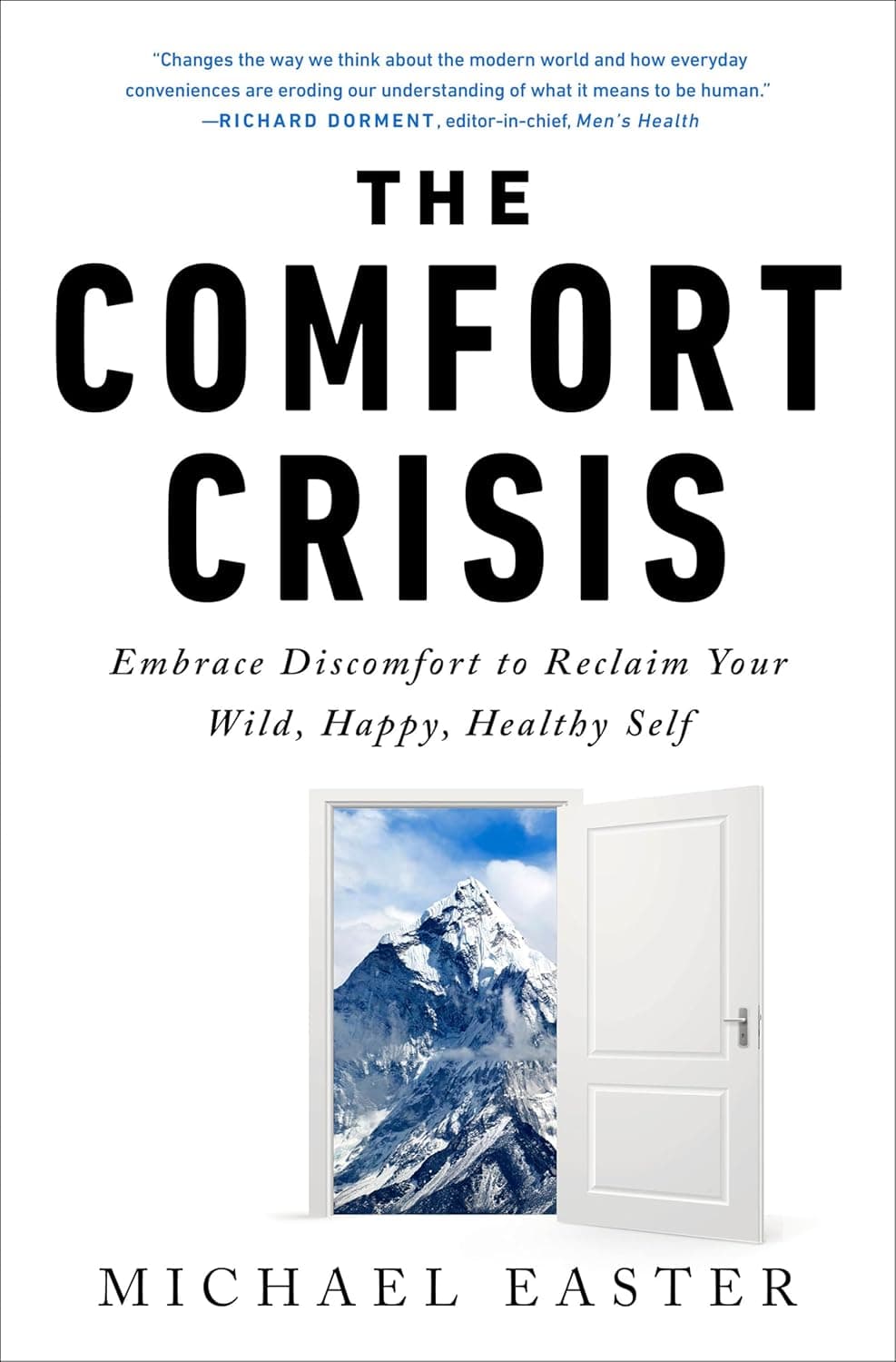
The Health Benefits of Hunger reframes hunger from a threat to be avoided into a deliberate, productive discomfort. Michael Easter argues that constant access to food has dulled ancient biological mechanisms that once protected our bodies and sharpened our minds. By occasionally allowing hunger, we trigger cellular repair, recalibrate our reward systems, and rebuild a mindful relationship with eating. The theme ultimately positions fasting and strategic scarcity not as diet fads, but as practices that reconnect us to an evolutionary rhythm our bodies still expect.
How It Develops
The idea emerges out of the broader Crisis of Comfort: a world where convenience erases the stressors that once kept us healthy. Early in the book, Easter contrasts modern abundance with ancestral patterns—humans who were “always hungry”—then intentionally engineers a deficit while preparing for his Arctic misogi. Even before he leaves, the math of the trip sets the story’s stakes: he will be deeply underfed by design.
The theme turns visceral in Part Three’s “Feel hunger,” especially in Chapter 14. There, the daily -4,000-calorie gap narrows life to a single axis—where the next calories will come from—and everyday foods transform under deprivation’s “best sauce.” Hunger becomes both a mental crucible and a sensory recalibrator: bland, freeze-dried meals suddenly taste vivid, and the crew’s conversations orbit food with comic intensity.
In Chapter 15, the narrative pivots from experience to explanation. Easter consults experts, notably nutritionist Trevor Kashey, to separate “real hunger” (biological need) from “reward hunger” (psychological want), introducing kuchisabishii—the “lonely mouth.” He also explores timing: how a 12–16 hour fast sparks autophagy and hormone cascades that clear cellular “trash,” while the modern 15-hour eating window stalls that maintenance entirely.
The arc culminates in Part Five with the hunt and feast in Chapter 20. The fresh caribou meat is not just sustenance but narrative resolution: famine makes feast meaningful, and the satiation lands with an ancestral force. The story thereby completes the cycle it’s been arguing for—how strategic scarcity heightens gratitude, health, and reward.
Key Examples
Hunger in The Comfort Crisis is never a stunt; it’s a lens. By letting readers feel deprivation, then unpacking the biology and psychology behind it, Easter shows why the discomfort is protective rather than punitive.
- The psychological toll of hunger: In the Arctic, scarcity shrinks attention down to food—where to find it, how to ration it, and what to eat first when they return, right down to Moose’s Tooth Pub and Pizzeria. This narrowing exposes how primal our drive to eat is, while also showing hunger’s re-enchantment effect: even “deer-scat-like pellets” of freeze-dried lasagna become “tasty, even,” proving how deprivation intensifies appreciation and presence.
- The biology of repair: Easter explains autophagy—“self-devouring”—as the body’s cleanup operation that turns on after 12–16 hours without food. By grazing across a 15-hour waking day, we deny ourselves that repair window, allowing damaged cells and metabolic dysfunction to accumulate; hunger, then, functions as scheduled maintenance for a modern machine that’s been run too continuously.
- Real hunger vs. reward hunger: With Kashey, Easter disentangles energy need from psychological craving. Recognizing kuchisabishii—the “lonely mouth”—reveals how often we self-medicate stress and boredom with hyper-palatable food, and why aligning eating with true physiological cues is both a health strategy and a moral one: it returns agency where environment and habit have hijacked it.
Character Connections
Easter’s own journey anchors the theme. As narrator, he submits to a daily deficit that strips away abstraction; the -4,000-calorie hole is not a metaphor but a felt reality that reorders priorities and sharpens perception. His later synthesis—folding in expert interviews and evolutionary logic—models how to convert discomfort into durable understanding rather than a one-off ordeal.
Donnie Vincent embodies the backcountry acceptance of feast-famine rhythm. His ravenous delight in stale saltines scavenged from an abandoned Conex box dramatizes the axiom that “hunger is the best sauce.” Donnie doesn’t merely tolerate hunger; he trusts it as part of the process that makes both food and life more vivid.
Kashey supplies the framework that converts intuition into practice. By debunking myths and clarifying energy density, timing, and the split between “real” and “reward” hunger, he gives readers tools to reinterpret cravings and restructure routines. His role shows that embracing hunger isn’t about toughness alone; it’s about precision—knowing what signal you’re responding to, and why.
Symbolic Elements
The 4,000-calorie deficit: A stark metric for voluntary discomfort, this number quantifies the chasm between modern abundance and ancestral scarcity. It stands as a measurable doorway into the theme: the body adapts—and benefits—when we occasionally cross that threshold.
Freeze-dried meals: Initially derided as “ultraprocessed,” they become delicious under deprivation, symbolizing hunger’s power to recalibrate taste, attention, and gratitude. Their transformation is the story’s proof that context often matters more than content.
The caribou steak: Hard-earned, protein-rich, and shared, it completes the feast-famine loop. More than a meal, it signifies alignment—how earned abundance feels different from perpetual plenty, and why reward lands deeper when preceded by strain.
Contemporary Relevance
In an era of metabolic disease, endless snacking, and algorithmic temptation, this theme offers a counterculture of timing, awareness, and restraint. Time-restricted eating and intermittent fasting gain coherence here not as hacks but as ways to restore a broken maintenance cycle and distinguish need from noise. Naming reward hunger and kuchisabishii equips readers to resist stress-eating and engineered hyper-palatability, while embracing voluntary discomfort reframes fasting as a humane practice: periodic hunger to preserve health, deepen gratitude, and reclaim attention from a food environment designed to steal it.
Essential Quote
We fully metabolize our last meal after 12 to 16 hours... That’s when our body releases testosterone, adrenaline, and cortisol: a symphony of hormones that act as signals to burn stored tissues for energy. But we don’t burn our finest tissues. “We get rid of a lot of dead and damaged cells,” said Panda.
This passage crystallizes the theme’s thesis: hunger is not simply absence but a trigger for sophisticated repair. By showing how timing flips cellular switches, Easter shifts the conversation from willpower to physiology—revealing that the right dose of discomfort is the body’s cue to clean house.