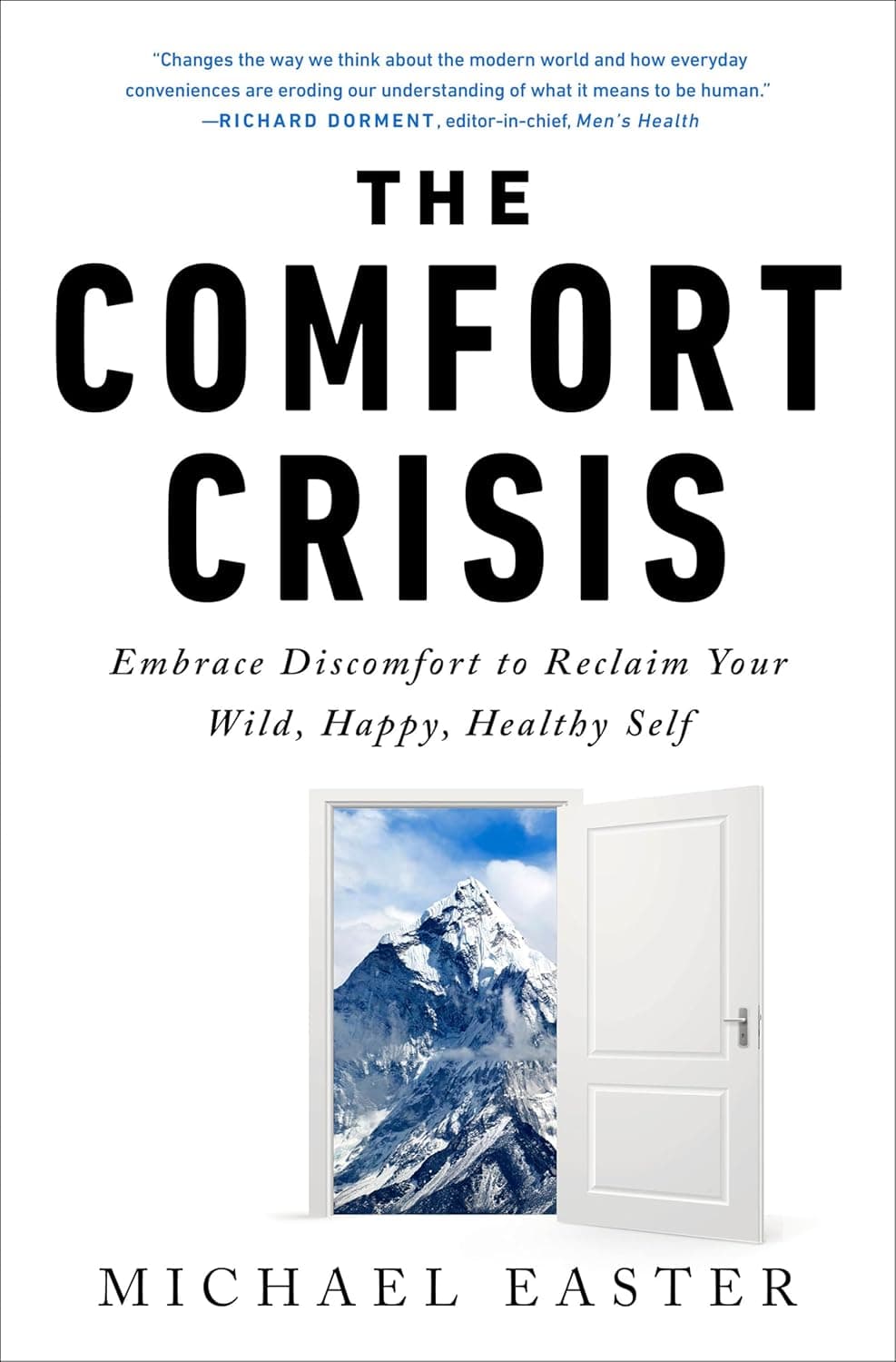
The Comfort Crisis — Summary & Analysis
At a Glance
- Genre: Narrative nonfiction blending adventure journalism, science, and memoir
- Setting: The Alaskan Arctic wilderness; detours to Bhutan and modern Las Vegas
- Perspective: First-person account by Michael Easter
- Core Idea: Modern ease has erased essential hardship; we thrive by Embracing Voluntary Discomfort
Opening Hook
A month in the Alaskan backcountry strips life to its bones: cold, hunger, silence, and the brutal clarity of being prey and predator at once. In that emptiness, Easter rediscovers capacities that comfort had dulled—patience, courage, attention, gratitude. The trip becomes a crucible for ideas from biology, psychology, and ancient wisdom, brought to life through near-misses, aching shoulders, and long, lonely miles. When he returns to Las Vegas, he sees that comfort isn’t neutral—it creeps.
Plot Overview
Act I: Leaving the Comfort Blanket
Easter opens with his reckoning with The Crisis of Comfort. Sobriety had taught him that chasing numbness—his “comfort blanket”—nearly cost him everything; the pain of quitting alcohol revealed that discomfort can heal rather than harm. Determined to test that lesson in the real world, he plans a thirty-three-day caribou hunt in the Alaskan Arctic as charted in Chapter 1-5 Summary. With Dr. Marcus Elliott, he frames the expedition as a misogi—a once-a-year challenge with a real chance of failure—linking it to The Need for Rites of Passage we’ve lost. Under the mentorship of seasoned hunter Donnie Vincent, Easter trains his body and steels his mind for a landscape that won’t care if he’s ready.
Act II: A Laboratory in the Wild
Dropped into the tundra, Easter sheds the conveniences that mediate modern life. As detailed across Chapter 6-10 Summary, Chapter 11-15 Summary, and Chapter 16-20 Summary, each day becomes an experiment in useful hardship.
- Boredom and silence close in when the phone goes dark; in exploring The Power of Boredom and Solitude, he consults James Danckert, who shows how boredom forces the mind to generate its own meaning, sparking creativity and self-insight.
- Calories run out before miles do. Studying The Health Benefits of Hunger with nutrition scientist Trevor Kashey, he learns how fasting triggers autophagy and recalibrates appetite.
- A side journey to Bhutan reframes fear of death. Guided by monk Khenpo Phuntsho Tashi, Easter practices Confronting Mortality for a Fuller Life, discovering that meditation on impermanence intensifies gratitude and presence.
Through storms, long stalks, and blank horizons, the tundra becomes a mirror—showing how much of modern malaise comes from avoiding the very frictions that keep us whole.
Act III: The Weight of the Kill, The Work of Returning
The hunt resolves in a hard-earned shot at an old bull—less triumph than communion. The emotional charge of field dressing and carrying the animal clarifies Easter’s place in the predator-prey cycle: not above nature, but inside it. The heaviest test arrives afterward, when the expedition turns to labor. In Chapter 21 Summary, he explores The Importance of Physical Work and Carrying Loads with rucking pioneer Jason McCarthy, showing why hauling 100+ pounds across rough country builds a resilient “tactical chassis” the gym rarely touches.
Back home in the Epilogue, Las Vegas feels brighter and sharper—like the “pink cloud” of early sobriety has returned. Easter knows comfort will creep back, inch by inch. The answer isn’t rejection of modern life, but regular recalibration: periodic, purposeful discomfort that restores perspective, health, and joy.
Central Characters
For a fuller cast list, see the Character Overview.
-
Michael Easter: Journalist, recovering alcoholic, and our lens on the experiment. His arc—from anesthetizing pain to courting productive hardship—gives the book its emotional center. By testing ideas on his own body and mind, he grounds the science in stakes you can feel.
-
Donnie Vincent: The guide as realist and romantic. He models ethical hunting, patience, and the discipline to suffer well. In Donnie’s world, toughness isn’t bravado; it’s sustained attention to the land and to limits.
-
Dr. Marcus Elliott: The scientist who translates misogi into modern training. He reframes risk and failure as necessary for growth, providing a template readers can scale to their lives.
-
The Experts: Researchers and practitioners who supply evidence and texture. Psychologist David Levari names “comfort creep,” boredom scholar James Danckert shows how understimulation spurs creativity, nutritionist Trevor Kashey clarifies fasting’s benefits, GORUCK founder Jason McCarthy champions carrying weight, and monk Khenpo Phuntsho Tashi makes mortality contemplation practical.
Major Themes
For a complete map of the book’s ideas, see the Theme Overview.
-
The Crisis of Comfort: Convenience ratchets our baseline upward until ordinary life feels intolerable. Easter argues that many modern ailments—anxiety, distraction, lethargy—are symptoms of over-ease, not under-resourcing.
-
Embracing Voluntary Discomfort: Planned difficulty, from small daily frictions to big misogis, works like a reset button. It restores contrast, expands capacity, and makes comfort feel like a gift rather than a default.
-
Reconnection with Nature and Wildness: The tundra proves that humans are calibrated for outdoor complexity—weather, terrain, risk. Time in nature, especially when it’s challenging, quiets modern noise and re-tunes attention to what matters.
-
The Power of Boredom and Solitude: Without screens, Easter encounters his own mind—restless at first, then inventive. Boredom becomes a forge, burning off superficial cravings so deeper questions and ideas can surface.
-
The Health Benefits of Hunger: Occasional true hunger rebuilds a sane relationship with food and taps cellular cleanup. The Arctic imposes deficits that science shows can be healthy when done deliberately and safely.
-
Confronting Mortality for a Fuller Life: Keeping death in view sharpens priorities and increases compassion. Bhutan’s practices show that acceptance of endings is a route to richer living, not a morbid fixation.
-
The Importance of Physical Work: Carrying heavy loads across rough ground trains the body and the will together. Functional strain develops durability that desk life—and even many workouts—don’t demand.
Literary Significance
The Comfort Crisis revitalizes science writing by embedding research inside a high-stakes narrative. Easter’s trip functions as a moving test bench where evolutionary biology, psychology, and spiritual practice meet lived experience, making complex ideas memorable because they’re felt. As a cornerstone text in the modern “discomfort” movement, it stands alongside works like Tribe and Born to Run in arguing for ancestral practices that modernity has sidelined. Crucially, it bridges philosophy and action: misogi, rucking, fasting, and digital breaks become a practical toolkit rather than abstract ideals. Its relevance only sharpened in the post-pandemic era, as sedentary, screen-heavy routines and system fragilities came into focus. For standout lines and takeaways, see our curated Quotes.