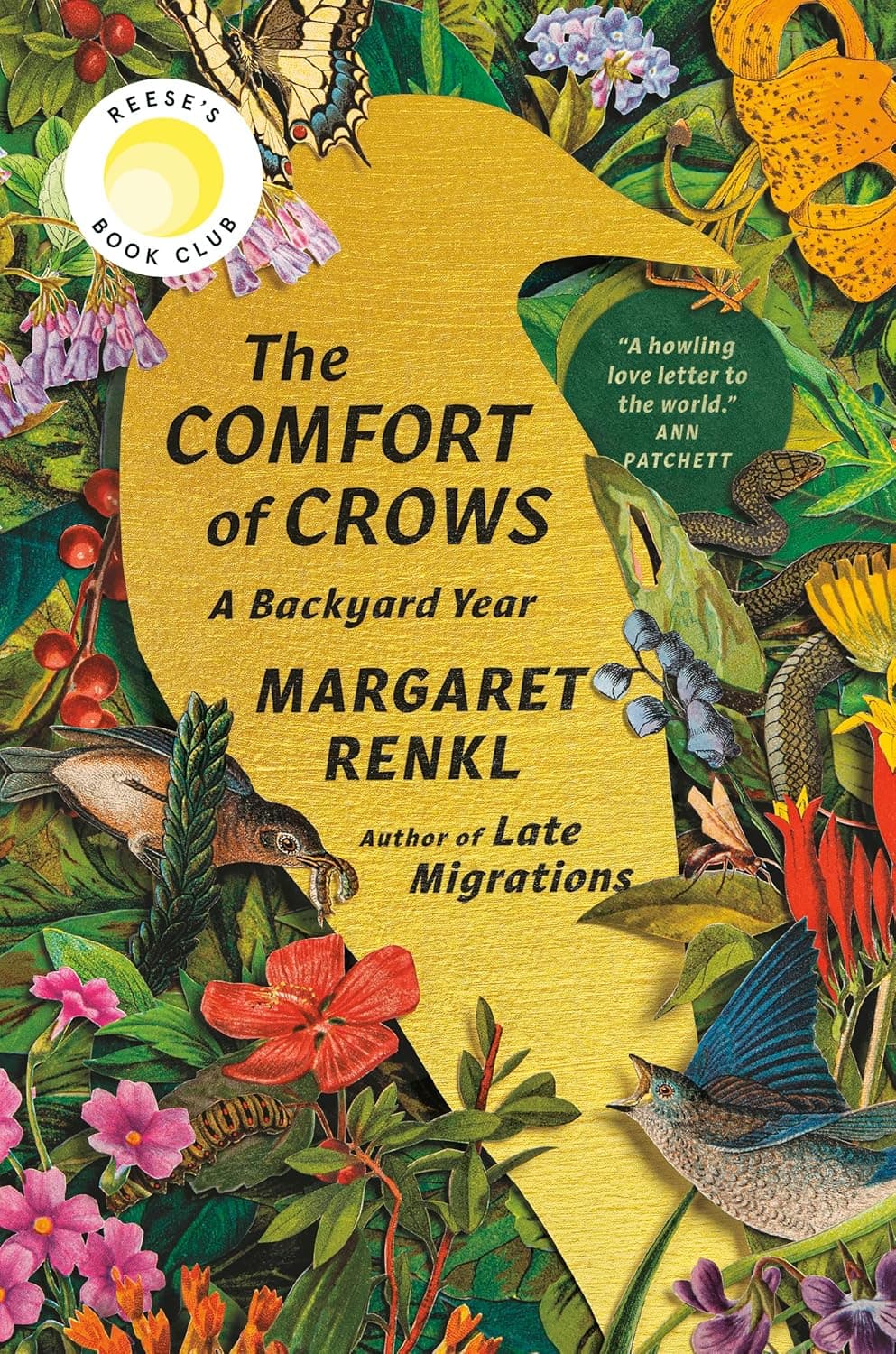
Margaret Renkl
Quick Facts
- Role: Author-narrator; the book’s central consciousness and guide through suburban Nashville’s seasons
- First appearance: The opening January entries as the year—and her sixties—begin
- Home base: A yard, garden, and nearby parks in Nashville, where daily noticing becomes a practice
- Key relationships: Husband Haywood; The Sons; The Parents and Grandparents; the creatures of her yard, including The Bluebirds, The Crows, The Foxes, and her dog Rascal
Who She Is
As the author and first-person narrator of The Comfort of Crows, Margaret Renkl is both witness and interpreter: a writer who turns ordinary yardwork, dog walks, and neighborhood drives into meditations on love, time, and the fragility of the natural world. She offers no physical self-portrait; instead, she is a voice, a gaze, and a set of careful hands—opening a nest box, ladling water into a snail’s shell, sowing seeds, and taking notes. Through her, the book’s major threads—The Human-Nature Connection, Aging, Family, and the Passage of Time, Grief, Hope, and Environmental Change, and Cycles of Life, Death, and Renewal—are braided into a single, luminous year.
Personality & Traits
Renkl’s sensibility is contemplative and lyrical, but never detached. She is a close reader of the living world whose empathy extends from family to “unloved animals,” and whose anxieties are steadied by the steadying indifference of nature. Her voice balances tenderness with moral clarity, nostalgia with realism, sorrow with a stubborn, daily practice of joy.
- Observant and attentive: She builds meaning from minutiae—the “tangled rootlets of the poison ivy vine,” the “infinitesimal” first instar caterpillar, the way autumn light shifts by degrees. Her work follows Mary Oliver’s dictum: “To pay attention, this is our endless and proper work.”
- Reflective and introspective: The life cycles in her yard become mirrors for her own—bird fledging echoes children leaving; seed to bloom to seed again echoes the rhythms of [Aging, Family, and the Passage of Time].
- Empathetic and compassionate: She tries to rescue a sick fox, builds a stock-tank pond, and is gutted by the baby bluebird she accidentally kills—acts that reveal a conscience attuned to small lives and the costs of care.
- Anxious yet self-regulating: She worries about her children, democracy, and ecological collapse; returning to the backyard is her way to “balance” truth with other truths—beauty, persistence, and work that can still be done.
- Nostalgic without sentimentality: Memories of Alabama, a mother’s garden, a father’s storm-watching, and a great-grandmother’s faith supply her moral vocabulary and deepen the present tense of each observation.
- Resiliently hopeful: Even in a “broken” world, she keeps choosing repair—planting, noticing, intervening carefully—finding reasons to trust in daily renewal and the small wins of stewardship.
Character Journey
Over one year, Renkl moves from grasping for renewal to practicing it. Entering her sixties, she clings to the crow’s promise of metamorphosis, letting that symbol orient her self-understanding. Early attempts to help the wild world expose the limits of human intervention: her efforts with a sick fox are halting, and the shattering loss in “And Then There Were None” teaches her that love does not guarantee good outcomes. Yet she refuses despair. In “The Butterfly Cage,” she intervenes selectively—saving two swallowtail caterpillars from wasps in a landscape already tilted by human damage—signaling a more nuanced ethic: do no harm when possible; do small good when needed.
At home, her “reverse nesting” after her children leave recasts the family plotline. Watching bluebirds whose older fledglings help feed a new brood, she discovers a model for continuity beyond permanence—how love adapts when forms change. By year’s end, she accepts uncertainty and divided desires (“I want nothing to change. I want everything to change.”) while training her gaze on “radiant things” that persist even amid construction noise and habitat loss. The arc is not toward certainty, but toward a steadier, hard-won, fluttering hope.
Key Relationships
-
Haywood: Her husband is a quiet ballast—practical, patient, and game for her projects. He constructs ponds, delivers tadpoles for anniversaries, and listens without rushing to solve, embodying the reliable love that makes her attention possible.
-
The Sons: Their moves into independent adulthood trigger grief, gratitude, and reinvention. Renkl reframes the empty house by learning from the backyard—fledglings go, families reconfigure, caregiving changes shape but doesn’t end.
-
The Parents and Grandparents: Though gone, their habits and loves—gardening, storms, faith—seed her ethics. Remembering them intertwines private mourning with seasonal time, letting lineage function as both comfort and compass.
-
The Animals: The creatures are not props but neighbors and teachers. With crows as emblems of metamorphosis, bluebirds as emblems of parental devotion and risk, foxes as emblems of suffering at the edges of human life, and Rascal as daily companion, Renkl learns how to love a world she cannot control.
Defining Moments
Her year is punctuated by small events that resonate far beyond the yard—each a test of how to live, care, and hope in a damaged world.
- “And Then There Were None”: The accidental death of the last baby bluebird becomes a moral earthquake. It confronts her with the unintended harms of loving intervention and recalibrates her ethic toward humility and restraint.
- “Reverse Nesting”: Facing the emptied rooms after her sons leave, she likens the house to a crime scene. The metaphor captures grief’s shock while clearing space for a new, quieter pattern of love.
- “The Butterfly Cage”: After repeated pollinator failures, she saves two swallowtail caterpillars from wasps and successfully raises one. The choice acknowledges an already-altered ecosystem and models thoughtful, proportional action.
- “The Lazarus Snail”: A few drops of water revive a seemingly dead snail. This miniature resurrection sharpens her conviction that small acts matter—and that life’s tenacity often hides in unglamorous corners.
- “The Thing with Feathers”: As bluebirds scout their old box amid nearby construction, she feels a slight, undeniable flutter of hope. Holding dissonant desires—stay and leave, mourn and praise—becomes her Year’s-end discipline.
Essential Quotes
I have entered my sixties now, a time of change—to my body, to my family, to the way I think about my future—and I cling to the crow’s promise of metamorphosis. What more could anyone ask from a new year than the promise—or just the hope—of renewal?
This opening declaration frames her arc: aging as metamorphosis rather than diminishment. The crows’ promise supplies a symbolic scaffold for the year, turning attention itself into a ritual of renewal.
I’m not trying to hide from the truth but to balance it, to remind myself that there are other truths, too. I need to remember that the earth, fragile as it is, remains heartbreakingly beautiful.
Renkl’s method is not denial but counterweight. Beauty here is not an escape hatch; it is a discipline that keeps fear from monopolizing perception and action.
I am learning that it is possible to want two contrary things at once. I want nothing to change. I want everything to change.
Her candor about ambivalence is central to the book’s honesty. Rather than “solving” contradictions, she learns to inhabit them, which becomes a mature form of hope.
The natural world’s perfect indifference has always been the best cure for my own anxieties. Every living thing—every bird and mammal and reptile and amphibian, every tree and shrub and flower and moss—is pursuing its own vital purpose, a purpose that sets my human concerns in a larger context.
This perspective reorders scale and urgency. Nature’s indifference humbles her fears and steadies her by restoring proportion—she is part of a larger field of purposes, not the center.
Even now, with the natural world in so much trouble—even now, with the patterns of my daily life changing in ways I don’t always welcome or understand—radiant things are bursting forth in the darkest places, in the smallest nooks and deepest cracks of the hidden world. I mean to keep looking every single day until I find them.
Here hope is a verb: looking. The commitment to daily noticing converts anxiety into practice, aligning her ethics with her art—attention as stewardship, wonder as resistance.