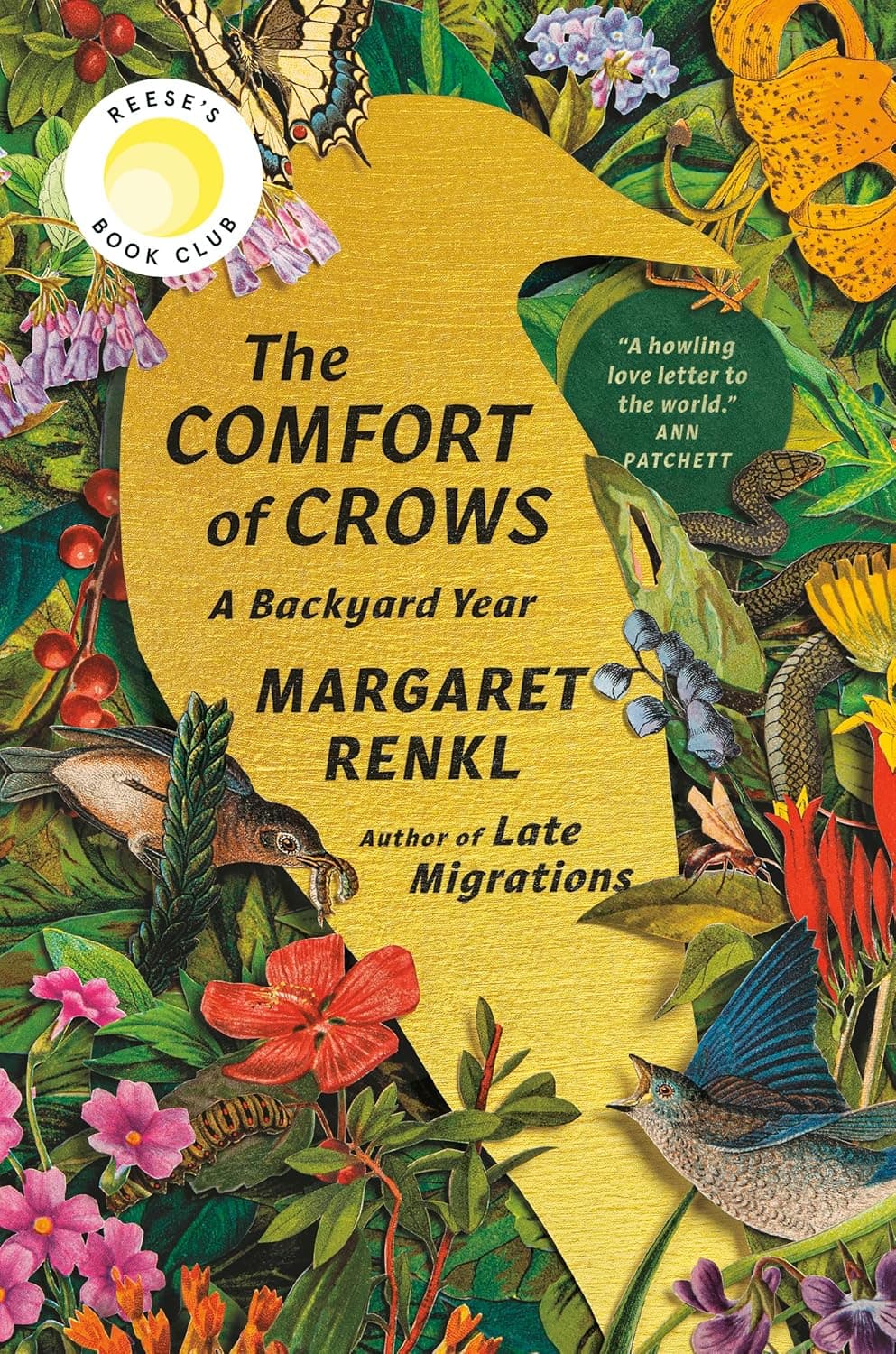
The Crows
Quick Facts
- Role: Namesake flock and symbolic through-line of the book; a multigenerational corvid family living in and around the narrator’s neighborhood
- First appearance: The “First Bird” of New Year’s Day, an omen that initiates the book’s winter-to-winter cycle
- Primary observer: Margaret Renkl, whose backyard becomes their shared stage
- Key relationships: Renkl; smaller songbirds and amphibians (prey); raptors such as red-tailed hawks (rivals); the human-altered landscape that both threatens and sustains them
Who They Are
The crows are not a single bird so much as a living chorus—glossy silhouettes in winter, “three-dimensional” against a gray sky, and a constant conversation in sound. Their presence folds the daily backyard into something mythic: harsh cries and subsong chatter, sleek black bodies gleaming in autumn light, family units that persist across seasons. They stand at the crossroads of tenderness and ferocity, intelligence and appetite.
As mirrors for human life, the crows embody kinship and continuity, the pulse of Aging, Family, and the Passage of Time. They also hold the book’s most difficult dualities: consolation alongside dread, steadfast survival alongside ecological grief—an uneasy balance that echoes the mood of Grief, Hope, and Environmental Change. Through them, winter becomes a reckoning and spring a test: what endures, and at what cost?
Personality & Traits
Renkl’s crows are a study in contradictions that never cancel each other out. Their intelligence is inseparable from their play; their familial devotion does not soften their predatory edge. Renkl admires them without romanticizing them, letting their behavior insist on complexity.
- Intelligent and adaptable: Renkl is “beguiled by the promise of a year watched over by this bold, problem-solving bird.” She invokes Aesop and modern research—tool use, problem-solving, even holding grudges—to frame a creature that thrives in human-dominated spaces.
- Social and familial: “American crows remain together as a family through the seasons,” with several years of young helping their parents. Renkl watches them groom one another high in the trees and recognizes in their routines an echo of human caregiving.
- Playful: They “ride down snowy roofs on flat objects they put to use as sleds,” suggesting curiosity and pleasure that serve no obvious survival function—and yet surely train balance, coordination, and social bonds.
- Vocal and communicative: More than twenty distinct calls, plus an undercurrent of “clacking and cooing and rattling and clicking,” turn the yard into a multilayered soundscape, a running commentary on danger, food, family, and play.
- Auditory-visual force: Uniformly black, “glossy” feathers become “breathing shadow” in winter light. Their “harsh cries” and shifting silhouettes make them impossible to miss, even when perched motionless.
- Brutal and predatory: They poach nestlings from songbird nests, devour exhausted migrants, and circle ephemeral ponds to scoop up toads and tree frogs. Renkl lets this ferocity stand, refusing to sentimentalize what their young require.
Character Journey
Across the year, the crows do not transform so much as Renkl’s way of seeing them does. The first crow of New Year’s Day feels like a benediction—intelligence and renewal stitched into winter’s spare light. As daily observation deepens, their intricately social lives come into focus: a household that “remains together,” grooming, warning, mobbing, and teaching. In “The Crow Family” (Chapter 1-5 Summary), Renkl braids their multigenerational clan with memories of her own, calling them “kindred creatures.” By year’s end, the crows have become both fact and symbol—neighbors and augurs—anchoring her emotional landscape even as their predation complicates her admiration.
Key Relationships
-
Margaret Renkl: As watcher and chronicler, Renkl moves from intrigue to kinship, reading the crows’ family structure through the lens of her own. Their grooming rituals call up memories of parental tenderness, and their resilience steadies her through seasons of worry and change.
-
Other wildlife: The crows are both threat and shield—poachers of nestlings and amphibians, yet also vigilant sentinels that cooperatively mob a red-tailed hawk. As carrion-eaters, they quicken the cycle of decay into sustenance, transforming death into motion, warning into chorus.
Defining Moments
Even as ordinary backyard scenes, these episodes crystallize the flock’s meaning in the book.
-
The First Bird of the Year: Spotting a crow on New Year’s Day frames the year as one watched over by cleverness and grit. It signals a stance of attention: to survive, observe; to observe, honor complexity.
-
The Crow Family: Renkl’s most detailed social portrait links multigenerational crow households to her grandparents’ home, illuminating how caregiving ripples across years. The essay refracts the theme of [Aging, Family, and the Passage of Time] through beaks and feathers rather than genealogy alone.
-
Mobbing the Hawk: A furious, coordinated defense against a red-tailed hawk reveals courage as a communal act. The scene underscores how intelligence and solidarity—not size—define power in the neighborhood sky.
-
Predators at the Pond: Friends watch a “great black circle” of crows in the mud, scooping up toads and tree frogs. The starkness of the image presses the theme of Cycles of Life, Death, and Renewal, insisting that tenderness and predation belong to the same story.
Essential Quotes
I am beguiled by the promise of a year watched over by this bold, problem-solving bird—the playful prankster, the curious collector, the tender parent, humankind’s steadfast companion. Even if the terrible time comes when all the other songbirds are gone, lost to the fiery world, crows will remain among us, living on what we leave behind.
This passage compresses the crows’ paradoxes into a single creed: wit and warmth alongside apocalyptic endurance. “Living on what we leave behind” both critiques human waste and acknowledges the corvid gift for survival, fusing dread with wary hope.
I love the crows not because they are exotic but because they are kindred creatures. I see in them my own kind.
Renkl refuses to exoticize; kinship, not rarity, grounds her gaze. The crows become mirrors rather than specimens, expanding the book’s ethical frame from admiration to identification.
American crows remain together as a family through the seasons, with parents and young from several nesting years working together to find food and fend off predators. I watch them grooming one another in the high branches... I remember the way my mother, when I crawled into the big bed between her and Dad, would run her fingers lightly down my arm, the way Dad would scratch my back.
Natural history folds into memoir: a factual note about cooperative breeding becomes a bridge to tactile memory. The comparison dignifies both species’ caregiving and shows how watching crows reawakens intergenerational tenderness.
This is crow light. Light that gleams on glossy black feathers and makes of the crow a breathing shadow, a living, winging, crow-talking god.
The prose slips toward the devotional, letting winter light verge on the sacred. Calling the crow a “breathing shadow” and “god” elevates a backyard silhouette into a figure of awe, a reminder that attention can transfigure the ordinary.