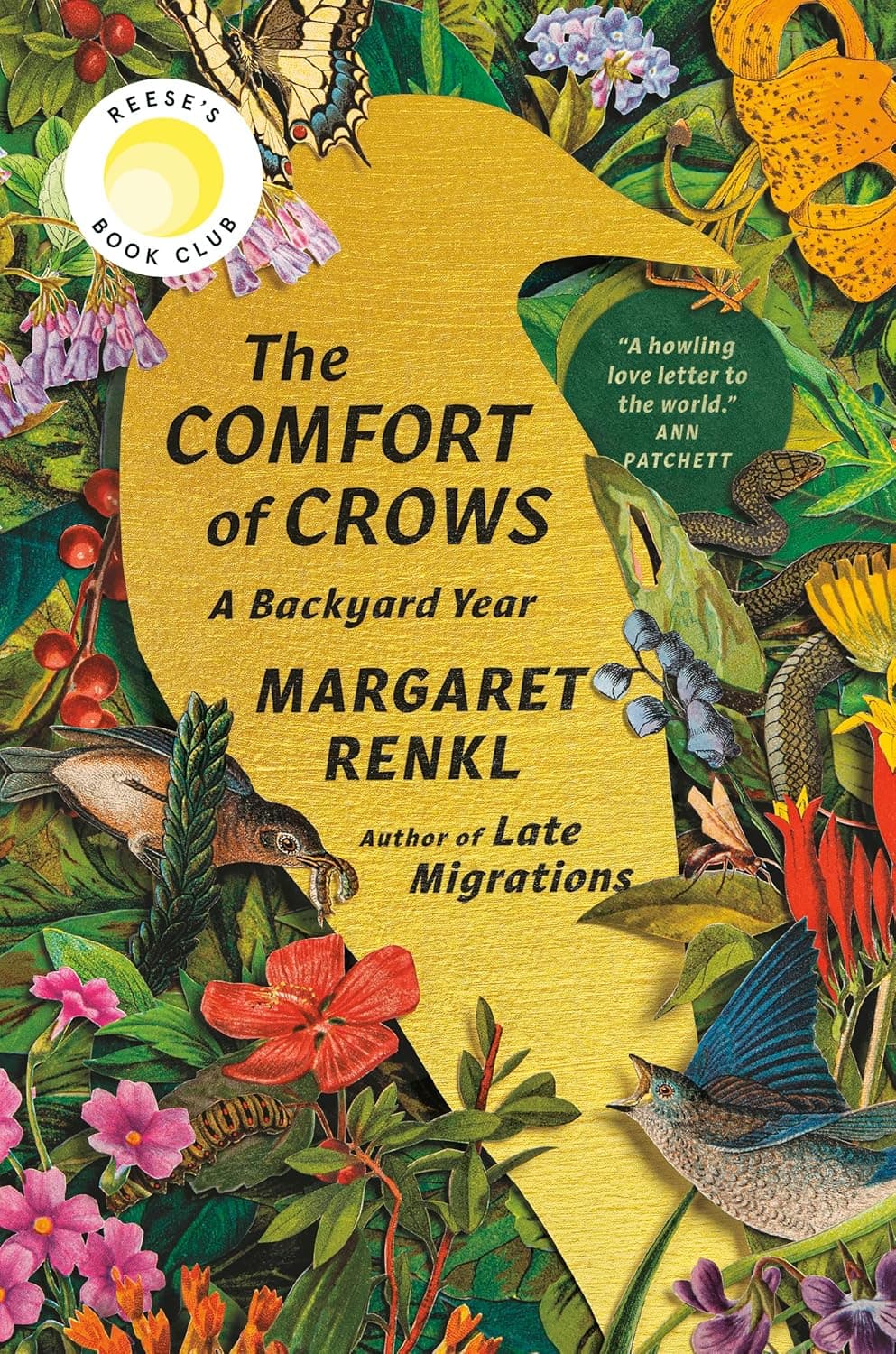
The Comfort of Crows: A Book of Days — Summary & Analysis
At a Glance
- Genre: Nature writing, memoir
- Structure: 52 weekly entries across one calendar year
- Setting: A half-acre backyard in Nashville, Tennessee (with the city’s rapid growth as backdrop)
- Perspective: First-person, reflective; lyrical and clear-eyed
- Tone: Luminous, attentive, elegiac yet hopeful
Opening Hook
Margaret Renkl builds a devotional out of attention. Guided by Mary Oliver’s insistence that paying attention is “our endless and proper work,” she turns a suburban backyard into a sanctuary where crows keep company, bluebirds risk everything, and a fox slips through winter light. As the seasons turn, family milestones and losses weave through the dramas of wild neighbors. Grief meets gratitude. The smallest daily sightings become a way to live in a troubled world without turning away.
Plot Overview
Winter — The Season of Sleeping
Winter strips the yard to its bones, and with the leaves gone the “contours of the earth” are newly legible. In these early entries (see the Chapter 1-5 Summary), Renkl finds kinship with The Crows, admiring their intelligence, playfulness, and family bonds—a model community in a bleak season. A rescue attempt for a sick fox (The Foxes) underscores how precarious urban wildlife can be, even with human care nearby. As she tends a heated birdbath and watches for life in the bare garden, she mourns an aging father-in-law and anticipates her sons leaving home, sensing the same quiet coiled energy that lies beneath winter’s dormancy.
Spring — The Season of Waking
Spring rushes in with color and peril (see the Chapter 6-10 Summary). Ephemeral wildflowers flare and vanish. The return of birdsong fills the yard—now flavored with sorrow as Renkl grieves the loss of biodiversity and her inadvertent role in the death of a baby from the family of The Bluebirds. The season vibrates with a double vision: the joy of a world resuming its music and the heartbreak of a planet in crisis. Beauty doesn’t cancel loss; it makes the losses harder to bear and more necessary to honor.
Summer — The Season of Singing
Summer teems. Insects whir, fledglings scream, and predator-prey dramas unfold at every glance (see the Chapter 11-15 Summary). Inside, the human nest empties—“Reverse Nesting”—as her sons move out, a hush that contrasts with the riot of life outdoors. At her desk, Renkl traces a loop of interdependence: fruit flies hatch from the worm composter, feed a spider, and in turn sustain hummingbirds circling the yard. She builds a stock-tank pond for frogs, a small act of repair that becomes a temple to unloved, essential beings and a reminder that stewardship can be joyful.
Fall — The Season of Making Ready
Autumn’s light slants toward rest (see the Chapter 16-20 Summary). Hummingbirds tank up for migration; squirrels cache nuts with comic urgency. Renkl’s personal story turns to memory and inheritance as she helps her sons furnish a new apartment with family heirlooms, feeling how love persists as objects and stories change hands. The season gathers its lessons in letting go and holding on. The bluebird family returns to inspect the nest box for communal winter roosting, offering a final image of endurance and the promise of return.
Central Characters
Renkl’s “cast” blends humans and the wild neighbors she watches with reverence and curiosity. A full list is available on the Character Overview page.
Margaret Renkl
The narrator, Margaret Renkl, writes with quiet authority and open-hearted vulnerability. She admits mistakes, resists despair, and practices what she calls benign neglect—letting the yard be messy enough for life to thrive. Her arc is a hard-won balancing act: grieving environmental and political turmoil while reclaiming wonder and purpose in close observation.
The Crows
More than backyard regulars, the crows are Renkl’s emblem of resilience. Intelligent, social, and loyal, they model kinship and adaptation—the “comfort” that steadies her during winter’s hardest days and the book’s most sorrowful passages.
The Family
Renkl’s husband, Haywood, is a quiet co-steward who helps build the pond and shares her patient attention to the everyday wild. Their Sons are sources of joy and the ache of departure, sharpening the book’s meditation on time, change, and what it means to make a home that life can outgrow.
Other Key Figures
- The bluebird family: Their nesting and losses thread through the year, embodying hope’s risk and the tenderness of repair.
- The foxes: One sick, one healthy—together they reveal the hazards and mystery of urban wildlife.
- Rascal: The dog whose nose and alertness widen Renkl’s field of vision, reminding her that attention is a shared practice.
Major Themes
For a broader exploration of patterns and motifs, see the Theme Overview.
The Human-Nature Connection
At its core, the book affirms The Human-Nature Connection: attention to the more-than-human world offers ballast in anxious times. Nature’s indifference to human drama paradoxically soothes; it places personal joys and sorrows within a larger order. By aligning her days with birds, insects, and plants, Renkl finds an ethic of humility and belonging.
Cycles of Life, Death, and Renewal
Structured by the seasons, the narrative enacts Cycles of Life, Death, and Renewal. Dead leaves feed soil; fungi rise from fallen trunks; predators sustain themselves; a “Lazarus Snail” animates the miracle of return. Human life mirrors the same pattern: as one generation fades, another takes flight, and love learns to change its shape.
Grief, Hope, and Environmental Change
Renkl refuses to look away from Grief, Hope, and Environmental Change—the insect apocalypse, amphibian declines, climate disruption. Yet she cultivates “active hope”: planting natives, building a pond, tending a yard where life can persist. The book insists that mourning and celebration are not opposites but twin obligations of care.
Aging, Family, and the Passage of Time
Backyard seasons become a clock for Aging, Family, and the Passage of Time. Entering the “last third” of life, Renkl grieves her elders and adapts to an emptier home, knitting memory to the present. Lessons from her Parents and Grandparents infuse the year with continuity, turning inheritance into a living practice.
Literary Significance
The Comfort of Crows stands in the American nature-writing line of Aldo Leopold and Annie Dillard while offering a form all its own—part almanac, part book of days, part memoir. Its power lies in scale: a half-acre backyard becomes proof that you need not travel to wilderness to meet the sacred; the ordinary is already ablaze with meaning. Renkl makes a persuasive case for the ecological importance of backyards and the moral agency of individuals, locating beauty and responsibility in local, repeatable acts. Her collaboration with her brother, Billy Renkl, whose collage art accompanies the text, deepens the book’s tactile, contemplative experience, binding form and theme into a single, quiet call to care.
Historical Context
Written in the early 2020s, the book records a cultural moment of political bewilderment and media saturation. Renkl names her retreat to the backyard as an antidote: “To follow politics these days is to court bewilderment, denial, complete despair. ... Immersing myself in the natural world of my own backyard...is the way I cope with whatever I think I cannot bear.” Set in a rapidly developing Nashville, it also documents the environmental costs of unchecked growth: construction noise, teardown culture, and shrinking habitat. The yard becomes both refuge and witness.
Critical Reception
Upon publication, critics praised Renkl’s precise, lyrical prose and the book’s capacity to console without denying crisis. Reviewers highlighted how intimately scaled observations—bluebirds fledging, a spider’s meal—illuminate vast issues like biodiversity loss and climate change. The blend of personal vulnerability and ecological attention felt bracingly honest; readers found solace in its clarity and gentleness. Billy Renkl’s artwork was widely noted as integral to the book’s atmosphere. Many of the most resonant lines are collected on the Quotes page, capturing why this work has swiftly become beloved.