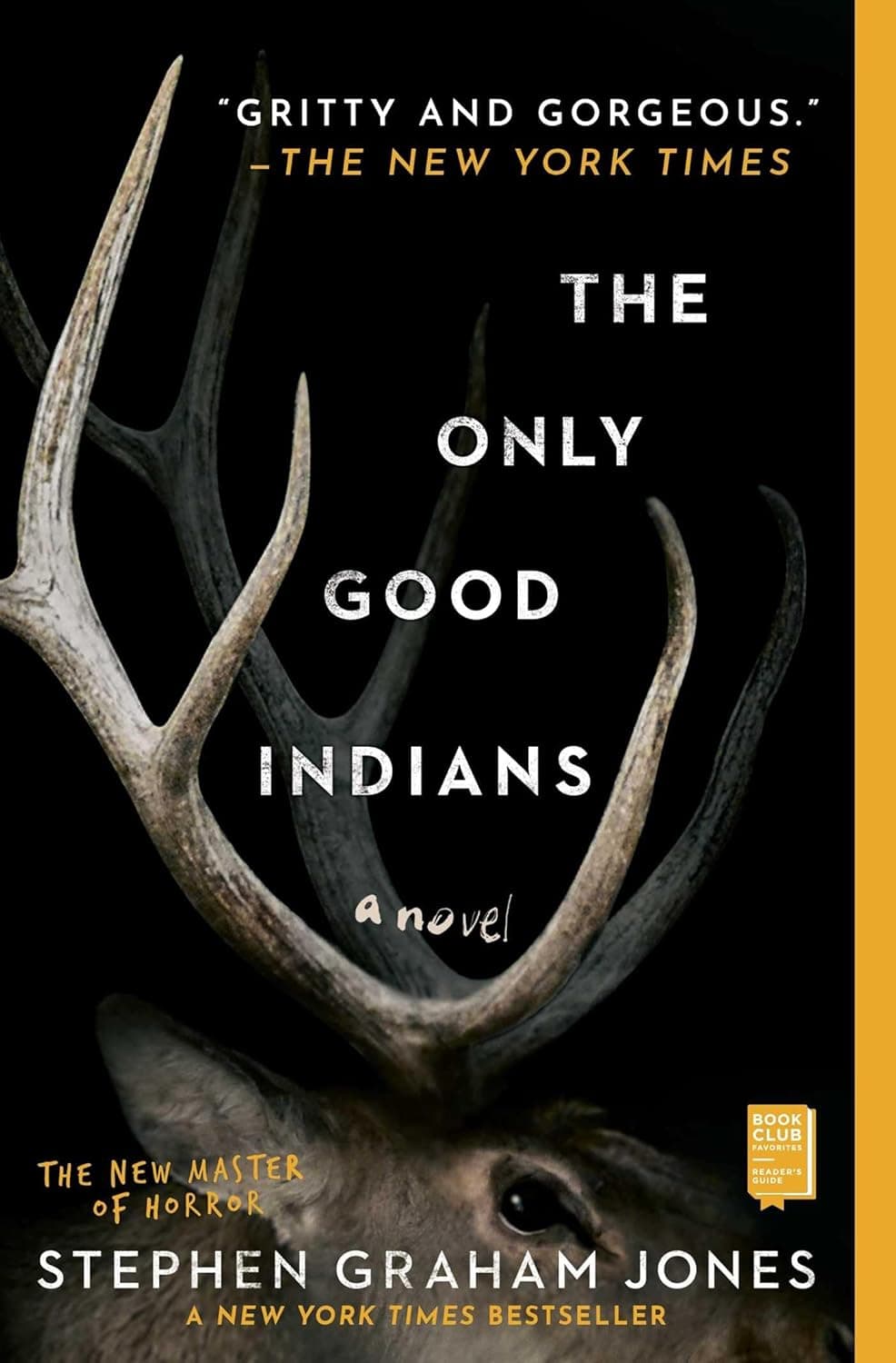
Elk Head Woman
Quick Facts
- Role: Vengeful spirit and primary antagonist; the avenging cow elk slaughtered a decade earlier
- Also known as: Po’noka, Ponokaotokaanaakii (“Elk Head Woman”)
- First appearance: As a dead elk impossibly splayed across a living-room floor, glimpsed in the strobe of a ceiling fan
- Forms: Spectral presence; shadow; possession of Shaney Holds; full body-horror transformation into an elk-headed woman; finally a living cow elk
- Motive: A ruthless campaign of Revenge and Retribution for the killing of her herd and unborn calf
- Thematic role: Living repository of the hunters’ Guilt and Atonement
- Key relationships: Lewis Clarke; Gabriel Cross Guns; Cassidy Sees Elk; Denorah Cross Guns; Shaney Holds
Who They Are
At her core, Elk Head Woman is grief made predatory. She is the land’s memory given teeth, a mother whose loss curdles into judgment. As the unquiet spirit of a cow elk butchered on off-limits ground, she refuses to be an anonymous entry in the men’s hunting stories. Instead, she becomes their story—an exacting force who turns their bravado into consequence. She is less a villain than a law of return, an embodiment of debt: what is taken must be paid back. Her vengeance is maternal, ritual, and precise—an answer to a broken boundary that ripples through family and future, binding her to the novel’s meditation on Parenthood, Legacy, and Intergenerational Trauma.
Personality & Traits
Her personality is an unsettling blend of predator’s focus and mother’s memory. She exploits human frailty—guilt, desire, loyalty—then weaponizes it against the men and everyone within their circle. Even when she wears a human face, her presence feels like weather moving in: inevitable, impersonal, and exact.
- Vengeful, with a moral calculus: She doesn’t merely kill; she makes the men re-live her loss by threatening what they love most—spouses, friends, and children—so that punishment mirrors crime.
- Patient and cunning: “I slept” for a decade, waiting until the last scraps of her meat were discarded before returning; she times every escalation to multiply fear, confusion, and isolation.
- Maternal and protective: Her rage is rooted in the murdered calf; every action moves toward replacing that loss—culminating in a grotesque, supernatural rebirth—and securing the calf’s survival.
- Primal, relentless hunter: She moves in straight lines through houses and winter fields, unfazed by doors or bullets, radiating the inevitability of a tracker who never loses a trail.
- Intelligent and deceptive: Inside Shaney’s body, she reads rooms and people, using flirtation, sympathy, and plausible stories to infiltrate and divide.
- Shapeshifter, rendered in body horror: Her “head that’s not human” is “too heavy, too long”; when she drops the mask, eyes go “yellowy,” jawlines lengthen, and bones crack into an elk’s muzzle—a visual grammar of truth forcing its way out.
Character Journey
She begins as rumor in a guilty mind—a flicker only Lewis can see—then grows more corporeal as she scores psychological wins and turns suspicion into blood. The haunting of Lewis gives way to possession of Shaney, to manipulation of old friendships, and then to the ritual unmaking of a community. Her cruelty scales with her closeness to her goal: not just four dead hunters, but the erasure of what they stand to pass on. The final pursuit of Denorah Cross Guns—the child who represents a future the men would have chosen—forces a reckoning. When Denorah refuses to answer violence with violence, the spirit’s campaign against the Cycle of Violence collapses into something else: a path for the calf to live. With that debt settled, Elk Head Woman sheds the hybrid horror and re-enters the world as a true elk, her purpose spent but her lesson—about boundaries, memory, and cost—indelible.
Key Relationships
-
Lewis Clarke: Her first and most intimate target. He fired the bullets that killed her unborn calf and carries the heaviest shame. She undermines his sanity until he murders Peta and Shaney, then arranges the circumstances of his own death—proof that the mind, once haunted, can be a deadlier weapon than any antlers or hooves.
-
Gabriel Cross Guns and Cassidy Sees Elk: She exploits their loyalty and shared guilt, turning a lifelong friendship into fatal suspicion. The “Sweat Lodge Massacre” isn’t random slaughter; it’s a carefully staged moral trap that makes Gabe kill Cass, then corners Gabe with an ultimatum that drives him to suicide—friendship transmuted into penance.
-
Denorah Cross Guns: Denorah is the proving ground for Elk Head Woman’s thesis that harm breeds harm. The one-on-one on the court, and later on the ice and in the bone field, tests whether the past will dictate the future. Denorah’s refusal to kill—and her instinct to protect the newborn calf—answers vengeance with care, undoing the spirit’s narrative of inevitable payback.
-
Shaney Holds: Shaney’s body is the costume Elk Head Woman wears to enter human spaces; her death is a lever pulled to isolate Lewis and accelerate his unraveling. Through Shaney, the spirit shows how fluently she can mimic human charm while hollowing out the person who carries it.
Defining Moments
Her story advances in set pieces where superstition becomes visible and payback acquires ritual form. Each scene escalates her power and clarifies her code.
- The Haunting of Lewis: Appearing as an elk sprawled on a living-room floor, visible only in the flicker of a fan, she fuses domestic space with wilderness taboo—introducing the novel’s blend of reality and The Supernatural and the Unseen. Why it matters: Horror begins as perception; she colonizes Lewis’s vision before she claims his life.
- The Sweat Lodge Massacre: By engineering mistrust, stolen money, and the death of Cass’s dogs, she turns a sacred space into a killing ground. Why it matters: She corrupts a place meant for purification, proving that guilt, once invited in, can desecrate even the holiest rooms.
- The Basketball Game: Her one-on-one with Denorah is a duel over will and narrative—can the future be played straight, or will it double back into the past’s mistakes? Why it matters: The contest reframes violence as choice; Denorah’s grit shows that survival can be skillful, not savage.
- The Final Transformation: In the bone field where the slaughter began, her human mask breaks—“Her cheeks and chin tear… Not a horse… an elk”—as she births the calf. Why it matters: The site of harm becomes a delivery room; Denorah’s protection rather than retaliation lets the spirit complete her purpose and relinquish monstrosity.
Essential Quotes
I slept for ten years. This flat sentence compresses patience into threat. She isn’t gone; she’s waiting for the men’s last safeguard—time—to fail them, proving that unatoned harm doesn’t heal but ferments.
"You're his calf," she says, like that explains anything. Naming Denorah as “calf” reframes the girl as both target and symbol. The spirit insists that debts are inherited unless someone refuses the terms; Denorah’s later mercy contradicts that fatalism.
Ponokaotokaanaakii. Elk Head Woman. The name functions as invocation and identity, translating a natural being into a ceremonial title. Speaking it aloud makes the moral order audible: this is not a random haunting but a specific, remembered wrong answering back.
"Do it or I go after your calf for real." Her threats always track to lineage. By leveraging the fear of losing one’s child, she forces characters to reenact the pain she carries—until Denorah’s choice interrupts that script and the promise of “for real” no longer governs the future.