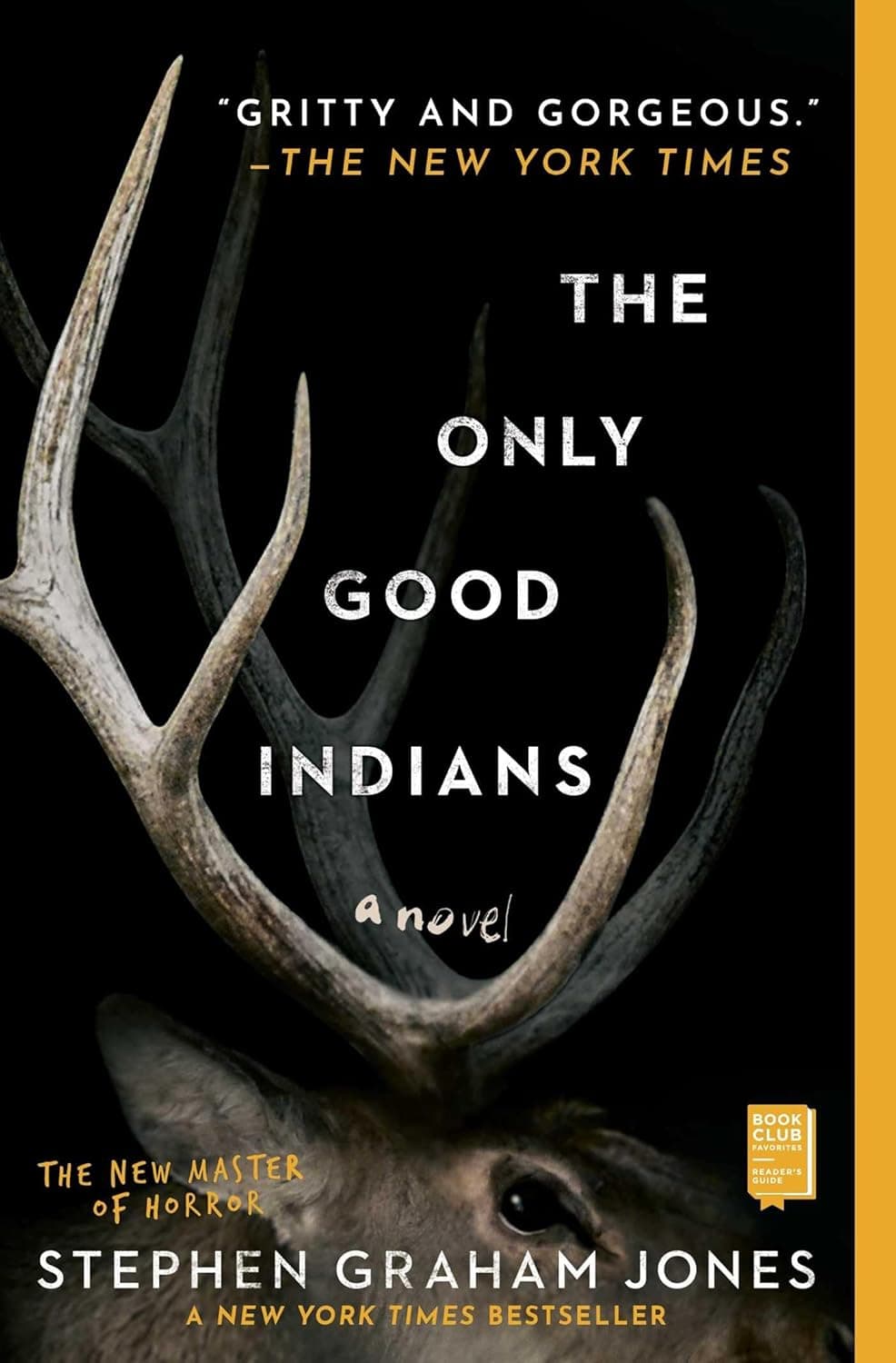
The Only Good Indians: Summary and Analysis
At a Glance
- Genre: Social/psychological horror; Indigenous literature
- Setting: Great Falls, Montana; North Dakota; Blackfeet Indian Reservation in Montana
- Perspective: Shifting close third-person, moving among key characters
Opening Hook
Ten years after a forbidden winter hunt, four Blackfeet friends learn that the past doesn’t stay buried—it hunts back. A presence shaped by grief and rage takes human shape and follows them from city streets to reservation backroads, turning ordinary spaces into traps. Their bonds fray under guilt, superstition, and bad luck that feels like design. What begins as a shard of memory becomes a full-body haunting, and the only way forward may be to break a cycle that has already claimed too much.
Plot Overview
Part I: The House That Ran Red
Outside a North Dakota bar, Richard Boss Ribs dies in a brawl that looks like racist violence and feels like a setup. The story then zeroes in on Lewis Clarke, who left the rez to start fresh in Great Falls with his white wife, Peta. One vision unravels his fragile peace: the pregnant cow elk he shot a decade ago appears in his home, and the world tilts. Lights stutter. The dog acts wrong. Calls to old friends Gabriel Cross Guns and Cassidy Sees Elk dredge up the “Thanksgiving Classic,” the day they trespassed in the elders’ hunting grounds and gunned down a herd (see Chapter 1-5 Summary). Game warden Denny Pease banned them from hunting after, but the spiritual damage was already done.
Lewis fixates on a new coworker, Shaney Holds, convinced she is the shape the Elk Head Woman has taken to reach him. He lures Shaney to his garage, kills her, and spirals. When Peta returns and dies in a freak fall, Lewis’s break with reality is complete; he imagines an elk calf inside her, cuts her open, and flees—only to be gunned down by police (see Chapter 6-10 Summary).
Part II: Sweat Lodge Massacre
Back on the Blackfeet Reservation, the story follows Gabe and Cass and centers the bright future of Gabe’s daughter, Denorah Cross Guns, a rising basketball star. Wearing Shaney’s stolen face, Elk Head Woman arrives on the rez to finish what she started. As friends plan a sweat to honor Lewis, old resentments and bad luck multiply (see Chapter 11-15 Summary). Dogs die. Cass’s girlfriend, Jo, is murdered, and the blame is set to land on Gabe. A tribal officer, Victor Yellow Tail, brings his son Nathan to the sweat, hoping the ceremony will set the boy straight.
Inside the lodge, pressure boils over. Cass attacks Gabe, and in the confusion Cass accidentally kills Nathan, who’s wearing Denorah’s jersey. Gabe kills Cass in turn, only to face the truth of the spirit stalking them. When Elk Head Woman reveals herself and makes Gabe believe Denorah is dead, he takes his own life to protect her—or what he thinks is left to protect.
Part III: It Came from the Rez
The final act is Denorah’s chase story, a cat-and-mouse sprint across fields, roads, and rusting train cars (see Chapter 26-30 Summary). She runs smart, using the land and her coach’s voice in her head. Remembering that elk fear trains, she slips through a line of derelict boxcars, buying seconds. The hunt ends where the men once slaughtered the herd. There, Elk Head Woman births the calf that was stolen from her a decade before. When Denny Pease arrives to end it with a bullet, Denorah steps between hunter and hunted, interrupting the Cycle of Violence. The spirit, satisfied by this break in the pattern, becomes elk again and departs with her calf. Denorah survives—alone, changed, and carrying the story forward (see Chapter 31 Summary).
Central Characters
For a complete cast, see the Character Overview.
-
Lewis Clarke: A man who left the reservation to outrun guilt and history. His attempt at assimilation frays under supernatural pressure, and his paranoia makes him both victim and instrument of the revenge he fears.
- Defining traits: self-blame, isolation, fraying reality
- Arc: from uneasy domesticity to violent psychosis
-
Gabriel Cross Guns: A rez lifer whose love for his daughter keeps him tethered. He’s smart, stubborn, steeped in community ties, and ultimately cornered by a grief he can’t reason with.
- Defining traits: loyalty, volatility, fatalism
- Arc: protector to tragic sacrifice
-
Cassidy Sees Elk: A man trying to build a steady home life with Jo, only to find that stability collapses under the weight of old sins.
- Defining traits: pride, quick temper, longing for normalcy
- Arc: suspicion curdles into deadly misjudgment
-
Denorah Cross Guns: The future—focused, disciplined, and tough. Her basketball instincts become survival instincts, and her final act of empathy ends the haunting without another kill.
- Defining traits: resilience, tactical thinking, empathy
- Arc: promise to survivor and witness
-
Elk Head Woman: A grief-born force who wears human faces. She seeks balance more than cruelty, making her both terrifying and, in the end, comprehensible.
- Defining traits: relentlessness, cunning, maternal fury
- Arc: vengeance to release
-
Peta: Lewis’s wife, loving and practical, whose accidental death turns tragedy into horror and accelerates Lewis’s collapse.
- Defining traits: steadiness, warmth
- Arc: collateral in a haunting she never chose
Major Themes
For deeper dives, visit the Theme Overview.
-
Revenge and Retribution: The novel is a revenge engine powered by grief. Elk Head Woman’s pursuit is exacting and personal, forcing the men to reckon with the life they took and the balance they disturbed.
-
Cultural Identity and Assimilation: Lewis’s off-rez life contrasts with Gabe and Cass’s entanglement with tradition and community. The book probes what “belonging” costs, and who pays when cultural lines are crossed or abandoned.
-
Guilt and Atonement: Lewis’s guilt acts like a beacon for the supernatural, but the story refuses easy absolution. Atonement isn’t confession—it’s a shift in behavior and belief, embodied by Denorah’s final choice.
-
Respect for Nature: The “Thanksgiving Classic” isn’t sustenance; it’s spectacle. The haunting reads as nature’s counterclaim, restoring a sacred balance the hunters violated.
-
Parenthood, Legacy, and Intergenerational Trauma: A mother’s rage launches the horror; a daughter’s empathy ends it. Denorah inherits both trauma and responsibility, showing how legacies can be carried—and changed.
Literary Significance
The Only Good Indians retools horror to speak from, and to, contemporary Indigenous life. Stephen Graham Jones blends slasher tension with social realism, using close-third narration to sink readers into characters whose choices are shaped by community, scarcity, and history. The novel flips tired “Indian burial ground” tropes by centering harm done by the protagonists themselves—against animals, elders’ rules, and the land—and then follows the consequences without moral shortcuts. Its voice—funny, jagged, intimate—feels lived-in and specific, and its ending refuses nihilism without denying cost. As Indigenous slipstream, it bends genre expectations to honor cosmologies where the seen and unseen share space, insisting that horror can reveal how cycles break as well as how they repeat.
Historical Context
- The book’s title riffs on the genocidal phrase “The only good Indian is a dead Indian,” forcing a confrontation with its afterlife in American culture and the psychological pressure it exerts.
- Life on the Blackfeet Reservation appears without romance: economic precarity, dense kin networks, and the daily negotiation between tradition and modernity.
- The story assumes a world where spiritual and physical realms overlap; the horror emerges from rupturing that balance, echoing The Supernatural and the Unseen.
Critical Reception
Widely acclaimed, the novel won the 2020 Bram Stoker Award (Novel), the 2020 Ray Bradbury Prize, and the 2021 Alex Award, and was a finalist for the Shirley Jackson and World Fantasy Awards. Critics praised its nerve-shredding suspense, layered characters, and pointed social commentary; it’s frequently cited as a landmark of 21st‑century horror and a touchstone for the rise of Indigenous genre fiction.