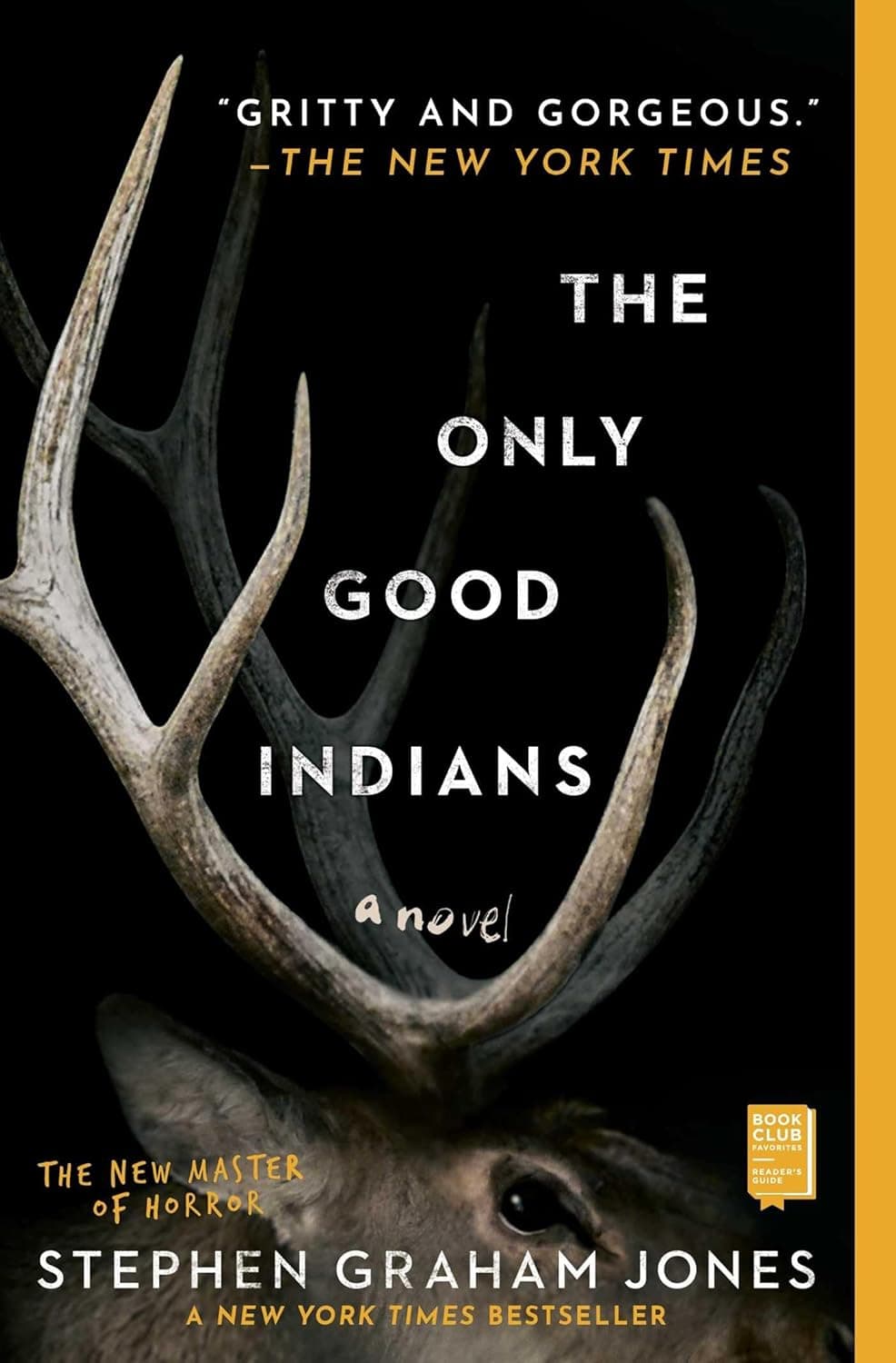
Lewis Clarke
Quick Facts
- Role: First of the novel’s four focal protagonists; a Blackfeet man trying to live off-reservation
- Age/Occupation/Setting: Mid-30s; U.S. Postal Service carrier; suburban Great Falls, Montana
- First appearance: Opens the novel’s human story as the POV character in the early chapters
- Key relationships: Wife Peta; coworker Shaney Holds; childhood friends Gabriel Cross Guns, Cassidy Sees Elk, Richard Boss Ribs; hunted by the Elk Head Woman
- Markers of assimilation: Rented suburban home, USPS job, a Harley-Davidson Road King project, voice “smoothed down flat” from talking mostly to white people
Who They Are
At his core, Lewis is a man trying to refashion himself—an experiment in off-reservation respectability who hopes the right job, neighborhood, and marriage will seal the door behind him. He embodies the friction between reinvention and memory, the self he performs and the one that refuses to be left. In him, the pressures of Cultural Identity and Assimilation compress into a private, relentless self-scrutiny. What he can’t outrun is the trespass that shaped him: the illegal elk hunt. That past becomes the live wire of Guilt and Atonement, the charge that invites the Elk Head Woman into his carefully built life. Lewis’s tragedy is not simply that the past returns—it’s that he has trained himself to mistrust his own ways of knowing, so when justice arrives, he can’t recognize it until it devours everything.
Personality & Traits
Lewis’s personality is a tug-of-war between love and secrecy, reason and superstition, pride and shame. He wants a quiet, ordinary life; he gets a myth he can neither translate nor escape. The way he changes his speech and decor, the way he polices his memories—each is a small concession that becomes a chasm.
- Guilt-ridden: He runs an “internal newspaper” printing headlines about his failures; the “Thanksgiving Classic” hunt isn’t a memory so much as a newsroom that never closes.
- Conflicted assimilation: He sneaks “tribal junk” onto the walls and feels his voice slide back into reservation cadences with Cassidy Sees Elk—moments that comfort and incriminate him at once.
- Anxious, then paranoid: The calf on his living room floor—visible only through a flickering fan—turns ordinary vigilance into obsession, expanding suspicion to Shaney, then Peta.
- Rationalizing against terror: Even as events align with The Supernatural and the Unseen, he methodically restages lighting and angles, clinging to coincidence and optics like flotation devices.
- Loving but secretive: He adores Peta yet withholds the hunt’s “full, gruesome” truth, wrongly believing silence protects her. That secrecy becomes the precise leverage the haunting requires.
- Assimilation, embodied: Shorter hair, softened speech, a house and Harley—each signals distance from the rez. But those same choices double as evidence exhibits in the case he’s always prosecuting against himself.
Character Journey
Lewis begins with errands and small repairs: a flickering spotlight, a marriage to tend, a motorcycle to rebuild. The calf’s visitation cracks the facade. His guilt, once sublimated, starts scripting reality: every glitch becomes omen, every friend a suspect. Seeking validation, he confesses the elk story to Shaney—an attempt at cultural intimacy that curdles into fear. The moment he decides Shaney must be the monster, the story tips from dread to catastrophe; the murder commits him to a delusion he can no longer disprove. Peta’s accidental death collapses his last tether to the ordinary. In his final rupture, he reframes the world with mythic certainty—performing a “delivery” to atone for the calf he stole—before dying in a hail of gunfire, swaddling an elk hide he believes is his child. The life he curated and the life he denied collide, and neither survives.
Key Relationships
Peta Peta is Lewis’s anchor to the life he’s trying to make: pragmatic, loving, and protective. Yet the intimacy she offers requires truth, and truth demands he revisit the hunt. His silence—meant to shelter her—isolates him, leaving her outside the narrative he’s living in. When she dies, the grief doesn’t teach him; it unmoors him completely, clearing the stage for delusion.
Shaney Holds As the only other Native person in his daily orbit, Shaney becomes the mirror Lewis both needs and fears. He confesses to her to feel seen; then he projects the story’s monster onto her to avoid seeing himself. His misrecognition—reading kinship as threat—culminates in her murder, the irrevocable act that seals his fate.
Gabriel Cross Guns, Cassidy Sees Elk, Richard Boss Ribs These friends hold the history Lewis is trying to outpace. His calls to Gabriel and Cassidy are not casual check-ins; they’re desperate tests—Is it just me? Am I the only one being called to account? They embody the bonds and codes of the reservation world he’s edited out of his life, and their distance underscores how alone he has made himself.
Elk Head Woman The Elk Head Woman is vengeance embodied, the relentless logic of the story itself. She is not simply an external monster but the shape Lewis’s guilt takes, the justice his rational mind can’t assimilate. Her pursuit dramatizes Revenge and Retribution, but what she really exposes is how vulnerable Lewis becomes when he refuses to speak, remember, and atone.
Defining Moments
Lewis’s collapse is a chain reaction of recognitions he refuses to accept, each denial sharpening the next disaster.
- The calf in the living room: The flicker-lit vision inaugurates his unraveling. Why it matters: It tests whether he’ll trust Indigenous knowledge about signs and story; he chooses lightbulbs and angles instead.
- Harley’s death: He cycles from accident, to haunting, to blaming Peta. Why it matters: His grief becomes a lens that turns loved ones into suspects, proving how guilt distorts affection into threat.
- The confession to Shaney: He reaches for kinship and context. Why it matters: It could have been a bridge back to community, but he weaponizes it by recasting Shaney as the monster, turning connection into catastrophe.
- The murder of Shaney: He lures her home and kills her with his motorcycle. Why it matters: This is the point of no return, where paranoia becomes irreversible harm—and where his “rational” explanations collapse into ritualized violence.
- Peta’s death: She falls from a ladder after discovering the truth; he watches, stunned. Why it matters: His passivity in the moment seals his complicity. The silence that began as protection ends as abandonment.
- The “birth” of the calf: He performs a C-section on Peta and “delivers” the elk hide from a decade ago. Why it matters: This is total surrender to myth, a grotesque atonement that reveals how far he’s drifted from shared reality.
Symbolism
Lewis is a portrait of a fractured modern Native identity: a man performing normalcy while reading himself through an internal tabloid of shame. The “newspaper” headlines literalize how public his self-judgment feels, as if community scrutiny lives in his head. His house, job, and Harley are scaffolding for a new self—yet their fragility shows that unprocessed harm does not vanish; it waits. The Cycle of Violence here is as psychological as it is supernatural: harm denied becomes harm repeated, first inward, then outward.
Essential Quotes
“The Indian who climbed too high. Full story on 12b.”
- Analysis: A headline from Lewis’s inner tabloid, this line ironizes his upward mobility. “Climbed too high” frames assimilation as hubris; the page number joke underscores how his self-judgment feels public, serialized, and inescapable.
“FULLBLOOD BETRAYS EVERY DEAD INDIAN BEFORE HIM. It’s the guilt of having some pristine Native swimmers—they probably look like microscopic salmon, even though the Blackfeet are a horse tribe—it’s the guilt of having those swimmers cocked and loaded but never pushing them downstream...”
- Analysis: The headline merges sex, lineage, and duty into a single indictment. Lewis reimagines reproduction as cultural responsibility, revealing how deeply he equates private choices with communal betrayal—fuel for his corrosive shame.
“Do you ever …” Lewis says, still unsure how to say it, even though he ran it through his head all last night and all the way in to work. “Do you ever, you know, think about them?”
- Analysis: His halting question to Shaney shows the cost of silence; even seeking help feels like a transgression. The ellipses and repetition enact his fear that speaking the story will make it real—yet not speaking has already let it rule him.
“Now the next ten years of his life can start, finally. Payment came due for that young elk, for all nine of those elk—ten if the unborn calf counts—but, this far from the reservation, he just managed to duck paying it.”
- Analysis: Lewis mistakes geographic distance for moral amnesty. Calling it “payment” acknowledges a debt, but the hope that he “ducked” it is denial masquerading as relief—the exact hinge the haunting will rip open.
“Indian stories always hoop back on themselves like that, don’t they? At least the good ones do.”
- Analysis: The novel flags its own structure: cyclical, not linear. For Lewis, the “hoop” means what was taken must return; the story bends back until balance is restored, whether or not he can survive its curve.