The Crisis of Comfort
What This Theme Explores
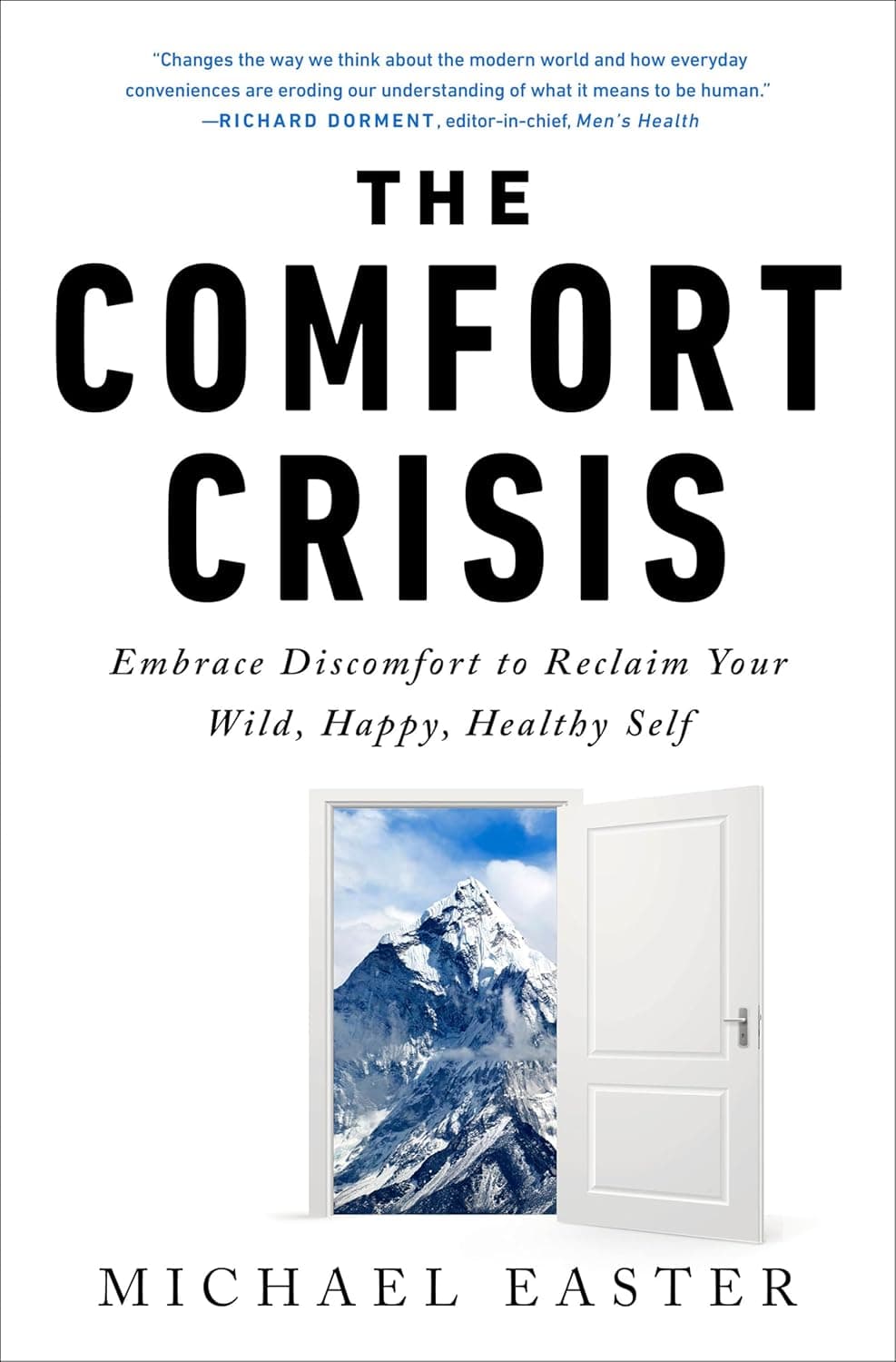
The Crisis of Comfort asks how a species shaped by scarcity, danger, and effort fares when ease becomes the default. It probes the evolutionary mismatch between bodies and minds built for hardship and a modern world that removes friction, risk, and boredom. The theme argues that ubiquitous comfort—physical, emotional, and cognitive—dulls resilience and erodes meaning, even as it extends lifespan and convenience. It ultimately questions whether strategically reintroducing discomfort can restore health, purpose, and a fuller experience of being human.
How It Develops
The theme surfaces early as the author recognizes that his reliance on alcohol functioned as a “comfort blanket,” an anesthetic against the ordinary frictions of life. By Chapter 2, sobriety becomes his first deliberate experiment in choosing discomfort over numbing, opening the inquiry: if one comfort can quietly corrode a life, what about the countless others we take for granted?
From there, the book widens its lens to the evolutionary mismatch that sits at the heart of the crisis. In Chapter 3, the text underscores how the modern comforts we assume as normal occupy only a sliver of human history, far too brief for biology to adapt. Easter then introduces “comfort creep,” drawing on David Levari and the idea of prevalence-induced concept change; in Chapter 4, he shows how every new ease resets our baseline so yesterday’s “fine” becomes today’s “unacceptable.”
Midway, the narrative turns to boredom and nature. The silence and long stretches of waiting in the Arctic force a confrontation with attention, revealing how the death of boredom in a screen-saturated life blocks creativity, self-reflection, and basic emotional regulation. This return to wild places functions as a counterweight to indoor living, where climate control and algorithmic stimulus conceal how much we’ve drifted from the environments that shaped us.
As the journey intensifies, hunger and mortality push the theme deeper. True hunger—induced by a massive energy deficit—reacquaints him with biological processes like cellular repair and recalibrates the difference between “want” and “need.” Contemplating death, including practices from Bhutan, reframes discomfort not as punishment but as perspective—an antidote to apathy that restores urgency and gratitude.
The arc culminates in physical work. Carrying heavy loads, moving all day, and embracing effort reveal how sedentary ease undermines the spine, metabolism, and spirit. In the Epilogue, the synthesis lands: not a rejection of modernity, but a program of deliberate, bounded discomfort—periodic challenges, time in nature, fasting, and physical burden—to reverse the drift toward fragility.
Key Examples
-
Personal Awakening and Sobriety: Recognizing alcohol as a tool for numbing “insecurities, situations, thoughts, and emotions,” Easter’s decision in Chapter 2 to get sober becomes proof that discomfort can heal what comfort conceals. This first experiment establishes the governing logic of the book: removing an easy escape exposes life’s difficulties—but also restores agency and growth.
-
The Modern Comfort Inventory: Cataloging his day—temperature-controlled home, ergonomic chair, smartphone stimulus, and streaming on an overstuffed sofa—he shows comfort’s quiet totality. The point isn’t guilt but awareness: when every friction is solved by design, we lose the everyday stresses that keep bodies strong and minds engaged.
-
Evolutionary Mismatch: In Chapter 3, the book emphasizes that the conveniences defining modern life have existed for a tiny fraction of human history. Because our biology expects scarcity, movement, and cold, an always-fed, always-warm, always-seated life destabilizes systems calibrated for challenge.
-
Comfort Creep and Moving Goalposts: Drawing on David Levari, Chapter 4 shows how adding comforts shifts thresholds so that “today’s comfort is tomorrow’s discomfort.” This explains why satisfaction remains elusive despite abundance: the baseline keeps rising, generating perpetual restlessness.
-
Diseases of Comfort: The narrative links ease to modern epidemics—obesity, diabetes, heart disease, and “diseases of despair.” Without the ancestral stressors that used to prune, repair, and test us, physiological systems drift into dysfunction and the psyche stagnates, turning comfort into a slow-acting toxin.
Character Connections
Easter’s transformation anchors the theme: moving from an office-bound, screen-saturated routine to an Arctic crucible, he becomes both investigator and subject. His willingness to test discomfort—sobriety, hunger, cold, boredom—demonstrates that resilience is a trainable trait, not a fixed identity.
Donnie Vincent operates as a living counternarrative to modern ease. Months in the backcountry harden his body and sharpen his senses; his life shows that exposure to risk and effort can cultivate judgment, humility, and competence—the precise capacities dulled by comfort.
Dr. Marcus Elliott provides a framework with misogi, the radical challenge designed to carry a 50% chance of failure. Misogi converts discomfort into a structured path for identity expansion, asking not just what you can do, but who you become by attempting the near-impossible.
The “Average American” figures as a composite character: climate-controlled, seated, and screen-bound. This portrait underscores the theme’s stakes—most people haven’t chosen comfort so much as drifted into it, making the crisis less a personal failing than a cultural design problem that requires conscious counter-design.
Symbolic Elements
-
The Arctic Landscape: Vast, indifferent, and severe, the Arctic symbolizes the un-negotiable reality that shaped humans—cold, hunger, exposure, and consequence. It strips away illusions, revealing capacities forged only through trial.
-
The Climate-Controlled Room: The steady 72 degrees stands for the insulated bubble of modern life—predictable, sterile, and frictionless. Its comfort is soothing but anesthetizing, training us to recoil from the very stresses that keep us adaptive.
-
The Smartphone: As a pocket-sized dispenser of novelty and relief, it embodies comfort’s most seductive form: the end of boredom. It replaces reflection with stimulus, shrinking attention and making the unmediated world feel intolerably slow.
-
The Bush Plane: This rattling threshold between civilization and wilderness marks the crossing from safety-netted predictability to risky autonomy. Boarding it is a ritual of consent to discomfort—and to the growth and uncertainty it brings.
Contemporary Relevance
The theme lands squarely in a world of soaring metabolic disease, mental-health strain, and omnipresent screens. It offers an evolutionary lens for why fulfillment lags behind progress: when effort, risk, and friction vanish, so do the signals that tell bodies how to repair and minds how to find meaning. Rather than reject technology, the argument proposes a design-for-discomfort approach—periodic hunger, cold exposure, time outdoors, heavy carries, hard goals—as a practical antidote to stagnation. In an increasingly virtual era, choosing real-world difficulty becomes a surprisingly modern way to feel fully alive.
Essential Quote
We are living progressively sheltered, sterile, temperature-controlled, overfed, underchallenged, safety-netted lives. And it’s limiting the degree to which we experience our “one wild and precious life,” as poet Mary Oliver put it. — Michael Easter, Chapter 1
This line condenses the thesis: comfort has become comprehensive—thermal, nutritional, cognitive—and the cumulative effect is a narrowing of experience. By invoking Mary Oliver, the book reframes discomfort not as masochism but as the doorway to wonder and vitality; discomfort expands the range of life we can actually feel. The quote thus positions voluntary challenge as a moral and existential imperative, not just a fitness hack.