Opening
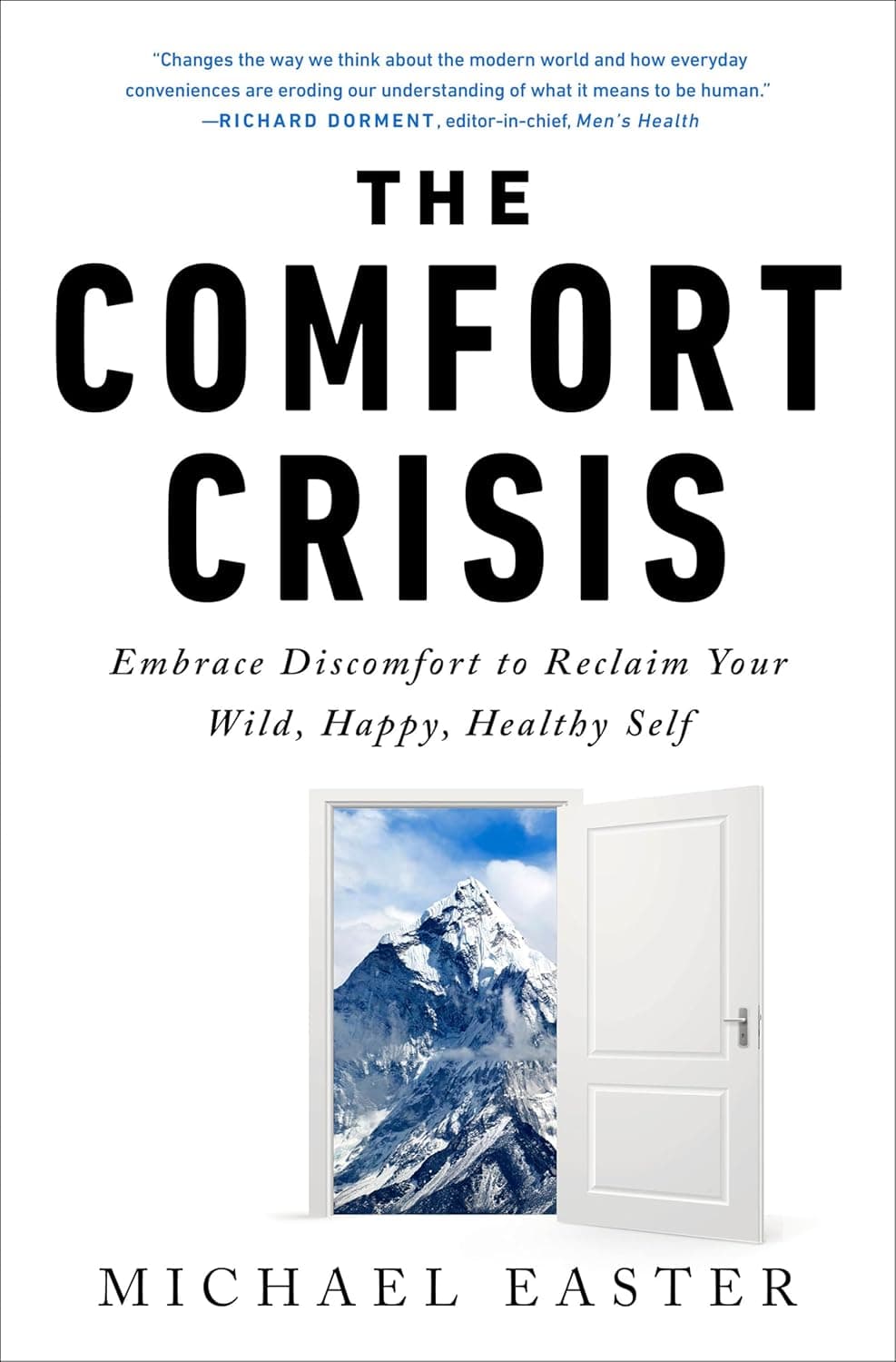
After the Nevada hunt changes him, Michael Easter searches for the source of that lingering charge and finds misogi—a purification through ordeal that promises clarity and renewal. Guided by Dr. Marcus Elliott, grounded by science, and tested by a looming Arctic expedition, he moves from observer to participant, turning discomfort into a deliberate practice.
What Happens
Chapter 6: 50/50
Easter chases the “buzz” from Nevada and lands on misogi, a Shinto-rooted practice where a person undertakes an epic, nature-based challenge to purify body and mind. He retells the Kojiki myth: the god Izanagi descends to the underworld to retrieve his wife, fails, and barely escapes; in a freezing river he cleanses himself to reach sumikiri—pure clarity and renewed strength. That ancient logic—use a grueling task to wash away modern defilements—reappears today as a secular methodology: set a near-impossible challenge to reset your compass.
His search brings him to Elliott, a Harvard-trained physician and pioneering sports scientist behind P3, the performance lab trusted by elite athletes like Luka Dončić. When Easter reaches out, Elliott is more eager to talk misogi than biomechanics. He invites Easter to Santa Barbara, opening the door to a philosophy of deliberately engineered hardship that mirrors the stakes our ancestors once faced.
Chapter 7: When I Returned
On a brutal trail run above Santa Barbara, Elliott lays out his thesis: modern life lets us operate inside a thin sliver of our capacity, and that deprivation of difficulty starves something essential—what the book names The Crisis of Comfort. Misogi, he says, is a “contrived concept” that recreates elemental, life-or-death difficulty and can induce flow—total absorption born of high challenge and skill. He reels off examples: hauling an 85-pound rock underwater for five kilometers; stand-up paddleboarding 25 miles across the Santa Barbara Channel.
Elliott’s story doubles as proof-of-concept. A former world-ranked triathlete who finished Harvard Medical School, he never stops orchestrating “kooky challenges” outdoors to probe his limits. He adopts the term misogi from a friend and makes it an annual ritual. In pro sports—first with the New England Patriots, then at P3—he applies rigor and measurement, yet credits misogi as a deeper engine for his growth and success, revealing potential that standard training never touches.
Chapter 8: The Rules of Misogi and Rites of Passage
As they climb, Elliott offers two hard rules for a modern misogi:
- It must be really, really hard—about a 50% chance of success even if you execute perfectly.
- You can’t die—build in safety.
Two guardrails shape the spirit: pick a quirky, uncommon task to avoid comparison, and do not post about it on social media. Misogi points inward, not outward. This becomes a flagship method for Embracing Voluntary Discomfort.
Easter connects the practice to anthropologist Arnold van Gennep’s model of rites of passage—The Need for Rites of Passage—found across cultures, from Aboriginal walkabouts to Maasai lion hunts. Each rite moves through separation (leaving society), transition (the ordeal), and incorporation (returning transformed). In the modern West, he and Elliott argue, such rites largely vanish, crowded out by helicopter and snowplow parenting that sandblasts every obstacle. The fallout shows up as anxiety, depression, and untested adulthood. Misogi becomes a self-created rite—an avenue for Confronting Mortality for a Fuller Life and discovering capability in a world that no longer demands it.
Chapter 9: The Science of Toughening
To test the philosophy, Easter talks with Mark Seery, a psychologist who studies stress and resilience. Seery’s research on “toughening” shows a U-shaped curve: people with some adversity—not none, not too much—report better health, higher life satisfaction, and stronger resilience. In lab tasks like ice-water immersion, these individuals perceive pain as more manageable and frame the stressor as a challenge rather than a threat.
The implications translate: undertaking voluntary difficulty builds general stress capacity. Outdoor challenges amplify the effect, likely because they mirror ancestral stressors we evolved to solve. When Easter describes misogi, Seery says it “dovetails really nicely” with the data—evidence that the benefits transfer beyond the event, redesigning how a person meets everyday strain.
Chapter 10: 50, 70, or 90
The theory demands a test. Opportunity arrives when Donnie Vincent invites Easter on a 33-day caribou hunt in the Alaskan Arctic—vastly tougher and riskier than their Nevada outing. Acknowledging he is “hazardously underprepared,” Easter commits to six months of rewilding to hit Elliott’s 50/50 threshold.
He trains like a professional expeditionary. He completes a wilderness emergency medicine course; studies grizzly protocols; and plans a calorie deficit, embracing The Health Benefits of Hunger. He invests in gear that works in the Arctic and follows a Special Forces–designed plan that prioritizes functional strength and The Importance of Physical Work and Carrying Loads. As he learns new skills and drills the fundamentals, he notices how presence replaces autopilot. The preparation itself becomes a rehearsal for Reconnection with Nature and Wildness. Packed and committed, he heads to the airport.
Character Development
Easter evolves from curious journalist to committed practitioner, moving his inquiry from the page to his body. Elliott emerges as the catalytic mentor whose lived example and precise rules give Easter a workable template.
- Easter:
- Chooses hardship deliberately, reframing fear of failure into a target (50/50).
- Builds new competencies—medical readiness, fieldcraft, functional strength—to earn self-trust.
- Shifts from external validation to inner orientation, treating discomfort as a teacher.
- Elliott:
- Clarifies misogi as a disciplined, safety-conscious rite rather than spectacle.
- Models alignment between belief and behavior, linking annual misogis to professional excellence.
- Grounds grand ideas with tangible examples that invite imitation, not idolization.
Themes & Symbols
Misogi serves as a modern rite of purification and identity-formation. By enforcing a 50% success horizon and banning performative signaling, it forces participants to confront uncertainty, finitude, and the real edge of their abilities. The challenge appears physical but works primarily on the psychological and spiritual planes, stripping away excuses until clarity—sumikiri—emerges.
Rites of passage frame the societal need: separation, ordeal, return. In cultures where formal rites fade, anxiety and aimlessness rise. Misogi restores the arc, offering a voluntary crucible that aligns with evolution and with data on toughening. The 50/50 rule becomes a bright boundary: cross it, and you meet yourself; stay inside it, and you remain unknown to yourself.
Key Quotes
“It must be really fucking hard”—about a 50% chance of success.
This line sets the bar. A misogi isn’t a stunt or a PR; it’s calibrated uncertainty. The coin-flip odds ensure the task is neither trivial nor suicidal, maximizing learning and identity shift.
“You can’t die.”
The second rule enforces respect. Misogi seeks transformation, not martyrdom. Safety planning, redundancy, and judgment become part of the challenge—courage plus competence.
Misogi is a “contrived concept” designed to mimic ancestral, life-or-death challenges.
By admitting it’s contrived, Elliott reveals the purpose: to manufacture conditions that modern life no longer provides. The designed ordeal awakens dormant systems—attention, courage, cooperation—that thrive under real stakes.
Seery says misogi “dovetails really nicely” with the science of toughening.
The bridge from philosophy to evidence is crucial. If the benefits generalize—lower threat response, greater resilience—the misogi becomes not just a story but a replicable method for everyday strength.
Why This Matters and Section Significance
These chapters supply the book’s operating system: diagnose the problem (The Crisis of Comfort), propose a method (misogi with clear rules), validate it with research, and then enact it at full scale. They move the narrative from abstraction to embodiment, converting ideas into a lived test.
Placed after the groundwork of the early chapters (Chapter 1-5 Summary), this section marks the hinge from theory to practice. Easter’s commitment to the Arctic misogi personalizes the stakes and primes the climactic expedition to reveal whether the method truly transforms the person who dares it.