What This Theme Explores
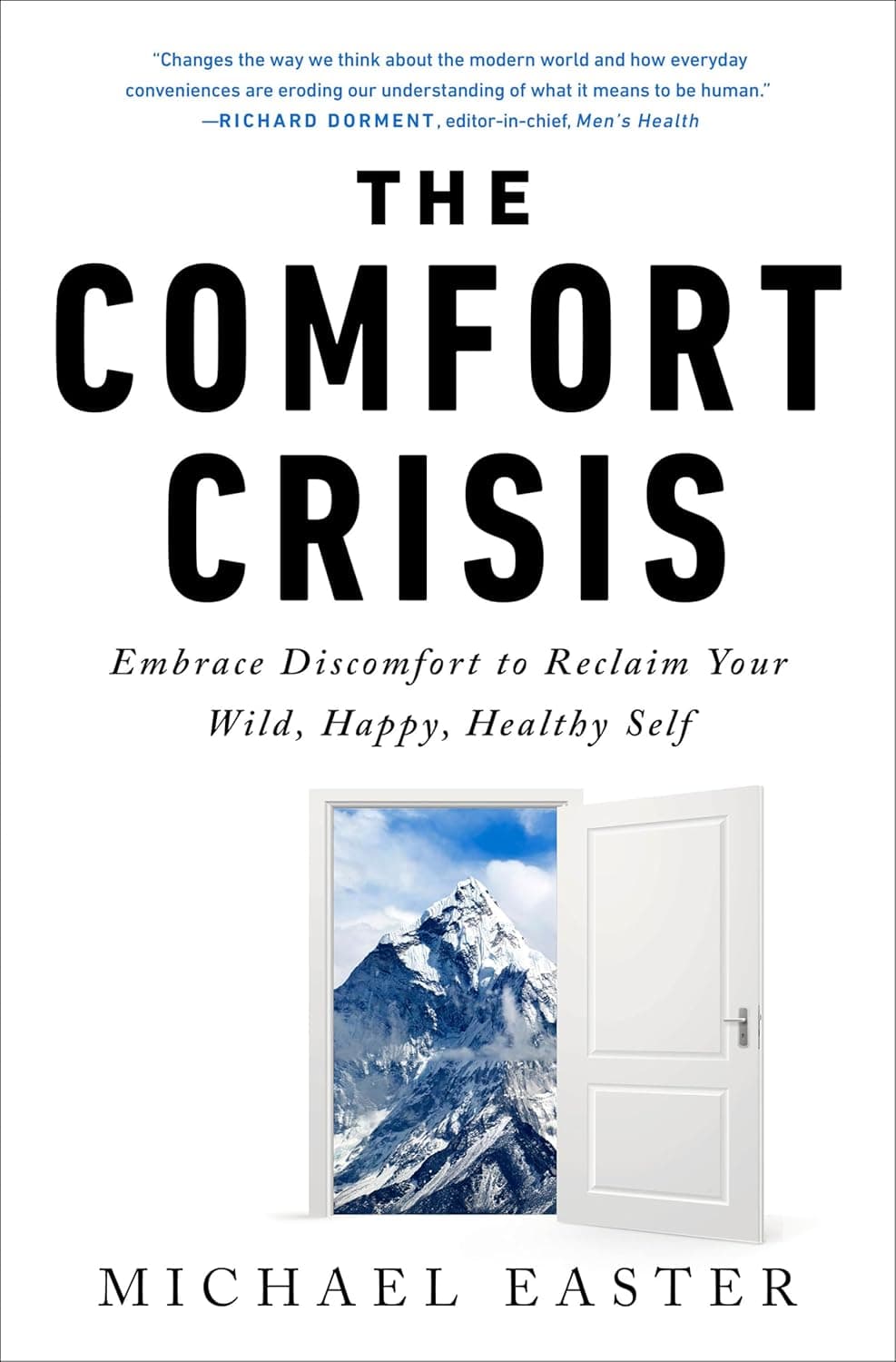
Embracing Voluntary Discomfort asks how deliberately chosen hardship can reverse the stagnation created by comfort—and which kinds of stress best rekindle strength, meaning, and joy. It reframes adversity not as masochism but as a precise, time-bound tool that awakens adaptations our species evolved for, countering what the book names a Crisis of Comfort. The theme probes a set of practical questions: What intensity and frequency of challenge stretch us without breaking us? How do physical, mental, and existential discomforts each train different capacities? And how can controlled difficulty make everyday life feel richer rather than merely tougher?
How It Develops
The theme begins as confession and experiment: journalist-adventurer Michael Easter admits that convenience and numbing habits have made his life small, then chooses a radical reset—a 33-day caribou hunt in the Arctic. In Part One (Chapters 1–10), his involuntary discomfort—quitting alcohol—exposes how reflexive comfort can quietly erode meaning. That opening pain primes him for voluntary trials and for a framework supplied by Dr. Marcus Elliott: misogi, a once-yearly challenge with a genuine 50/50 chance of success. The point is not performance but identity change—using difficulty to redraw one’s sense of what is possible.
Part Two (Chapters 11–13) trades spectacle for stillness. Long Arctic lulls force Easter into boredom, which, guided by psychologist James Danckert, he reframes as a productive discomfort that restores attention and spurs creativity. Rather than anesthetizing every lull with screens, he learns to sit with emptiness until it becomes fertile.
Part Three (Chapters 14–15) moves from the restless mind to the empty stomach. Calorie deficits on the hunt reacquaint Easter with true hunger—a sensation most moderns never reach. With insight from nutrition scientist Trevor Kashey, he links fasting to autophagy and metabolic flexibility, redefining hunger as an instructive signal and a restorative state rather than an emergency that must be solved immediately.
Part Four (Chapters 16–18) aims at the deepest discomfort: mortality. In Bhutan, conversations with Khenpo Phuntsho Tashi illuminate death contemplation as a daily practice that heightens gratitude and clarifies priorities. The abstractions crystallize against the visceral reality of hunting, where taking a life demands moral presence and responsibility.
Part Five (Chapters 19–21) returns to the body with an ancient, democratic hardship: carrying weight. After the kill, Easter packs out more than 100 pounds of meat, embodying the “rucking” philosophy popularized by Jason McCarthy. Load carriage becomes a metaphor for taking on burdens worth bearing—work that develops integrated strength, stamina, and character.
In the Epilogue, Easter distills these trials into a stance toward modern life. Discomfort is not a one-off cure but a practice that resists “comfort creep,” helping him maintain resilience and appreciation amid thermostats, apps, and effortless abundance.
Key Examples
-
The Arctic Hunt: Thirty-three days of cold, uncertainty, and exertion provide a full-spectrum laboratory for discomfort—mental (boredom, fear), physical (hunger, fatigue), and moral (killing an animal). Because the hardship serves a purpose—obtaining meat and meaning—it feels clarifying rather than arbitrary, showing how aim transforms pain into growth.
-
Misogi: The misogi model converts amorphous “toughness” into a clear, high-stakes container with a 50/50 success horizon. By courting the unknown, it targets identity rather than metrics; the process enlarges the practitioner regardless of outcome, proving that the right dose of difficulty is defined by uncertainty, not suffering for its own sake.
-
Sobriety as Catalyst: Quitting drinking is an initial, unwelcome discomfort that strips away numbing routines and exposes the cost of ease. That pain sharpens Easter’s appetite for challenges he chooses, turning avoidance into approach and setting the psychological foundation for bigger, purposeful trials.
-
The Caribou Pack-Out: Hauling more than 100 pounds uphill for miles condenses the book’s argument into one task: a hard thing done for a tangible, communal good. The weight literalizes responsibility and reveals how doing what is necessary—not merely optional—can feel deeply satisfying.
-
Fasting and Hunger: Experiencing true hunger recalibrates alarm signals and restores confidence in the body’s resilience. Framed by science, fasting becomes a cyclical stress that cleans and strengthens systems, showing how controlled deprivation builds capacity rather than depletion.
-
Confronting Mortality: Daily contemplation of death—paired with the concrete act of hunting—transforms dread into discernment. Accepting impermanence sharpens gratitude and guides choices, proving that existential discomfort can be the most life-giving.
Character Connections
Michael Easter evolves from comfort-chasing professional to experimenter in purposeful hardship. His candid self-assessment and willingness to test hypotheses in the field make him a credible guide: he doesn’t preach austerity; he demonstrates how specific frictions restore aliveness, agency, and appreciation.
Donnie Vincent personifies a life built around chosen difficulty. As a backcountry hunter and mentor, he models competence, patience, and reverence, showing Easter that discomfort is not a stunt but a way of aligning effort with stewardship, skill, and consequence.
Dr. Marcus Elliott provides the theme’s architecture. By articulating misogi’s few, strict guardrails and its 50/50 horizon, he bridges ancient rites of passage and contemporary life, ensuring that challenge remains transformative, not reckless, and that the unknown—rather than ego—drives growth.
Jason McCarthy translates the theme into a scalable practice. Rucking turns heroic hardship into communal habit, revealing that strength and resilience grow fastest when burdens are carried together—and when the work feels fundamentally human, not performative.
Mark Seery offers empirical ballast. His research on “toughening” shows that people who experience some adversity—not none, not relentless—exhibit greater resilience and life satisfaction, validating the book’s prescription for moderate, meaningful stressors.
Symbolic Elements
The Arctic Wilderness: A vast, indifferent landscape strips away artificial buffers and returns feedback to a human scale. In this liminal space, comfort’s promises lose their grip, and competence, humility, and attention become the currencies that matter.
The Ruck/Backpack: A chosen weight becomes a portable ethic: we are shaped by the burdens we elect to carry. Training with load tilts the psyche toward responsibility and reveals that strength is less a trait than a relationship to worthwhile work.
The Bush Plane: Each smaller aircraft marks another shedding of safety and certainty—the passage from climate control to consequence. “As our airplanes get smaller, our adventure gets bigger” captures threshold-crossing as both risk and invitation to become more fully alive.
Misogi: A modern rite of passage that sanctifies difficulty by giving it intention and form. The ritual creates a container for chaos, turning the fear of failure into a catalyst for identity expansion.
Contemporary Relevance
In a world optimized for frictionless living—one-tap deliveries, algorithmic entertainment, stable indoor climates—many people feel anxious, unfocused, and underfulfilled despite abundance. The theme explains that paradox: comfort removes acute pain while also eroding the stress-dosed experiences that teach capability, connection, and awe. Practices like ice baths, trail ultras, rucking, digital Sabbaths, and minimalist resets resonate because they reintroduce the right kinds of stress at humane doses. By pairing epic, occasional rites (a misogi) with daily micro-discomforts (walking in weather, lifting heavy, sitting with boredom), individuals can reclaim adaptability and gratitude without rejecting modernity.
Essential Quote
“In our model of misogi, there are only two rules,” said Elliott. “Rule number one is that it has to be really fucking hard. Rule number two is that you can’t die.”
This blunt formula captures the theme’s balance of audacity and wisdom: push to the edge, but honor the boundary that keeps growth sustainable. The rules center uncertainty (not masochism) as the engine of change, ensuring the challenge is meaningful enough to reshape identity while safe enough to repeat—and to integrate into a life well lived.