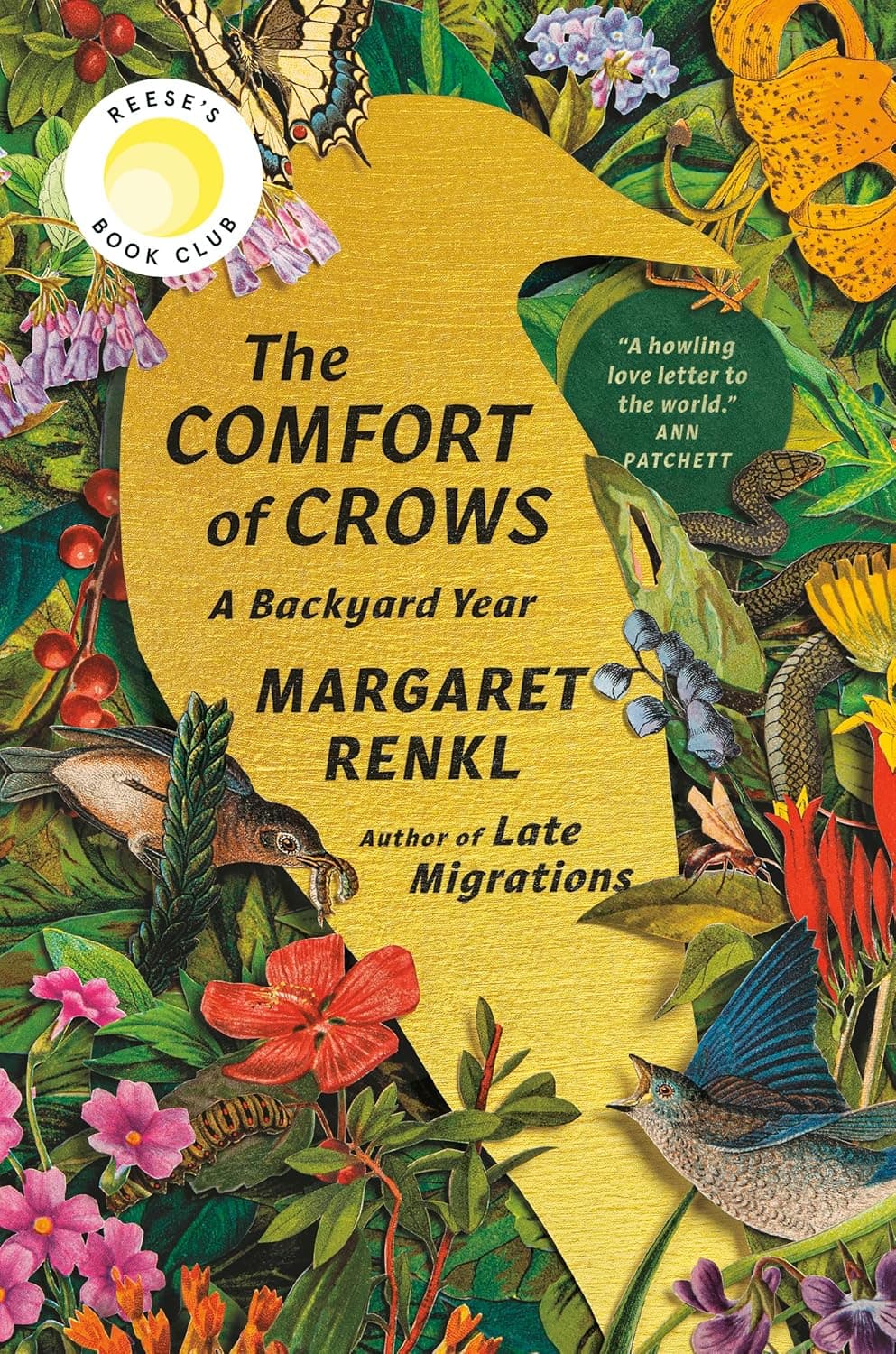
This collection of quotes from Margaret Renkl’s The Comfort of Crows distills the book’s meditations on nature, family, time, and the fragile work of hope. Each passage turns close looking into a practice of meaning-making, showing how a suburban yard can become a cathedral of attention.
Most Important Quotes
These passages form the book’s compass, articulating its faith in attention, renewal, and humble hope.
The Mandate to Look
"We were never cast out of Eden. We merely turned from it and shut our eyes. To return and be welcomed, cleansed and redeemed, we are only obliged to look."
Speaker: Margaret Renkl (Narrator) | Context: Closing lines of the introductory essay, “Wherever You Are, Stop What You’re Doing,” which frames the book’s spiritual and ethical orientation.
Analysis: Renkl reimagines Eden as a present-tense reality accessible through unflinching attention, turning “looking” into a moral practice rather than a passive gaze. The biblical diction—“welcomed, cleansed and redeemed”—recasts ordinary perception as a form of grace and stewardship. This passage supplies the book’s governing claim: the world’s salvation begins with the eye and the heart that refuse to look away, a thesis that launches the theme of The Human-Nature Connection. The cadence and triadic structure heighten its liturgical feel, making the line both benediction and charge.
Life in Death in Life
"What caught my eye was a cluster of chickweed seedlings colored the new green of springtime, so bright they seemed to glow. They were growing in the loam inside the knothole. Far above the ground, a hole made by decay in a living tree had become a cold frame, a natural greenhouse that let in light and kept out frost. Life in death in life."
Speaker: Margaret Renkl (Narrator) | Context: From “The Knothole” (Winter, Week 11), where a winter walk yields a hidden greenhouse thriving inside a decaying oak.
Analysis: The image of luminous seedlings nested in rot compresses an ecological truth into a single, unforgettable emblem of Cycles of Life, Death, and Renewal. Syntax mirrors the ecology: phrases accrete like layers of humus, culminating in the refrain-like “Life in death in life,” a paradox that reads as both mantra and thesis. Renkl’s observation offers an antidote to despair by showing decay as a generative medium rather than an endpoint. The knothole becomes a miniature sanctuary, proof that life’s tenacity is not sentimental but structural.
The Thing with Feathers
"I am far from feeling any confidence in the future, but when I look at the busy tableau before me, something flutters inside—something that feels just a little bit like hope."
Speaker: Margaret Renkl (Narrator) | Context: Final sentence of “The Thing with Feathers” (Fall, Week 13), as bluebirds test an old nest box while construction workers raise a new house next door.
Analysis: Renkl refuses easy consolation, locating hope not in certainty but in sensation—“something that feels”—and anchoring it in the co-presence of birds and builders. The word “flutters” fuses inner life with avian life, an embodied echo of Dickinson’s metaphor while keeping hope literal and local. This closing image braids Grief, Hope, and Environmental Change with Aging, Family, and the Passage of Time, holding human industry and wild persistence in a single frame. The sentence’s modesty is its power: a small, earned hope feels truer than a grand pronouncement.
Thematic Quotes
The Human-Nature Connection
The Cure for Anxiety
"The natural world’s perfect indifference has always been the best cure for my own anxieties. Every living thing—every bird and mammal and reptile and amphibian, every tree and shrub and flower and moss—is pursuing its own vital purpose, a purpose that sets my human concerns in a larger context."
Speaker: Margaret Renkl (Narrator) | Context: From “The Beautiful World beside the Broken One” (Spring, Week 4), after recovery from illness and doom-laden headlines.
Analysis: Paradoxically, it is nature’s indifference—not its affection—that steadies Renkl, decentering the human drama and restoring scale. The catalog of beings builds a litany of purpose, echoing a creation hymn that re-situates the self within a wider ecology of intent. The idea reframes “escape” as clarity; attention to other lives returns the world to proportion. Stylistically, the sentence’s accumulating list enacts the abundance it describes, turning enumeration into relief.
The Work of Attention
"To pay attention, this is our endless and proper work."
Speaker: Mary Oliver | Context: Epigraph that sets the book’s poetic and ethical lineage.
Analysis: Oliver’s imperative consecrates watchfulness as vocation, aligning Renkl with a literary tradition that treats observation as discipline and devotion. The phrase “endless and proper” yokes the infinite to the ordinary, elevating daily noticing to a lifelong craft. As a framing device, it primes the essays to read as a liturgy of looking, where small acts accrue moral weight. The stark simplicity of the line—no ornament, only charge—becomes the book’s working rule.
Cycles of Life, Death, and Renewal
The Tragedy of Clinging Beauty
"Apocalyptic stories always get the apocalypse wrong. The tragedy is not the failed world’s barren ugliness. The tragedy is its clinging beauty even as it fails."
Speaker: Margaret Renkl (Narrator) | Context: From “Who Will Mourn Them When They Are Gone?” (Spring, Week 2), reflecting on vanishing species and environmental grief.
Analysis: Renkl overturns the usual wasteland image of apocalypse, insisting that loss is most piercing when beauty persists alongside decline. “Clinging beauty” personifies the world as both resilient and imperiled, heightening pathos through irony: the loveliness that remains makes mourning sharper. The observation captures the book’s tonal braid—rapture and lament in the same breath—resisting numbness. It shifts catastrophe from a future fantasy to a present condition, demanding a more watchful grief.
The Purpose of a Messy Yard
"Year by year, the creatures who share this yard have been teaching me the value of an untidy garden."
Speaker: Margaret Renkl (Narrator) | Context: From “The Winter Garden” (Winter, Week 5), explaining why she leaves stalks, leaves, and brush for habitat and food.
Analysis: The “untidy garden” becomes a corrective to human-centered aesthetics, converting neatness into an ecological question rather than a cosmetic one. Renkl shifts roles—from gardener to student—as local creatures author a pedagogy of reciprocity. Practically and symbolically, she joins the ongoing cycle that turns dead matter into shelter and seedbed, enacting the ethic she espouses. The line’s gentle humility—“teaching me”—models a posture of kinship rather than control.
Grief, Hope, and Environmental Change
The Permission for Joy
"In this troubled world, it would be a crime to snuff out any flicker of happiness that somehow flames up into life."
Speaker: Margaret Renkl (Narrator) | Context: From “Wild Joy” (Winter, Week 12), wrestling with delight at early greenness that is also a sign of ecological imbalance.
Analysis: Fire imagery—“flicker,” “flames”—figures joy as a fragile, necessary energy, indicting the reflex to extinguish it in times of crisis. Renkl refuses a punitive environmentalism that mistrusts gladness, arguing that joy sustains the long labor of care. The sentence’s moral language—“crime”—underscores the stakes of allowing light where it appears. Joy here is not denial; it is fuel.
Wanting Two Contrary Things
"I am learning that it is possible to want two contrary things at once. I want nothing to change. I want everything to change."
Speaker: Margaret Renkl (Narrator) | Context: From “Done with Waiting” (Winter, Week 8), as her sons prepare to leave home while she longs for spring.
Analysis: The parallel clauses enact the double-bind of midlife: clinging to what is loved while craving renewal. This paradox bridges the domestic and the planetary, mirroring her yearning for seasonal rebirth amid dread of ecological transformation. The austere repetition gives the lines a mantra-like honesty, acknowledging that mature hope makes room for contradiction. By stating the tension plainly, Renkl grants readers a vocabulary for living with it.
Character-Defining Moments
Margaret Renkl
"I can’t reverse the ravages of climate change, but this caterpillar? I can save this one."
Speaker: Margaret Renkl (Narrator) | Context: From “The Butterfly Cage” (Fall, Week 5), protecting a black swallowtail caterpillar from a wasp.
Analysis: Renkl translates overwhelm into action by narrowing the field of care to a single life, turning abstract dread into concrete stewardship. The sentence pivots on the adversative “but,” converting powerlessness into agency without grandiosity. The caterpillar, a figure of transformation, doubles as emblem and beneficiary of her ethic: do the good that is at hand. This is the book’s praxis in miniature—local, tender, persistent.
The Crows
"I love the crows not because they are exotic but because they are kindred creatures. I see in them my own kind."
Speaker: Margaret Renkl (Narrator) | Context: From “The Crow Family” (Winter, Week 10), reflecting on the birds that give the book its title.
Analysis: Affection here is born not of rarity but recognition: intelligence, social memory, and family devotion become mirrors across species lines. By naming crows “kindred,” Renkl dissolves the human-animal divide that the book steadily critiques. The phrasing resists romanticization while deepening identification, a moral stance that underwrites her calls to kinship. The crows serve as tutelary figures, guiding her toward a more companionable way of seeing.
The Sons
"Now this house is quieter than it has ever been, and I am nesting in reverse: giving away clothes my sons have outgrown, repurposing abandoned bedrooms, cleaning out closets..."
Speaker: Margaret Renkl (Narrator) | Context: From “Reverse Nesting” (Summer, Week 8), chronicling the transition to an emptying home.
Analysis: “Nesting in reverse” neatly inverts a biological metaphor to capture the bittersweet logistics of letting go. The inventory of tasks—clothes, rooms, closets—maps an emotional topography onto domestic spaces, making absence legible. This is the private analogue to the book’s temporal concerns: cycles of filling and emptying, arrival and departure. The trailing ellipsis leaves the work unfinished, as such reckonings always are.
Memorable Lines
The Call to Kinship
"Stop and think for a time about kinship. Think for a long time about kinship."
Speaker: Margaret Renkl (Narrator) | Context: From “Wherever You Are, Stop What You’re Doing,” after guiding the reader through close observation of shared anatomical patterns.
Analysis: The imperative repetition shifts the book’s opening litany from sensory attention to moral contemplation, elevating kinship from observation to obligation. Anaphora slows the reader, insisting on duration—“for a long time”—as part of the practice. By directing thought toward likeness across species, the line dissolves categorical boundaries that justify neglect. It is a thesis in command form: attend, then belong.
The Power of a Single Song
"All this long winter long, the song sparrow in his pine tree pulpit has been teaching me that one exuberant, unceasing song can change everything."
Speaker: Margaret Renkl (Narrator) | Context: From “Praise Song for the Praise Song of a Song Sparrow in Winter” (Winter, Week 5), as an anomalously persistent singer brightens the cold season.
Analysis: The churchly metaphor—“pine tree pulpit”—casts the sparrow as celebrant, converting a backyard into a sanctuary of resilience. Alliteration and repetition (“long winter long”) lengthen the sentence’s breath, so the bird’s music feels continuous and sustaining. By crediting one voice with the power to “change everything,” Renkl honors the disproportionate force of small persistences. The line distills the book’s hope: little songs can re-tune a season.
Opening and Closing Lines
Opening Lines
"Stop and look at the tangled rootlets of the poison ivy vine climbing the locust tree... Stop and ponder the skeleton of the snakeroot plant... Stop and listen to the ragged-edged beech leaves... Stop and consider the deep hollows of the persimmon’s bark..."
Speaker: Margaret Renkl (Narrator) | Context: “Wherever You Are, Stop What You’re Doing,” which inaugurates the book’s method.
Analysis: Anaphora—“Stop and…”—creates a liturgical cadence that arrests the reader’s hurry and reorients attention to texture, sound, and form. The progression from “look” to “listen” to “consider” models the deepening of perception into thought. By spotlighting the overlooked—rootlets, skeletons, hollows—the passage dignifies the small as sources of wisdom. It is both instruction and initiation: a practicum in seeing that the entire book will elaborate.
Closing Lines
"Every day I stand at my window and watch the bluebirds, and then I look past them to the cheerful competence of the human builders clinging to the scaffolding of the house that is taking shape under their hands. Standing before the sun-filled window of my own warm house, I can’t help wondering what springtime will bring. I am far from feeling any confidence in the future, but when I look at the busy tableau before me, something flutters inside—something that feels just a little bit like hope."
Speaker: Margaret Renkl (Narrator) | Context: “The Thing with Feathers” (Fall, Week 13), where daily rituals of watching birds unfold beside the rise of a new house.
Analysis: The closing tableau yokes wild and human labors—bluebirds and builders—into a single field of view, refusing to isolate one from the other. “Flutters” makes interior feeling mimic the movement of The Bluebirds, suturing perception to emotion. The return to questions—“what springtime will bring”—keeps the book open-ended, faithful to uncertainty. Ending on a felt, provisional hope rather than a claim, Renkl models a stance for living in the unresolvable.