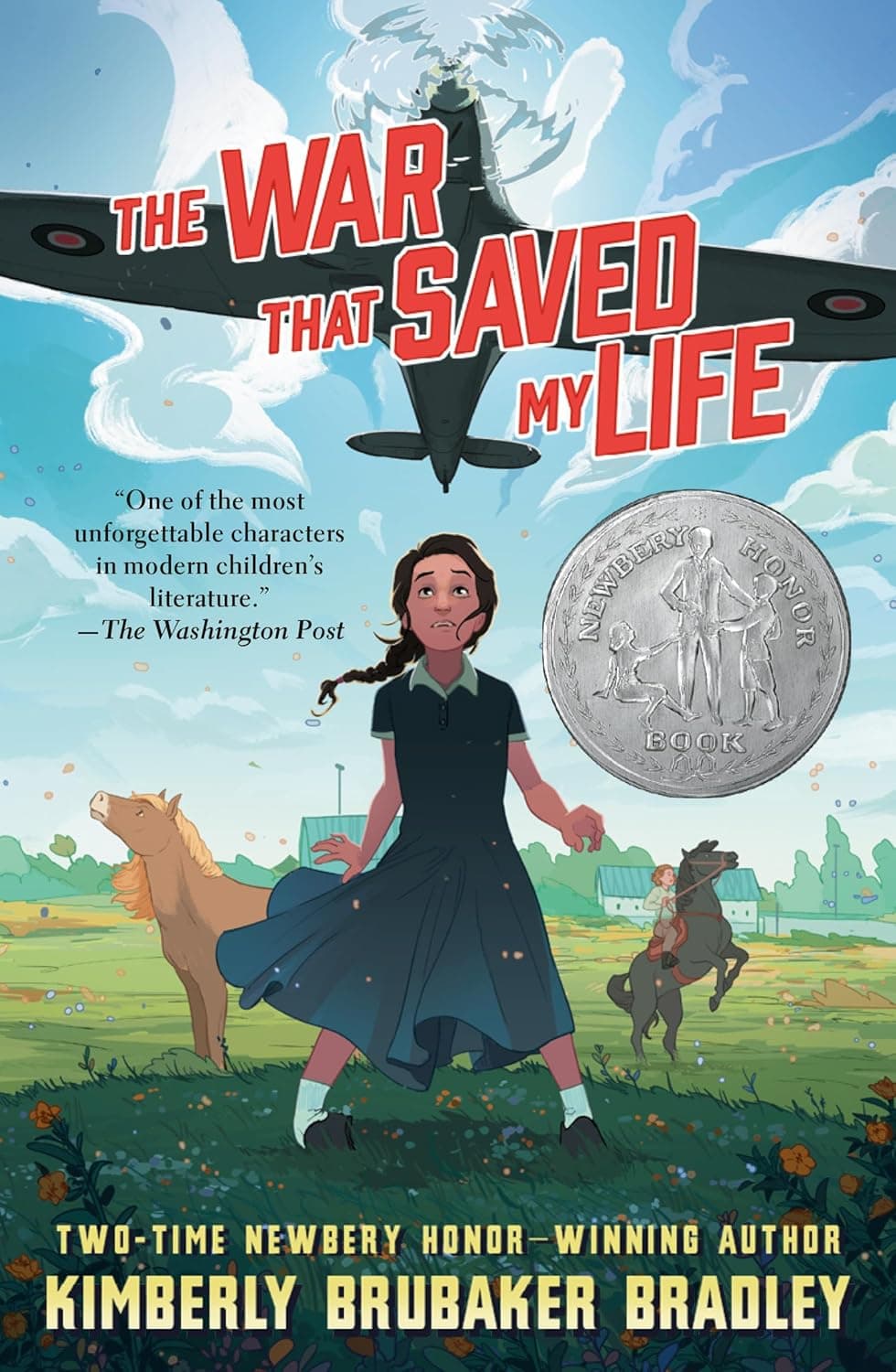
This page compiles and analyzes significant quotes from Kimberly Brubaker Bradley's The War That Saved My Life, exploring their literary importance and connection to the novel's characters and themes.
Most Important Quotes
These quotes are essential to understanding the core messages of the novel, tracking Ada's journey from abuse to healing and the formation of her new family.
The Two Wars
"There are all kinds of wars."
Speaker: Ada Smith (Narrator) | Location: Chapter 1 | Context: Ada reflects on her life at the beginning of the summer of 1939. After describing a violent encounter with her mother, she explains that her personal "war" was not with Mam, but with her brother Jamie for leaving her alone.
Analysis: This line lays out the novel’s central metaphor, equating Ada’s private battles with the public cataclysm of World War II. It signals that external conflict will press inward, igniting the internal struggles of shame, anger, and self-doubt—and, crucially, the possibility of victory. The phrase anticipates War as a Catalyst for Change, framing the war not only as danger but as the unlikely agent of freedom. Spoken by a child with a hard-earned clarity, it also exposes the source of her resilience: she has already survived a war in miniature with Mam.
The Hope for a Mother's Love
"She was my mother, after all."
Speaker: Ada Smith (Narrator) | Location: Chapter 2 | Context: While secretly teaching herself to walk, Ada imagines her mother reacting with pride and love. She fantasizes about Mam helping her down the stairs and proudly introducing her to the world.
Analysis: In seven words, Ada reveals the powerful psychological grip of filial loyalty and the distorted logic trauma imposes. She believes love is possible if she can “fix” herself, exposing how abuse twists blame inward and sustains hope against evidence—a defining feature of Ada’s initial mindset. The line is heartbreaking because it carries both yearning and denial, the grammar of a child making excuses for cruelty. It also sets the emotional stakes for Trauma, Abuse, and Healing: Ada must unlearn this self-blame to recognize real care when she finds it.
An Unconventional Savior
"You’re in luck, then... because I am not a nice person at all."
Speaker: Susan Smith | Location: Chapter 5 | Context: After arriving at Susan's house, Jamie tells her that "nice people hate that ugly foot." Susan responds with this dry, self-deprecating statement.
Analysis: Susan’s wry retort punctures the children’s learned expectations and reframes “niceness” as superficial performance rather than genuine care. The irony—that the woman who insists she isn’t “nice” becomes the most steadfast protector—defines Susan Smith and foreshadows her countercultural parenting. Her humor masks grief, but it also models a new moral logic in which honesty and steadiness trump politeness. This moment inaugurates the slow-growing trust that will become the backbone of The Meaning of Found Family.
A Mutual Salvation
"It’s lucky I went after you... The two of you saved my life, you did."
Speaker: Susan Smith | Location: Chapter 46 | Context: After Susan rescues Ada and Jamie from the London Blitz, their own house is destroyed by a bomb. Surrounded by villagers who thought they were dead, Susan looks at the children and makes this declaration.
Analysis: The novel’s title echoes through this line, reversing the direction of rescue and revealing dependence as mutual rather than one-sided. The war that freed Ada from Mam also pulls Susan out of her grief, turning devastation into unexpected renewal. The phrasing—intimate, plainspoken, emphatic—underscores how ordinary language can carry extraordinary love. It crowns the family they have chosen together, proving that what began as refuge has become a shared, sustaining life.
The Final Reckoning
"So now we’re even."
Speaker: Ada Smith | Location: Chapter 46 | Context: This is the final line of the book. After Susan says that Ada and Jamie saved her life, Ada slips her hand into Susan's and responds with this line, feeling a new emotion she identifies as joy.
Analysis: Ada’s closing words dissolve the old economy of debt and worth that governed her life, affirming a stable, reciprocal bond. For a girl who once measured love as payment owed, the phrase marks a new identity and self-worth: she is not a burden but a giver and receiver of care. The understatement—“even”—is quietly triumphant, an idiom of equality rather than accounting. It is the verbal sign that survival has tipped into belonging.
Thematic Quotes
Trauma, Abuse, and Healing
Leaving the Body to Survive
"When things got really bad I could go away inside my head. I’d always known how to do it... I would just be gone."
Speaker: Ada Smith (Narrator) | Location: Chapter 3 | Context: Ada describes her coping mechanism for when Mam forces her into the smelly, roach-infested cabinet under the sink as punishment.
Analysis: Ada’s description of dissociation is a stark portrait of how children adapt to unbearable harm within Trauma, Abuse, and Healing. The image of “going away” while the body remains trapped ties psychic flight to the novel’s preoccupation with Freedom and Imprisonment. This tactic protects her, yet it also distances her from feeling and trust—habits she must unlearn to inhabit safety. The blunt, matter-of-fact tone mirrors the numbness it describes, making the line unforgettable.
Wanting and Fearing Love
"I wanted Mam to be like Susan. I didn’t really trust Susan not to be like Mam."
Speaker: Ada Smith (Narrator) | Location: Chapter 24 | Context: After Susan stalks out into the night to put Butter away for her, Ada reflects on her conflicting feelings about the two maternal figures in her life.
Analysis: Ada names the paradox at the center of healing: longing for tenderness while bracing for cruelty. The sentence mirrors trauma’s double vision, where past experience with Mam collides with present care from Susan, making safety feel suspect. Its chiasmic structure (Mam/Susan, Susan/Mam) captures how old narratives overwrite new ones until trust is practiced over time. The line is pivotal because it articulates the exact knot Ada must untie before love can be received.
Identity and Self-Worth
The Weight of Rumors
"Simple. Not right in the head. That’s what everybody says... I didn’t even know you could talk."
Speaker: Stephen White | Location: Chapter 4 | Context: Stephen White encounters Ada at the school before the evacuation and expresses his shock at seeing her out and speaking coherently.
Analysis: Stephen’s casual cruelty exposes how community gossip has authored Ada’s identity for her, making ignorance into fact. Hearing the rumor aloud crystallizes the low status from which her reclamation of self must begin, the starting point for identity and self-worth. The staccato fragments mimic how labels strip nuance, reducing a person to a verdict. This moment hardens Ada’s resolve to prove the story wrong by writing her own.
Strength Named Out Loud
"I know you aren’t stupid... Stupid people aren’t half as brave as you. They’re not half as strong."
Speaker: Susan Smith | Location: Chapter 14 | Context: After a teacher declares Ada "isn't educable" because she can't read, Ada is devastated. Susan comforts her with these words.
Analysis: Susan offers Ada a counter-narrative anchored in character rather than deficiency, naming traits that cannot be graded: courage and resilience. The repetition and parallelism (“half as… half as…”) drum in a new metric for value, shifting the ground beneath Ada’s shame. By rejecting the school’s verdict, Susan challenges the authority that once defined Ada’s limits and begins to rebuild her self-concept. It’s a turning point where language itself becomes medicine.
The Meaning of Found Family
Choosing Each Other
"But then I couldn’t sleep. I sat in the shelter with the wretched cat and I realized that no matter what the rules were, I should have kept you. Because it was also true that you belonged to me."
Speaker: Susan Smith | Location: Chapter 46 | Context: After rescuing the children from the Blitz, Susan explains why she came back for them after letting Mam take them away.
Analysis: Susan quietly elevates love above legality, asserting a bond forged by care rather than blood—the essence of The Meaning of Found Family. The shift from “the rules” to “truth” marks her moral awakening, and her admission reframes belonging as a mutual claim. The humble image of a sleepless night in a shelter adds wartime realism to this epiphany, grounding sentiment in action. It’s the moment her reluctance gives way to conviction.
Facing Danger Together
"Some things you’ve got to face as a family."
Speaker: Susan Smith | Location: Chapter 42 | Context: Susan explains to Ada why she refuses to send the children away for a second evacuation, despite the danger of a German invasion.
Analysis: With this declaration, Susan defines family as a unit of shared risk and shared courage, not merely a household arrangement. Her logic resists bureaucratic solutions that value distance over attachment, honoring the children’s history of abandonment. The simple, aphoristic phrasing carries moral weight, turning a decision about evacuation into a pledge of solidarity. It solidifies Susan’s transformation from reluctant caretaker to protective mother.
Character-Defining Quotes
Ada Smith
A Vow to Move Forward
"I’m going to do that."
Speaker: Ada Smith | Location: Chapter 4 | Context: From the evacuation train, Ada sees a girl riding a pony, jumping a stone wall with joyous freedom.
Analysis: Ada’s spare promise is an act of self-creation: she speaks a future into being before her body can make it true. The pony—speed, power, joy—becomes a symbol of the life she claims, aligning with the novel’s fixation on freedom and imprisonment. The line’s blunt certainty, without hedging or apology, reveals the core steel that carries her through pain. It’s the seed of every risk she later takes, including riding Butter and refusing to be small.
Susan Smith
Life Outside Convention
"I never wanted children... because you can’t have children without being married, and I never wanted to be married. When I shared this home with Becky, that was the happiest I had ever been."
Speaker: Susan Smith | Location: Chapter 29 | Context: Susan explains to Ada why she seems to dislike children and why she was so reluctant to take them in.
Analysis: Susan situates herself outside the period’s domestic script, naming contentment in companionship and independence rather than marriage. This revelation reframes her initial coolness as grief and self-protection, not rejection of Ada personally. It also foreshadows how she will build family on chosen bonds that echo her life with Becky—unconventional, deliberate, and deeply loyal. The candor deepens trust, letting Ada see the pain that shaped her guardian.
Mam
The Voice of the Cage
"You can’t leave. You never will. You’re stuck here, right here in this room, bombs or no."
Speaker: Mam | Location: Chapter 3 | Context: Mam tells Ada that she will not be evacuated with the other children because of her clubfoot.
Analysis: Mam’s words weaponize prediction into a curse, compressing the theme of freedom and imprisonment into a single, crushing edict. The rhythmic insistence (“You can’t… You never will… You’re stuck…”) embodies control for control’s sake. Ironically, the war she dismisses becomes the very force that breaks Ada’s confinement, turning Mam’s certainty into dramatic irony. This line sets the bar Ada must clear—and she does.
Jamie Smith
Comfort in the Known
"At home I know the words for things."
Speaker: Jamie Smith | Location: Chapter 13 | Context: Jamie is crying and telling Ada he wants to go home. When Ada argues that home was terrible, Jamie offers this simple, poignant reason for his homesickness.
Analysis: Jamie’s confession captures a child’s logic: language is safety, and the familiar—even when harmful—feels survivable because it is named. His perspective complicates the narrative of escape, reminding us that liberation can be disorienting and that acclimating to kindness is its own labor for children like Jamie Smith. The line’s simplicity is its power; it renders dislocation in the smallest possible unit, a word. It also underscores Ada’s role as translator and anchor until their new home gains a vocabulary of its own.
Memorable Lines
The Vision of Freedom
"A girl on a pony was racing the train... The girl was laughing, her face wide open with joy... Suddenly I could feel it, the running, the jump. The smoothness, the flying—I recognized it with my whole body, as though it was something I’d done a hundred times before."
Speaker: Ada Smith (Narrator) | Location: Chapter 4 | Context: While on the train leaving London, Ada witnesses a girl riding a pony in a field.
Analysis: Vivid kinetic imagery—“smoothness,” “flying”—translates sight into sensation, letting Ada borrow freedom before she lives it. The scene turns the landscape into prophecy, with the pony prefiguring Butter and the leap prefiguring Ada’s own. This is less wish than recognition, as if her body remembers a life it was meant to have. The passage becomes a hinge in the narrative, converting escape from survival into joy.
Falling Down the Rabbit Hole
"Alice chased after a rabbit who was wearing clothes and a pocket watch. He went down his hole... but she went after him, and fell into a place she didn’t belong, a place where absolutely nothing made sense to her. It was us, I thought. Jamie and me. We had fallen down a rabbit hole, fallen into Susan’s house, and nothing made sense, not at all, not anymore."
Speaker: Ada Smith (Narrator) | Location: Chapter 28 | Context: Susan is reading Alice in Wonderland to Ada and Jamie, and Ada has a moment of profound identification with the story's protagonist.
Analysis: The allusion refracts Ada’s bewilderment through a classic tale, emphasizing how kindness can feel as disorienting as magic. By mapping Susan’s orderly, abundant home onto Wonderland, the novel captures the cognitive vertigo of trauma recovery: safety is strange before it becomes normal. The sustained metaphor validates Ada’s confusion while pointing toward growth; stories help her name her experience and thereby master it. It’s a moment when literature inside the novel becomes a tool for transformation.
Opening and Closing Lines
Opening Line
"Ada! Get back from that window!"
Speaker: Mam | Location: Chapter 1 | Context: The very first line of the novel, shouted by Mam as she yanks Ada away from the window of their one-room flat.
Analysis: The command slams the reader into confinement, with the window as both literal boundary and symbol of forbidden sight. The imperative voice and violent gesture establish stakes immediately: power, surveillance, and punishment. As an opening image, it primes us for a story about thresholds—those that imprison and those that, later, open. The line’s urgency makes Ada’s eventual vistas feel all the wider.
Closing Line
"So now we’re even."
Speaker: Ada Smith | Location: Chapter 46 | Context: The final line of the novel, spoken by Ada after Susan tells her that she and Jamie saved her life.
Analysis: Returning here, the line works as a bookend to the opening’s command, replacing coercion with consent and equality. It compresses an entire emotional arc into plain speech, proving that hard-won belonging doesn’t need ornament to resonate. By claiming parity, Ada signals that the family they have made is balanced, durable, and chosen. It reframes “being saved” from a one-way rescue into a shared life—an ending that feels earned because the language is so spare.