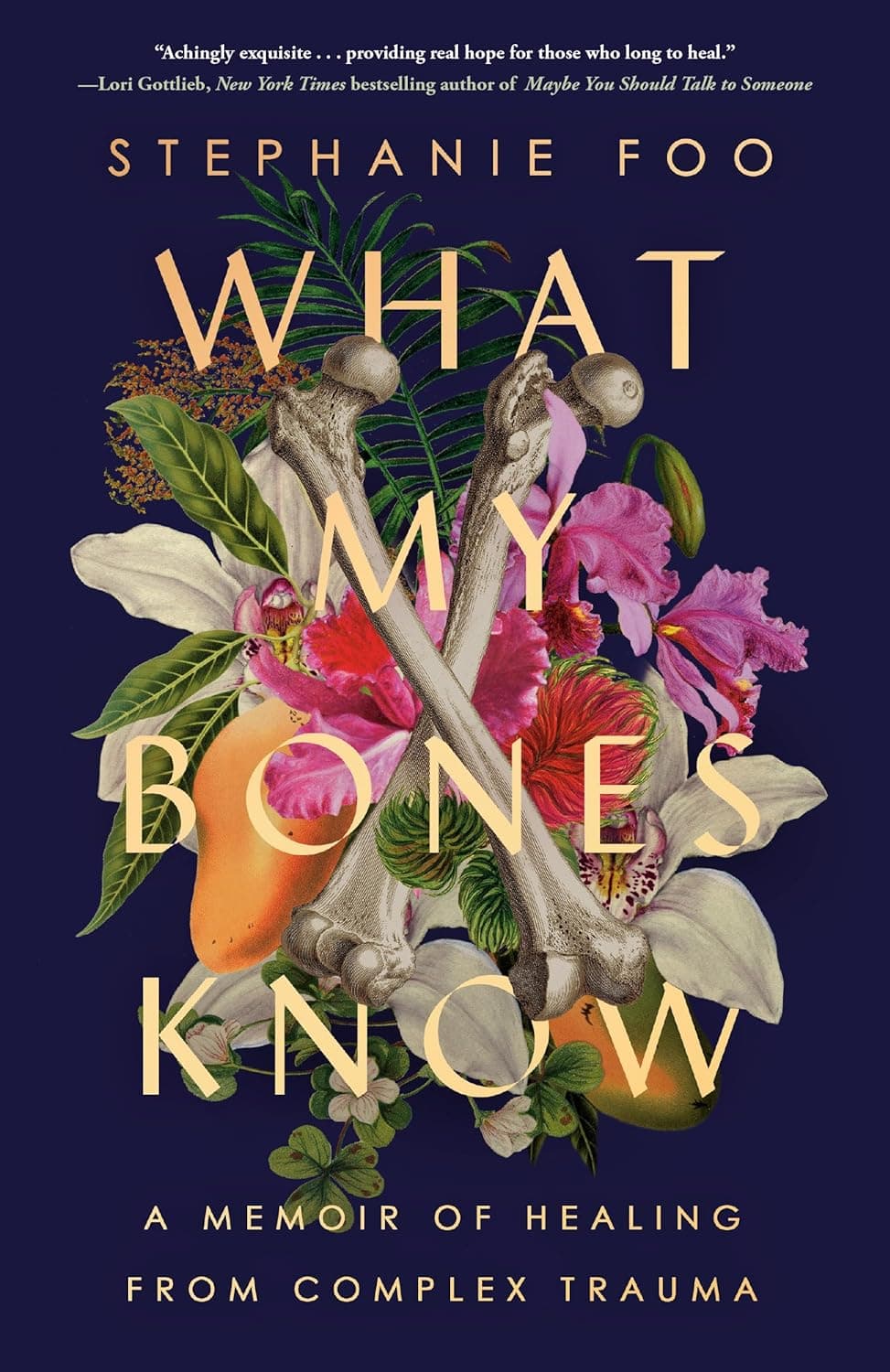
Stephanie Foo
Quick Facts
- Role: Author–narrator and central protagonist of the memoir
- First appearance: Opening pages of What My Bones Know
- Identity: Malaysian American journalist diagnosed with C‑PTSD
- Occupation: Audio producer and reporter (Snap Judgment; This American Life)
- Key relationships: Mother, Father, Joey (husband), Dr. Jacob Ham (therapist), Auntie
- Core conflict: Reclaiming a self shaped by severe childhood trauma and perfectionism
Who They Are
Bold and raw, Stephanie Foo is both subject and investigator: the wounded child grown into a meticulous journalist determined to map her own psyche. She guides readers through the terrain of Childhood Abuse and Family Dysfunction and the science of Complex Trauma and Its Lifelong Impact, translating clinical language into lived experience. Her voice toggles between the intimacy of a survivor and the clarity of a reporter, turning memory, symptoms, and relationships into evidence—and, ultimately, into a new kind of self-knowledge.
Personality & Traits
Stephanie’s personality is a set of survival tools forged in crisis—fierce, funny, hyper-competent, and often self-punishing. She begins the memoir armored in anger and achievement, but the book tracks how those defenses soften into curiosity, self-compassion, and relational trust.
- Driven and ambitious: As a teenager and young adult, she treats success as oxygen—climbing in public radio, measuring worth by output and prestige. Her work becomes a shield and a sedative, a pattern the memoir explicitly frames as Workaholism as a Trauma Response.
- Angry and confrontational: She calls herself “a sword,” escalating when threatened and wielding rage to keep people at bay—an instinct that briefly grants power but corrodes intimacy.
- Insecure and needy: Underneath bravado is a chronic fear of abandonment. In dating, she cycles through reassurance-seeking that strains partners and confirms her worst fears.
- Self-loathing: “The dread” is her name for a pervasive inner contempt—the internalized voice of abuse—central to the theme of Identity, Self-Loathing, and Self-Acceptance.
- Dissociative: She often watches herself “through glass,” or like a movie—functional on the surface, numb underneath. The memoir shows that numbness cracking in therapy as she finally feels grief and love in real time.
- Resilient and curious: Her reporter’s instinct—interviewing experts, logging symptoms, testing therapies—converts chaos into knowable patterns, making healing a research project she can enact.
Evidence in the body itself underscores these traits: teenage “dog collars and miniskirts” as armor; post-breakup weight loss so stark her “ribs formed a stepladder”; the early child in home videos with thick bangs and dimples—a visual baseline for the vulnerability she learns to claim again.
Character Journey
Stephanie’s arc traces the strenuous work of becoming someone new without disowning who survived. Early on, she copes by excelling, dissociating, and raging—strategies that help her escape home but not the pain coded into her nervous system. The shattering comes with a belated diagnosis of C‑PTSD by her therapist Samantha: a name that reorganizes her life story and exposes how deeply trauma drives her choices. She leaves her dream job—“Healing needs to be my job now”—and commits to The Journey of Healing and Recovery.
What follows is methodical and relational. Through EMDR and IFS, and with the steady, collaborative presence of Dr. Jacob Ham, she practices co-regulation, attunement, and repair—learning to witness panic without self-punishment and to hear anger as a protector, not a moral failure. Investigating family history and Intergenerational and Cultural Trauma, she visits her childhood home and speaks with Auntie, discovering that relatives saw but could not stop the harm. Gradually, Stephanie reframes symptoms as adaptations, finds stability in her marriage to Joey, and reclaims the “superpowers” of sensitivity and empathy. She doesn’t cure C‑PTSD; she integrates it—choosing connection over isolation, tenderness over contempt.
Key Relationships
- Mother: The memoir’s central wound. Their bond is a tangle of violence, manipulation, and yearning; even after abandonment, Stephanie chases approval that never comes. Naming the abuse—and refusing contact—becomes the first door to self-respect.
- Father: Neglectful and emotionally abusive, he compels Stephanie into a caretaker role that extends into adulthood. Estrangement marks a decisive boundary: she will no longer trade safety for proximity.
- Joey: A model of secure attachment. His patience and steady love give Stephanie the conditions her nervous system never had—time, safety, and acceptance—so she can risk vulnerability without bracing for betrayal.
- Dr. Jacob Ham: The therapist who treats healing as a relationship, not a protocol. He offers a corrective “new parent” stance—attuned, transparent, and collaborative—so Stephanie can practice conflict, repair, and self-compassion in the room.
- Auntie: Both haven and limit. Her affection proves Stephanie was lovable all along, yet her complicity in the family’s silence reveals how culture and fear can normalize harm.
Defining Moments
Healing in the memoir is a series of thresholds—each one redefining what strength means.
- The C‑PTSD diagnosis (from Samantha): After years in therapy, getting a name reorganizes the past and the present. Why it matters: It dismantles the “I’m fine because I’m successful” story and initiates a rigorous, intentional treatment plan.
- “I am a sword”: Stephanie’s self-image as a weapon crystallizes the function of rage in her life. Why it matters: She recognizes anger as a protector—useful, but unsustainable as an identity.
- Threatening her father with an ax: After his reckless driving endangers her, teenage Stephanie flips the script of terror. Why it matters: It’s a brief seizure of power that reveals how violence reproduces itself—and why boundary, not domination, is the path out.
- First EMDR breakthrough: She moves through dissociation into grief, accepting, “My parents didn’t love me, and it’s okay.” Why it matters: Feeling replaces numbness; knowledge becomes embodied understanding, opening a door to self-acceptance.
- The wedding speech: Surrounded by found family, she credits their love with raising her. Why it matters: A public rewriting of origin—community becomes lineage; chosen bonds become home.
Essential Quotes
The more I read, the more every aspect of my personhood is reduced to deep diagnostic flaws. I hadn’t understood how far the disease had spread. How complete its takeover of my identity was... Everything—everything, all of it—is infected. This captures the destabilizing power of naming C‑PTSD: diagnosis clarifies, but it also threatens to swallow the self. The memoir then resists that erasure by showing how Stephanie reclaims identity as more than a symptom list.
I told myself that I needed to be this way to defend myself. I told myself, I am not a girl. I am a sword. The “sword” metaphor condenses her defensive persona—sharp, strong, and isolating. The book’s arc reframes courage as softness and repair, not perpetual combat.
I told my boss, “Healing needs to be my job now.” A line of renunciation and recommitment. She abandons the prestige narrative to build a life that can hold her nervous system, prioritizing sustainable worth over external achievement.
There is a difference between knowing and understanding. I had known that this wasn’t my fault. EMDR unlocked the gate to the next realm, toward understanding. The difference is one between rote memorization and true learning. Between hypothesis and belief. Between prayer and faith. Stephanie differentiates cognitive insight from embodied healing. Therapy turns abstraction into felt truth, transforming self-talk into self-trust.
Maybe I had not really been broken this whole time. Maybe I had been a human—flawed and still growing but full of light nonetheless. This is the memoir’s emotional thesis: not unbreaking, but de-shaming. She shifts from pathology to personhood, granting herself complexity and light.
So this is healing, then, the opposite of the ambiguous dread: fullness. I am full of anger, pain, peace, love, of horrible shards and exquisite beauty, and the lifelong challenge will be to balance all of those things, while keeping them in the circle. Healing is never final. It is never perfection. But along with the losses are the triumphs. The ending refuses neat resolution in favor of integration. Healing is a practice of balance—holding contradictions without banishing any part of the self.