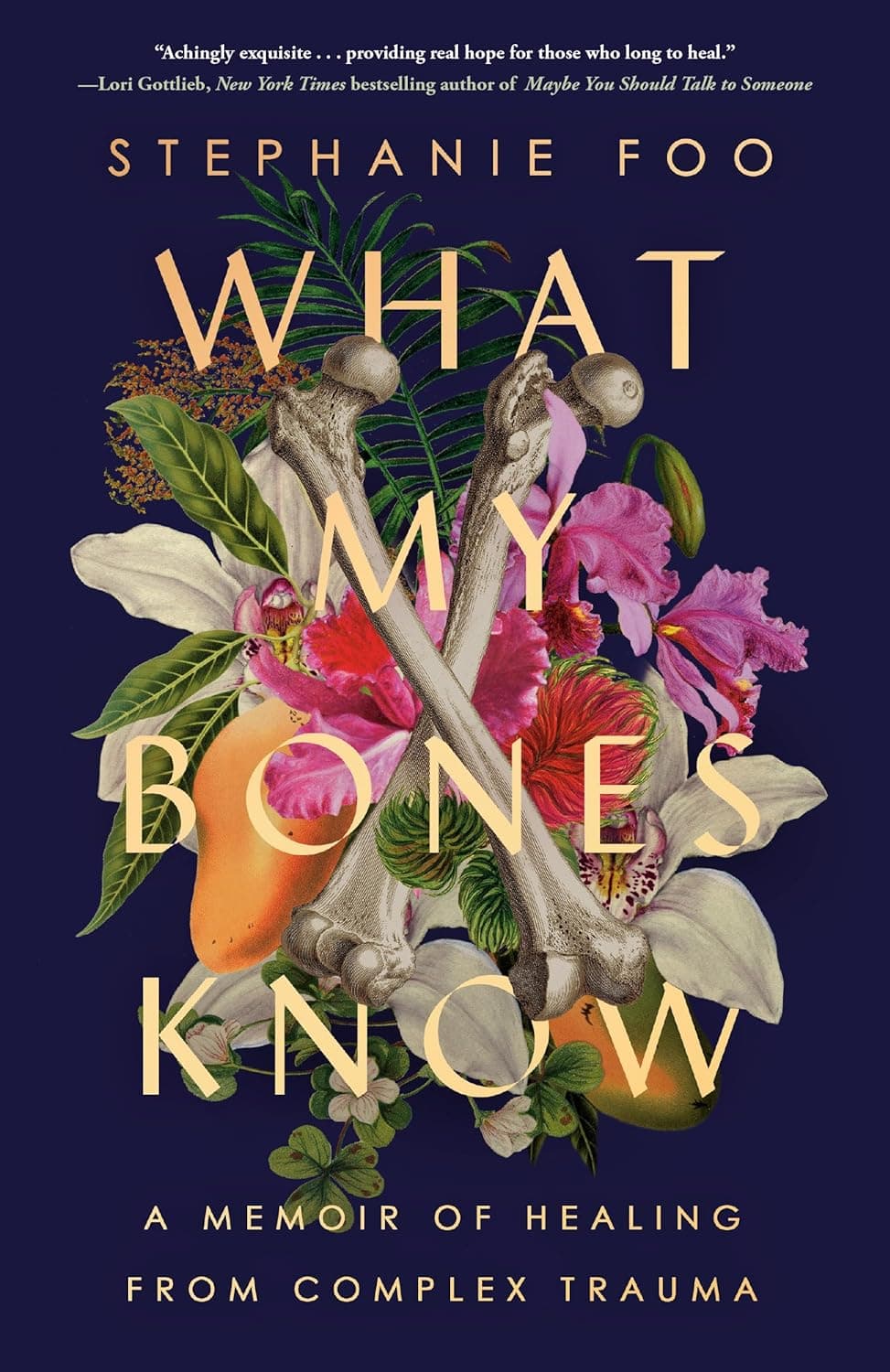
What My Bones Know — Summary
At a Glance
- Genre: Memoir; literary nonfiction with investigative journalism
- Setting: San Jose and the Bay Area; New York City; family history in Malaysia; 1990s–2020s
- Perspective: First-person, candid and analytical, from a journalist’s eye
Opening Hook
When Stephanie Foo hears the words “Complex PTSD” from her longtime therapist, Samantha, her life fractures—and clarifies. The label unlocks a past she’s spent years outrunning, even as her body keeps the score. In a voice as fierce as it is vulnerable, Foo hunts down the science of trauma while testing every path to repair. The result is a memoir that refuses tidy triumph, choosing instead a bracing honesty about survival, love, and the daily art of staying.
Plot Overview
The revelation arrives in the Prologue: after years of high-functioning anxiety and depression, Stephanie is diagnosed with Complex PTSD. The diagnosis demolishes her myth of invincibility and reframes her success as camouflage. Seeing that her relentless drive is really workaholism as a trauma response, she quits her dream job and commits to the messy, uncertain journey of healing and recovery.
To understand what she’s healing from, the narrative plunges backward. Childhood unfolds as a gauntlet of terror: a volatile, physically and emotionally abusive mother; a father who, first victimized, becomes an abuser himself. These early years establish the “disease of the self” that C‑PTSD becomes for her (Chapter 1-5 Summary). After her mother leaves, neglect and psychological warfare define adolescence. Journalism offers the first flicker of refuge and control, even as chaos at home escalates (Chapter 6-10 Summary).
As an adult, Stephanie pursues answers with a reporter’s rigor. She dives into the science of Complex Trauma and Its Lifelong Impact—ACE scores, brain and stress chemistry, the body’s alarms—which initially deepens her despair by suggesting damage etched into tissue and time (Chapter 11-15 Summary). Still, she experiments widely: EMDR, support groups, somatic practices, restorative yoga, even guided hallucinogens, cataloging what helps, what harms, and what suggests a way forward (Chapter 16-20 Summary; Chapter 21-25 Summary).
Healing also means widening the lens from the individual to the communal. Back in San Jose, Stephanie investigates intergenerational and cultural trauma in her immigrant community; she traces her family’s Malaysian history and the unspoken griefs that shaped them (Chapter 26-30 Summary). From her Auntie, she learns that people knew about the abuse but felt powerless. Naming that silence empowers her to set the clearest boundary of all: formal estrangement from her father, an act both devastating and liberating (Chapter 31-35 Summary).
A turning point arrives when she begins therapy with Dr. Jacob Ham, a relational psychoanalyst who treats the therapeutic relationship itself as a laboratory. Together, they study her triggers and habits in real time, co-authoring new ways of relating that feel safe and sustainable (Chapter 36-40 Summary). Meanwhile, her relationship with Joey models secure attachment; their wedding reframes “family” as something chosen and earned.
The memoir closes with acceptance rather than cure. Through the COVID-19 crisis, Stephanie recognizes the strange fluency her nervous system has in catastrophe—and reframes her C‑PTSD as both scar and strength. Healing becomes management, integration, and self-compassion, not erasure. The ending’s hard-won peace honors the ongoingness of survival (Chapter 41-43 Summary).
Central Characters
For more on cast and dynamics, see the full Character Overview.
-
Stephanie Foo
- A high-achieving journalist whose control and perfectionism mask profound injury. Over the memoir, she reclaims agency by learning to tend—not outrun—her nervous system.
- Key shift: from “broken” to self-accepting, using clarity and boundaries as acts of love for herself and others.
-
Samantha
- The longtime therapist who names the disorder and opens the door to treatment. Her diagnosis catalyzes the narrative.
- Function in story: truth-teller who reframes symptoms as survival adaptations.
-
Stephanie’s Mother
- The primary abuser—volatile, cruel, and likely carrying her own unprocessed trauma. Her absence after abandonment lingers as another form of violence.
- Symbolically: the origin point of fear and the boundary Stephanie cannot compromise.
-
Stephanie’s Father
- Both victim and perpetrator: a man crushed by circumstances who becomes controlling and neglectful. His refusal to change forces Stephanie to choose her own life.
- Turning point: formal estrangement, which anchors her recovery.
-
Joey
- A steady, loving partner whose family embodies safety without strings. His secure presence helps disarm Stephanie’s learned hypervigilance.
- Narrative role: proof that attachment can heal, not just harm.
-
Dr. Jacob Ham
- A therapist who makes the therapeutic frame explicit—studying misattunements, apologizing, repairing. He models new relational maps.
- Impact: enables Stephanie to feel seen without performance, shifting habit into choice.
Major Themes
For a broader map of the book’s ideas, see the Theme Overview.
-
Complex Trauma and Its Lifelong Impact
- The memoir reveals C‑PTSD as an organizing force—shaping identity, health, and worldview long after danger passes. Foo shows how the body hardwires vigilance and shame, making ordinary life feel like a battlefield. Understanding the mechanics of trauma becomes the first step toward loosening its grip.
-
The Journey of Healing and Recovery
- Healing here is iterative, experimental, and sometimes contradictory. Foo’s trials—clinical, communal, spiritual—prove there’s no single cure; progress looks like maintenance, relapse, repair, and practice. The book reframes recovery as daily work rather than a finish line.
-
Intergenerational and Cultural Trauma
- By placing her pain within family migration and communal silence, Foo shows how trauma travels: through stories told and untold, through expectations, through myths of success. The model-minority narrative hides suffering, making help-seeking seem like failure instead of courage. Naming this legacy allows her to choose what to carry forward—and what to end.
-
Identity, Self-Loathing, and Self-Acceptance
- Early on, the diagnosis confirms Stephanie’s worst fear: that she is fundamentally wrong. The arc bends toward reinterpreting symptoms as brilliant survival strategies, moving from self-contempt to care. This shift—chronicled in her move from self-loathing to self-acceptance—grounds every other change.
-
Childhood Abuse and Family Dysfunction
- Foo’s precise, unsparing account refuses minimization, showing how violence, neglect, and gaslighting pattern a life. The memoir insists on the reality of harm while also carving out the possibility of safety—through boundaries, chosen family, and ethical intimacy.
Literary Significance
What My Bones Know helped mainstream a conversation about Complex PTSD by pairing intimate memoir with journalistic depth. Foo interviews experts, decodes research, and tests treatments, creating a hybrid form that validates survivors while educating a broader public. As an Asian American narrative, it punctures the “model minority” façade to expose how silence and shame compound trauma across generations. Most crucially, the book argues for a new model of recovery—less redemption arc than long apprenticeship in care—offering rigor, warmth, and a durable kind of hope. For memorable lines that distill its spirit, see selected Quotes.