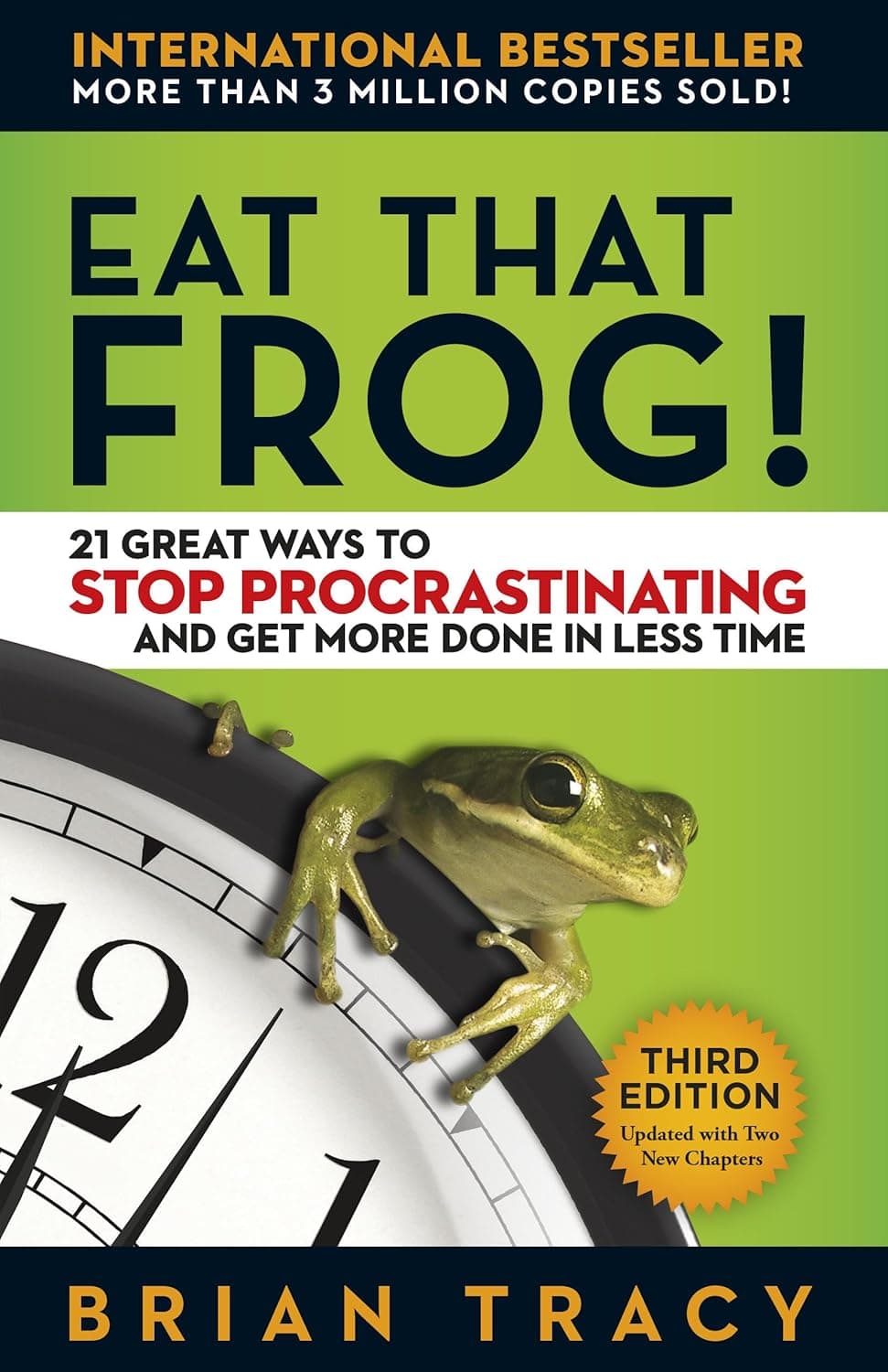
The Frog
Quick Facts
- Role: Central symbol and daily antagonist-turned-ally; the single, most consequential task on your plate
- First appearance: Introduction (defined as the “live frog” you must eat first)
- Also known as: The “A-1” task; the “biggest, ugliest frog of all” (Chapter 5)
- Key relationships: You (The Reader) as the one who must “eat” it; contrasted with “tadpoles” (small tasks); modeled by Successful People who tackle it first every day
Who They Are
At heart, The Frog is leverage embodied—the one task whose completion creates the greatest positive ripple across your work and life. It’s described with vivid, unappealing imagery—a “live” frog, and, if there are two, “the ugliest one first” (Introduction)—to capture how naturally repellent high-impact work can feel at the moment of decision. The Frog stands as the daily proving ground for the themes of Overcoming Procrastination and Taking Action and Self-Discipline and Habit Formation: the symbol you must face first to build momentum, confidence, and results.
Personality & Traits
The Frog’s “personality” comes from the kind of work it represents: large, meaningful, and initially intimidating. It resists casual attention and demands your best energy. Though it looks formidable up close, action shrinks it; once tackled, it becomes the engine of motivation for the rest of the day.
- Important: It carries “the greatest positive impact on your life and results” (Introduction); its long-term consequences outstrip every other item on your list.
- Challenging: Framed as “the biggest, hardest, and most important task” (Introduction), it requires deep focus rather than busywork.
- Daunting: Big Frogs “appear so large and formidable when you first approach them” (Chapter 18), triggering overwhelm and avoidance.
- High-value: Labeled the “A-1” task (Chapter 5), it epitomizes the 80/20 logic emphasized under Prioritization and Focus.
- Demanding: Best eaten when your “personal powers are at their peak” (Chapter 14), it asks for prime time and undivided attention, not leftovers.
Character Journey
The Frog doesn’t change—your relationship to it does. Early on, it looms as a source of dread, sitting on the list and staring back, sapping energy through postponement. As you apply the strategies taught by Brian Tracy, the Frog is reframed: you “slice and dice the task” (Chapter 18), break it into first steps, and discover that motion dissolves fear. Finishing the Frog triggers a surge of endorphins and a “positive addiction” to completion (Introduction). Over time, what began as an enemy becomes a catalyst—proof that discipline can be trained and that results compound when you start with what matters most.
Key Relationships
-
You (The Reader): This is an adversarial-turned-transformational pairing. Each morning presents a choice: face the task that scares you or feed procrastination. Eating your Frog first builds self-trust; your identity shifts from “avoider” to someone who does hard, valuable things on purpose.
-
Tadpoles: Tadpoles are the small, tempting tasks that feel productive but don’t move the needle. Tracy warns, “You should never be distracted by a tadpole when a big frog is sitting there waiting to be eaten” (Chapter 5). The contrast sharpens your discernment: urgency is not importance.
-
Successful People: They model a simple habit—Frog first, everything else second. Their consistency shows that excellence isn’t flair but routine: by normalizing discomfort at the start of the day, they free the rest of the day for execution and flow.
Defining Moments
The Frog anchors the book’s core method and is clarified through several pivotal instructions and images.
- The Introduction: The famous image—“eat a live frog” first thing—sets the tone. Why it matters: it converts abstract resolution into a concrete, daily act, promising relief and momentum once the worst is behind you.
- Chapter 5, “Practice the ABCDE Method Continually”: The Frog becomes the “A-1” task. Why it matters: it gives the metaphor teeth, embedding it in a prioritization system that prevents drift toward low-value work.
- Chapter 17, “Do the Most Difficult Task First”: The book’s climax—Frog before anything else. Why it matters: it establishes sequencing as strategy; timing your hardest task for your best energy creates compounding gains.
- Chapter 18, “Slice and Dice the Task”: Break the Frog into bites. Why it matters: it disarms overwhelm, turning the psychological barrier into a series of doable starts.
Essential Quotes
Your "frog" is your biggest, most important task, the one you are most likely to procrastinate on if you don't do something about it now. It is also the one task that can have the greatest positive impact on your life and results at the moment. (Introduction)
This defines the Frog in terms of leverage and resistance. The very task you avoid is the one that most accelerates your progress—naming that paradox is the book’s core insight.
It has also been said, "If you have to eat two frogs, eat the ugliest one first." (Introduction)
Prioritization within priorities: when multiple hard tasks compete, tackle the most critical—and most psychologically aversive—first. This prevents “productive procrastination” from disguising avoidance as work.
Here is one final observation: "If you have to eat a live frog, it doesn't pay to sit and look at it for very long." (Introduction)
Delay inflates fear. Staring at the task drains energy; beginning converts anxiety into momentum. The quote operationalizes the rule: act before rumination multiplies resistance.
This task is invariably the frog that you should eat first. (Chapter 3)
By labeling “this task” as the Frog, Tracy collapses theory into a next action. The advice eliminates ambiguity: identify the highest-impact item and commit to it before anything else.
Your A-1 task is your biggest, ugliest frog of all. (Chapter 5)
Here the metaphor meets a system. Calling the A-1 the “ugliest” directs attention to both importance and difficulty, ensuring your schedule reflects value, not comfort.