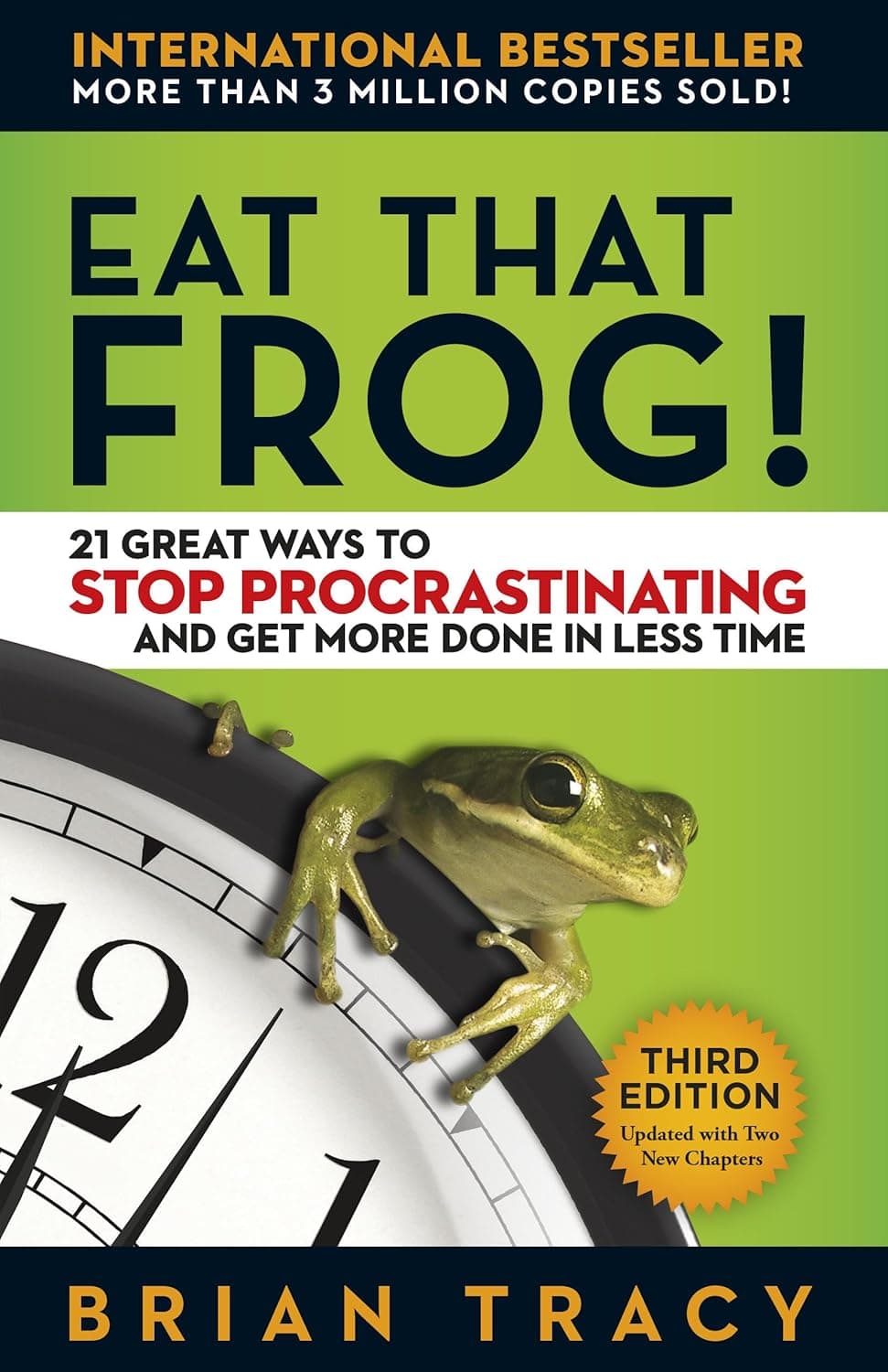
At a Glance
- Genre: Prescriptive self-help / productivity
- Setting: Modern life and the workplace in the digital age
- Perspective: A direct, second-person coaching voice guiding you through 21 principles
- Structure: Short, focused chapters that build a practical system for action
Opening Hook
Every morning, one hard, high-impact task silently decides your day. Eat it first, and everything else gets lighter; dodge it, and the day fills with busywork that moves nothing forward. Brian Tracy’s classic productivity playbook turns this stark choice into a repeatable habit, using simple tools and relentless focus to beat procrastination. The result isn’t just getting more done—it’s getting the right things done, with clarity and momentum.
Plot Overview
Act I: Facing the Problem and Naming the “Frog”
The journey opens in the Preface and introduction with a blunt truth: there will never be enough time to do everything, so success depends on picking and finishing what matters most. Tracy frames your “frog” as the biggest, most meaningful task you’re most likely to avoid. By committing to tackle it first, you clear mental resistance, create momentum, and set the tone for a productive day.
Act II: Laying the Foundation (Ch. 1–5)
In the early chapters, gathered in the Chapter 1-5 Summary, Tracy installs the fundamentals: define exactly what you want, plan each day in advance, and separate the vital few from the trivial many. Techniques like the 80/20 Rule and the ABCDE Method turn vague intentions into ranked priorities and concrete next steps. With goals clarified and a plan on paper, procrastination loses its ambiguity-powered grip.
Act III: Strategy and Momentum (Ch. 6–15)
The next phase blends big-picture strategy with personal leverage. In the Chapter 6-10 Summary, you identify your key result areas, prepare thoroughly before you start, and align tasks with your strengths to raise impact per hour. The Chapter 11-15 Summary shifts to momentum: break daunting projects into visible milestones (“one oil barrel at a time”), apply positive pressure and deadlines, and manage energy so your best hours fuel your best work.
Act IV: Advanced Tactics (Ch. 16–20)
Approaching the climax, the Chapter 16-20 Summary introduces harder-edged choices. You practice “creative procrastination,” deliberately neglecting low-value work to defend long, uninterrupted blocks for deep tasks. Systems, speed, and a bias for action help you start fast, stay focused, and finish more—without getting trapped in perfectionism.
Act V: Finish What You Start (Ch. 21–23)
The final movement, covered in the Chapter 21-23 Summary, delivers the decisive habit: single-handle your top task until it’s 100% complete. The conclusion knits all 21 methods into one daily commitment—choose your frog, begin immediately, and persist without diversion. Mastery comes not from complexity but from consistency: eat your frog first every day, and results compound.
Central Characters
Though non-fiction, the book uses vivid archetypes to dramatize your inner battle with delay. For a full list, see the Character Overview.
You (The Reader)
You begin capable yet spread thin, pulled by a “never-ending river of responsibilities.” Your arc is a shift from reactive busyness to deliberate, results-first action. By aligning goals, priorities, and habits, you learn to choose impact over activity.
Brian Tracy
Tracy is the mentor-coach: plainspoken, practical, and relentlessly focused on execution. He models learned, not innate, success—habits anyone can practice—and keeps you moving with clear tools and short, repeatable steps.
The Frog
The frog personifies resistance—the hardest, highest-value task you least want to face. Eating it first dissolves dread, unlocks momentum, and ensures your day serves your goals rather than your inbox.
Successful People
Tracy’s composite of disciplined achievers serves as a living benchmark. They act quickly on priorities, guard focus, and measure themselves by results, illustrating the payoff of the book’s methods.
Influential Thinkers
Tracy situates his advice within a broader tradition, drawing on Vilfredo Pareto for the 80/20 principle and Peter Drucker for questions of personal effectiveness. Their ideas anchor the book’s emphasis on leverage, clear priorities, and purposeful work.
Major Themes
For a thematic map of the book’s core ideas, see the Theme Overview.
Overcoming Procrastination and Taking Action
Procrastination is cast as the main barrier to achievement and peace of mind. The frog metaphor turns hesitation into a simple, daily choice—act now on the hardest task—and builds an action reflex that silences overthinking.
Prioritization and Focus
Not all tasks are equal; a few drive most results. Tools like the 80/20 Rule, ABCDE, and consequence-thinking train you to choose ruthlessly, protect attention, and concentrate on work that truly moves the needle.
Clarity, Goal Setting, and Planning
Vagueness breeds delay; clarity unlocks action. Writing goals and planning each day convert intention into direction, ensuring every hour serves a defined outcome rather than default distractions.
Self-Discipline and Habit Formation
High performance emerges from repeated behaviors, not talent alone. By practicing the 21 methods until they’re automatic, you develop persistence, start-fast habits, and the stamina to finish what matters.
Productivity and Personal Effectiveness
The book measures productivity by output of the right work in less time. That focus compounds into promotions, income, confidence, and reputation—tangible rewards for consistent, high-value execution.
Literary Significance
Eat That Frog! endures because of its radical simplicity: one vivid image, 21 compact practices, and an unshakable bias toward action. While many time-management books wade into psychology or software, Tracy strips productivity to cause and effect—clarify, prioritize, begin, and finish—making the system immediately usable. The frog metaphor has entered the language of work as a daily directive, cutting through complexity and indecision. Its short, modular chapters invite rapid application and revisiting, helping millions build practical routines. For memorable lines and mantras that reinforce these habits, see the book’s Quotes.
Historical Context
Published in 2001, the book arrived as email, 24/7 news, and the early internet accelerated the sense of “too much to do, too little time.” Against the tide of emerging apps and digital hacks, Tracy offered a tool-agnostic, pen-and-paper antidote: write goals, plan days, and protect focus. By acknowledging predecessors like Peter Drucker, Alan Lakein, and Stephen Covey, the book reframed 20th-century management wisdom for overstimulated 21st-century readers.
Critical Reception
-
Praise
- Celebrated for directness and immediate practicality—the 21 methods are short, clear, and easy to implement.
- The bite-size chapter structure makes the book highly scannable and solution-oriented.
- The central frog metaphor is widely regarded as sticky, motivating, and clarifying.
-
Criticism
- Some see the approach as overly simple, repackaging common-sense ideas without deep psychological analysis.
- Others note it synthesizes existing concepts rather than offering a new theory—though many view that curation as a strength.
Despite reservations, its longevity and steady word-of-mouth underscore its effectiveness. For individuals and teams alike, Eat That Frog! has become a foundational playbook for beating procrastination and producing results that matter.