What This Theme Explores
Prioritization and Focus asks a deceptively simple set of questions: What truly moves the needle, how do you tell the vital few from the trivial many, and how do you marshal the discipline to do the former first? In Eat That Frog!, Brian Tracy argues that success stems less from doing more and more from doing what matters most, more intensely. The theme probes how to convert clarity into action—how analytical ranking of tasks becomes single-minded execution. It also explores the courage to exclude: real focus means saying no to low-value work so the important can be done deeply and to completion.
How It Develops
The groundwork is laid in the Preface and Introduction, where Tracy frames modern overwhelm—“too much to do and too little time”—as the universal condition. Because you will never finish everything, he elevates the skill of choosing “your most important task at each moment” as the central determinant of results, repositioning productivity as selection plus concentration.
The book then equips the reader with mental models and tools in the Chapter 1-5 Summary. Clarity of goals and written lists translate intention into visible commitments; the 80/20 Principle reframes value, consequences reveal what truly matters, and the ABCDE Method forces a tangible ranking. Here, prioritization moves from vague intention to a visible, testable plan that can guide focus hour by hour.
In the Chapter 6-10 Summary, the lens tightens to context. Prioritizing Key Result Areas identifies where excellence actually produces outcomes, the Law of Forced Efficiency clarifies that time limits demand sharper tradeoffs, and leveraging special talents shows that you should prioritize where you are uniquely effective. Focus becomes not just choosing a task, but aligning selection with impact, constraints, and comparative advantage.
The Chapter 11-15 Summary advances from choosing priorities to removing what blocks them. By locating the single binding constraint, attention can be directed to the one change that unlocks many results. “One oil barrel at a time” reframes daunting projects into a sequence of immediate next steps, preserving momentum and preventing diffusion of effort.
Finally, the theme culminates in disciplined exclusion and uninterrupted execution across the Chapter 16-20 Summary and Chapter 21-23 Summary. Creative procrastination authorizes deliberate neglect of low-value work, while single-handling demands deep, continuous concentration until the highest-priority task is 100% complete. The result is a habitual, almost automatic cycle: select the right task, protect focus, finish fully.
Key Examples
-
The 80/20 Rule (Pareto Principle): Tracy shows that a small set of tasks produces most results, reframing productivity as ruthless selection rather than uniform effort. This principle exposes why busyness and value often diverge—and why prioritization must foreground consequence over convenience.
The sad fact is that most people procrastinate on the top 10 or 20 percent of items that are the most valuable and important, the "vital few." They busy themselves instead with the least important 80 percent, the "trivial many" that contribute very little to results.
-
The ABCDE Method: By labeling tasks A through E, the reader converts abstract priority into a binding sequence of action. The injunction to never do a B when an A remains forces alignment between intention and behavior, training attention to resist easy wins in favor of meaningful ones.
-
Creative Procrastination: Tracy recasts procrastination as a strategic tool—something you apply to low-value tasks on purpose. The discipline to delay or drop what doesn’t matter creates the time and energy to do what does.
You can get your time and your life under control only to the degree to which you discontinue lower value activities.
-
Single Handling: Working on one priority without interruption until completion compounds quality and speed. Tracy argues this practice can cut completion time dramatically because it eliminates the hidden costs of switching and re-starting, translating focus into tangible throughput.
Character Connections
You (The Reader) function as the book’s protagonist, beginning overwhelmed and reactive. As you adopt listing, ranking, and single-handling, your arc moves from scattered activity to intentional selection and deep work—the theme’s promised transformation in action.
Successful People embody the end state of the theme: they launch directly into major tasks and sustain attention until finished. Their behavior normalizes the countercultural choice to ignore minor tasks, illustrating how professional standards are built on disciplined focus rather than constant responsiveness.
Vilfredo Pareto supplies the intellectual backbone of prioritization, proving that unequal distributions are the norm and must inform daily choices. His principle legitimizes selective effort as rational, not ruthless. Peter Drucker sharpens this logic with his question—“What can I and only I do…?”—which ties priority to unique contribution, turning focus into a leadership act rather than mere personal preference.
Symbolic Elements
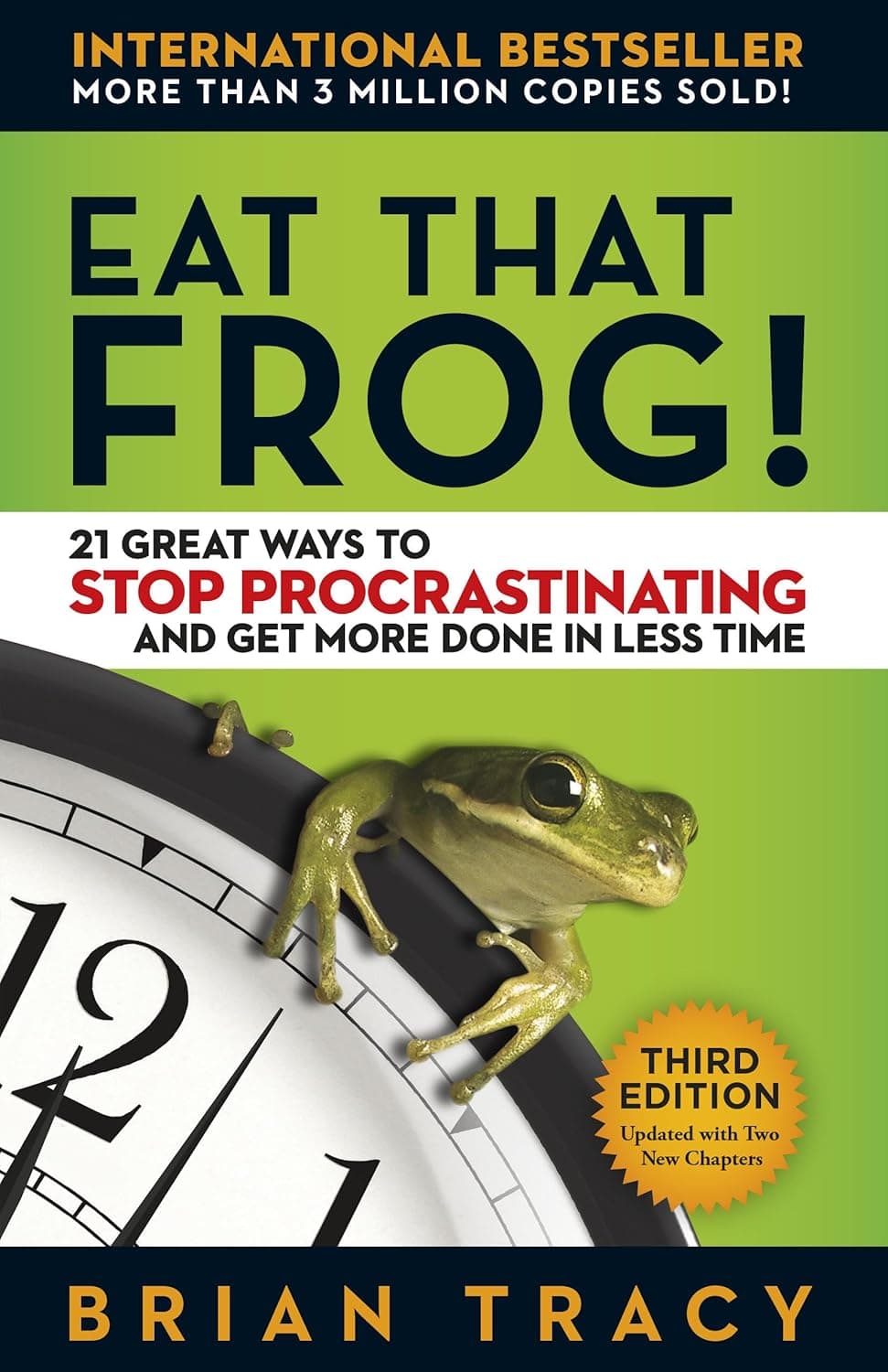
The Frog symbolizes the most consequential, emotionally aversive task—the one with leverage. “Eating” it first dramatizes the thesis that progress hinges on doing the important before the easy.
The Tadpoles stand for the swarm of low-value tasks that nibble attention without moving outcomes. Their abundance tempts activity; the theme insists they be ignored or delayed so the frog gets eaten.
Lists embody the conversion of intention into structure. Writing, ranking, and executing from a list externalize priorities, anchoring focus when willpower wavers.
The Oil Barrels from the Sahara story symbolize sequential focus: reaching the next marker rather than worrying about the whole desert. By breaking magnitude into immediate objectives, the symbol shows how sustained progress is made possible by narrowed attention.
Contemporary Relevance
In an age of infinite notifications, algorithmic feeds, and “always on” work, prioritization is no longer optional—it’s protective. The modern knowledge worker contends with systems that reward responsiveness over results, making visible lists, consequence-based ranking, and single-handling vital countermeasures. Tracy’s framework anticipates contemporary “deep work” by prescribing both selection (what to do) and shields (what to delay or decline). Mastering these habits turns attention from a liability—constantly hijacked—into an asset deployed where it matters most.
Essential Quote
“Your ability to select your most important task at each moment is the critical determinant of success.”
This line crystallizes the book’s argument that success is a function of choice, not merely effort. It reduces productivity to a repeatable act—select, then concentrate—making achievement feel both teachable and testable. By elevating selection to the decisive move, the quote reframes focus as the essential habit that all other techniques exist to support.