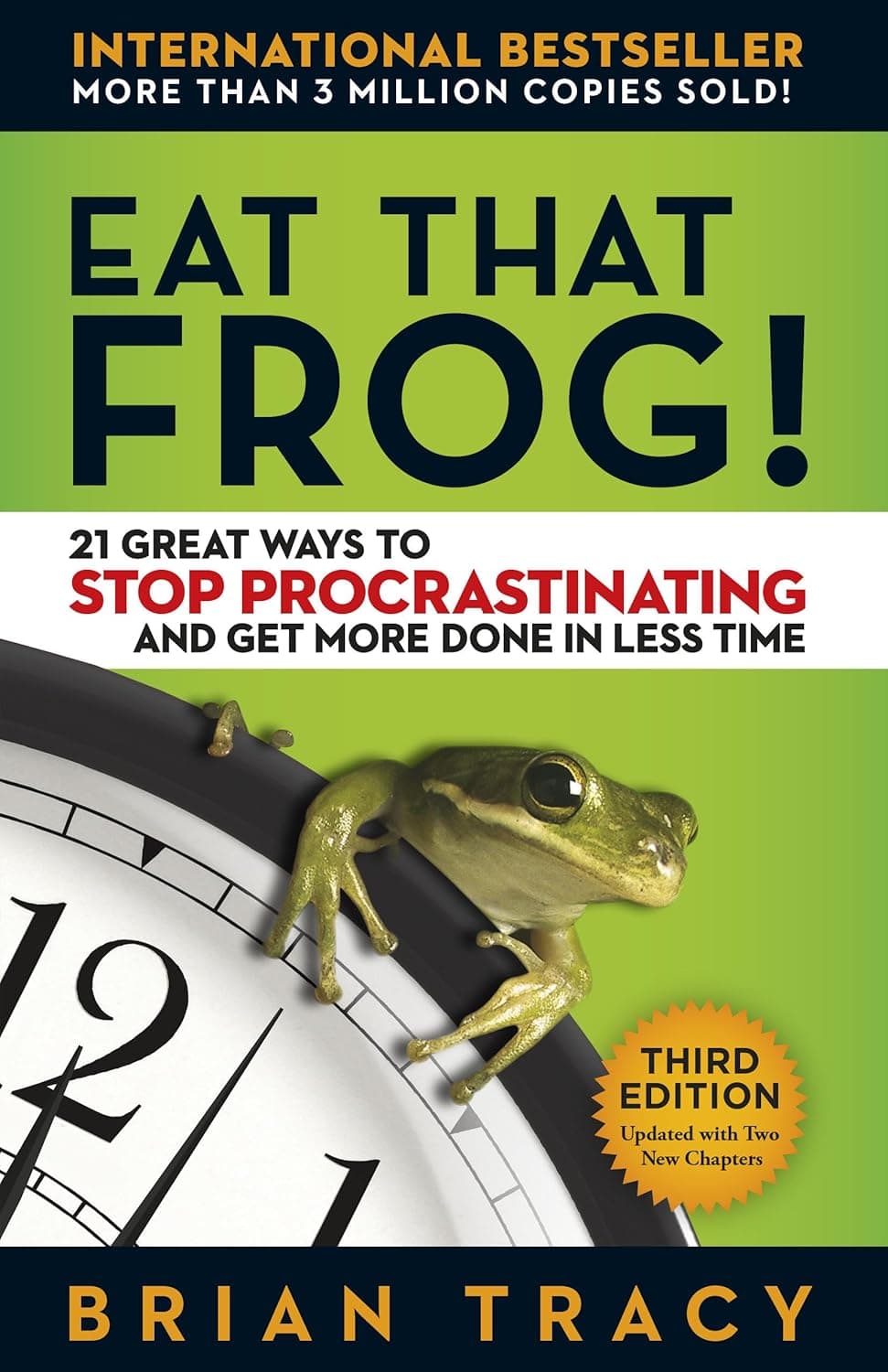
In Eat That Frog!, Brian Tracy lays out a practical, interlocking system for doing what matters most, faster. Each principle feeds the next: clarity sharpens choice, choice directs action, and disciplined action compounds into confidence and results. The book’s memorable metaphors and no-nonsense rules converge on one aim—ending procrastination by wiring your days around high‑value work.
Major Themes
Overcoming Procrastination and Taking Action
The book’s heartbeat is the mandate to act: the call to cultivate an action bias that turns intention into motion. In Overcoming Procrastination and Taking Action, Tracy argues that the difference between average and exceptional performance is the habit of tackling important tasks now—captured by the headline metaphor of “eating a live frog” as your first move of the day. Practices like “Do the Most Difficult Task First” (Chapter 17), “Develop a Sense of Urgency” (Chapter 20), and his warning that “failure to execute” cripples organizations all anchor this theme, with The Frog standing in for the big, valuable, avoidable task.
Prioritization and Focus
If action is the engine, Prioritization and Focus is the steering—choosing what to start and what to ignore. Tracy pushes rigorous filters like the 80/20 rule, tracing it to economist Vilfredo Pareto, and practical tools like the ABCDE method to sort work by consequence; he also endorses “creative procrastination” to defer low-value tasks. As Brian Tracy notes, this discipline echoes management thinker Peter Drucker: “What can I and only I do that, if done well, will make a real difference?”
Clarity, Goal Setting, and Planning
Everything begins with knowing the target. Clarity, Goal Setting, and Planning frames ambiguity as the root of delay and insists on “thinking on paper”: write goals, break them into tasks, and schedule them. The opening principles—“Set the Table” and “Plan Every Day in Advance”—anchor this foundation (see the Chapter 1-5 Summary), while the 10/90 rule argues that a little planning time saves massive execution time.
Self-Discipline and Habit Formation
Knowing what matters isn’t enough; you need the muscle to do it repeatedly. Self-Discipline and Habit Formation is the bridge from intention to action, built from Tracy’s three D’s—decision, discipline, determination—and reinforced by the “positive addiction” to the endorphins of completion. Practices like “Single Handle Every Task” (Chapter 21) demand sustained focus to 100% completion without distraction (see the Chapter 21-23 Summary).
Productivity and Personal Effectiveness
This is the synthesis: the compounding outcome of clarity, prioritization, action, and discipline. Productivity and Personal Effectiveness is not just doing more—it’s producing more value in less time, in line with the book’s subtitle, “Get More Done in Less Time.” Tracy promises these methods make you more valuable, culminating in flow—sustained, high‑quality execution described in the Chapter 16-20 Summary.
Supporting Themes
The Sense of Urgency
A cultivated quick-start tendency accelerates momentum and defeats hesitation. It intensifies Overcoming Procrastination while amplifying Prioritization by shrinking the gap between choosing and doing.
Creative Procrastination
By deliberately postponing or eliminating low-value work, you protect time for A‑level tasks. This theme operationalizes Prioritization and supports Self‑Discipline by normalizing the refusal to chase busywork.
Single Handling and Deep Work
Finishing one important task without switching preserves attention and rides the “efficiency curve” to higher output and quality. It embodies Self‑Discipline and unlocks Productivity by enabling flow.
Skill Building and Constraint Removal
Improving key skills and identifying bottlenecks raises the payoff of each hour. This preparation strengthens Clarity (know what matters to learn), sharpens Prioritization (attack constraints), and makes Action more effective.
Planning Rituals and Written Lists
Daily, weekly, and project plans convert goals into executable steps and visible progress. They are the practical toolkit of Clarity and the launchpad for Action.
Theme Interactions
Tracy designs the themes as a system in motion: clarity narrows your field of view; focus selects the few; discipline locks your attention; action creates momentum; and the resulting productivity feeds motivation to repeat the cycle. The friction of procrastination is reduced at each stage, turning sporadic effort into a sustainable operating rhythm.
- Clarity, Goal Setting, and Planning → enables → Prioritization and Focus: you can’t rank tasks until you can see them and their consequences.
- Prioritization and Focus → requires → Self-Discipline and Habit Formation: choosing the A‑1 task matters only if you start it and stick with it.
- Self-Discipline and Habit Formation → powers → Overcoming Procrastination and Taking Action: repetition builds the reflex to act on what matters.
- All of the above → culminate in → Productivity and Personal Effectiveness: the system’s compounding effect is more value in less time, consistently.
Thematic Development
Tracy sequences the 21 rules to stack capabilities. Foundation (Chapters 1–2) teaches you to “Set the Table” and “Plan Every Day in Advance,” proving that written clarity precedes meaningful effort. Strategy (Chapters 3–7) introduces consequence thinking, the 80/20 lens, and the ABCDE method to decide what truly counts (expanded in the Chapter 6-10 Summary).
Preparation (Chapters 8–11) tightens execution by upgrading skills, leveraging strengths, and removing bottlenecks so effort pays off more. Execution and Mindset (Chapters 12–21) then drill the mechanics of momentum—“Take It One Oil Barrel at a Time,” “Put the Pressure on Yourself,” “Motivate Yourself into Action,” and “Single Handle Every Task”—pushing from intention to reliable performance.
Character Embodiment
You (The Reader) personify the book’s central struggle and solution. Your arc moves from vague intention to written clarity, from scattered busyness to focused execution, as you practice daily planning, choose A‑tasks, and build the discipline to act despite discomfort.
Successful People model the destination state: they habitually define priorities, “eat” their biggest frogs early, and protect attention to finish. Their results flow less from talent than from consistent application of the system’s habits.
Brian Tracy serves as guide and proof of concept, translating management wisdom into simple routines and framing success as learnable. Peter Drucker appears as the strategic conscience—his question about unique contribution crystallizes Prioritization and keeps daily choices tethered to impact.
The Frog, as symbol, concentrates fear, discomfort, and value in a single task that—once eaten—unlocks momentum, confidence, and most of the day’s return.
Universal Messages
Success is learnable. Tracy insists that extraordinary results come from ordinary behaviors repeated: decision, discipline, determination—habits anyone can acquire with practice.
Action is the antidote to overwhelm. The quickest path out of stress and paralysis is starting the most consequential task; motion restores control, mood, and self‑respect.
The path of least resistance leads to mediocrity. Left alone, we default to easy, low‑value work; greatness requires choosing difficulty on purpose.
Personal responsibility is nonnegotiable. No one is coming—so set your own standards, apply pressure to yourself, and build systems that make the right work unavoidable.