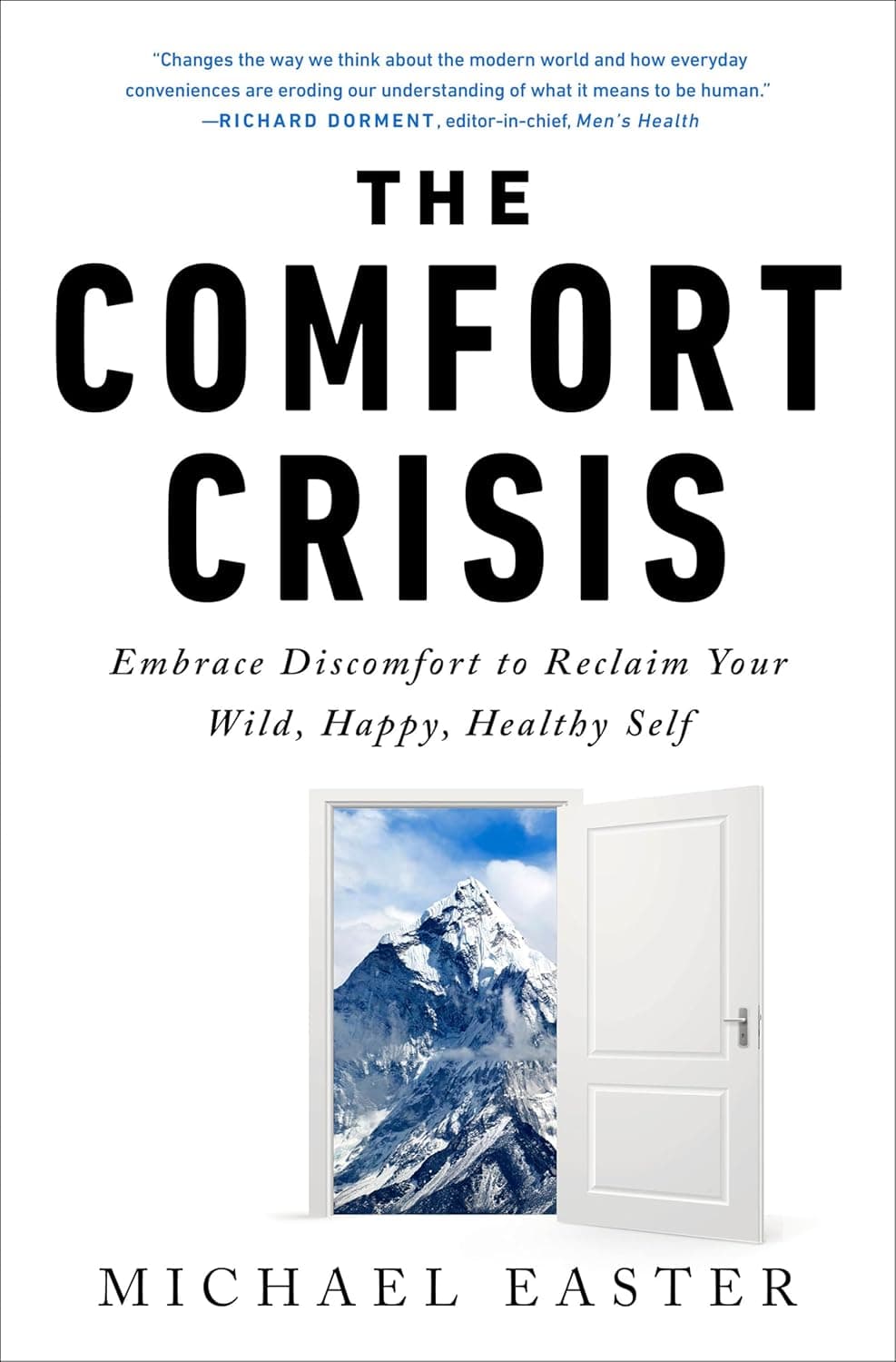
Opening
Chapters 11–15 shift from waiting and want into action and insight. As the Arctic hunt stretches on, Michael Easter discovers how boredom, nature, silence, hunger, and acceptance recalibrate the mind and body. The tundra becomes a crucible that tests modern habits and reveals the restorative power of intentional discomfort.
What Happens
Chapter 11: 11 HOURS, 6 MINUTES
Days of glassing wear on Easter, Donnie Vincent, and William. To pass the time, Easter reads gear labels, plots Christmas gifts, and drops for push-ups, until his attention loosens and widens. With no screen to fill the void, his mind drifts into story ideas and minute details: wind-shaved lichen, faint color shifts in the moss, the age of the land itself. He contrasts this unfocused state with modern media overload: an average of 11 hours and 6 minutes of daily digital intake that crushes mental idling and fuels fatigue.
Then a herd appears—anchored by a heavy, old bull. Boredom snaps to purpose. They slog three miles over spongy tussocks and ankle-grabbing hummocks. As Easter shoulders the rifle, the abstract possibility of killing becomes real, and a prickling tension settles in his chest. The ground demands total concentration; he ironically misses the idle mind he’d just resented.
Easter brings in James Danckert, who reframes boredom as a motivational state that nudges us toward more rewarding action. The brain’s default mode—the unfocused network that supports rest and creativity—needs empty space. Constant stimulation is like lifting without rest days: strain without recovery. A parable of two berry-picking cavemen makes the point—boredom pushes innovation—and anchors the Theme: The Power of Boredom and Solitude.
Chapter 12: 20 MINUTES, 5 HOURS, 3 DAYS
The stalk collapses when the wind swings, carrying their scent to the herd. Silence returns. Later, on the walk to camp, a second herd—spooked by William—pours straight at them, thundering past within 35 yards. The earth trembles; Easter feels a jolt of awe and presence, the kind of raw moment Donnie says you can only earn by being out there. The scene crystallizes Reconnection with Nature and Wildness.
Easter pivots to biophilia, forest bathing, and the “nature pyramid.” He outlines a prescription for dosage:
- 20 minutes, three times a week in nearby green spaces for “soft fascination”
- 5 hours a month in semi-wild “country nature”
- 3+ days a year in backcountry for the “three-day effect”
Neuroscience backs it: after three tech-free days, creativity can spike by 50%, and brain waves settle into calm alpha and theta rhythms. In Alaska, Easter feels that shift—attention clears, appreciation rises, stress drops. Nature functions less as scenery than as a nervous-system reset.
Chapter 13: 12 PLACES
On day six, Easter wakes to a silence so complete he hears the wingbeats of a raven and his own heartbeat. The absence feels medicinal—and rare. Human-made noise has quadrupled, and the brain treats loudness as threat, trickling stress hormones into a chronic low-grade storm. Data tie noise pollution to anxiety, depression, and cardiovascular disease.
He recounts research showing only 12 spots in the lower 48 where true, uninterrupted natural quiet lasts even 15 minutes. In Steven Orfield’s anechoic chamber—the world’s quietest room—people hear the inner workings of their bodies. The effect is recalibrating. Short of a chamber, actively seeking pockets of silence (parks, earplugs, quiet rooms) can “scrub” the brain and downshift the nervous system.
Chapter 14: -4,000 CALORIES
The hunt drags. Food runs low. They burn about 6,000 calories a day while eating roughly 2,000. Gnawing hunger colonizes their conversations—caribou steaks, pizza, and hot meals back home. Even freeze-dried lasagna tastes exquisite. The deprivation opens a window onto The Health Benefits of Hunger.
Easter counters diet confusion with the behavioral approach of Trevor Kashey. Kashey separates “real hunger” (physiology) from “reward hunger” (psychology). In a world of hyper-palatable foods, reward hunger drives overeating. His method:
- Track intake to raise awareness (the Hawthorne effect)
- Favor low energy density foods (vegetables, fruits, tubers, lean proteins)
- Allow all foods, but understand trade-offs: calorie-dense treats mean less fullness later
The point isn’t restriction; it’s agency. Learn to tolerate some hunger, avoid guilt spirals, and structure eating like long-lived traditional societies.
Chapter 15: 12 TO 16 HOURS
Cold, wet, hungry, and still unsuccessful, Easter stops fighting the misery. Remembering: “acceptance is the answer to all my problems today,” he relaxes into the discomfort and discovers ease inside it. Donnie’s gallows humor—mulling failure and entropy, then cracking a grin at the thought of Mountain House dinners—turns the bleakness on its head. Easter feels a new appetite for life, fueled by Embracing Voluntary Discomfort.
He unpacks fasting physiology. Most people eat across a ~15-hour window, muting the cyclical benefits of going without. After 12–16 hours, autophagy—“self-devouring”—kicks in, clearing damaged cells through the mTOR pathway and supporting rejuvenation. Hunger also heightens focus and energy, an adaptive edge for hunting that moderns can repurpose for productivity. Practical on-ramps: delay breakfast, create 12–16-hour fasts, schedule “hungry days,” or try a 24-hour fast. Hunger is not an emergency; it’s a maintenance state.
Character Development
Easter shifts from tolerating hardship to actively partnering with it. The tundra trains his attention, patience, and appetite for challenge; science gives him language and tools to reframe discomfort as medicine.
- Learns to value boredom as creative fuel rather than a void to plug
- Feels the three-day effect and trusts embodied calm over digital stimulation
- Confronts true, prolonged hunger and builds agency around it
- Practices acceptance, finding humor and meaning inside adversity
Donnie Vincent functions as a field philosopher. His patience, fieldcraft, and dark wit model a life attuned to wild rhythms.
- Reads the land and weather, then waits without complaint
- Frames rare encounters as earned, not owed
- Uses humor to metabolize risk, failure, and entropy into resilience
Themes & Symbols
The Power of Boredom and Solitude anchors the section. Danckert’s research explains why mental idling is not laziness but recovery and problem-solving time. The Arctic’s long pauses force Easter into default mode, where ideas bloom and attention widens. Modern over-stimulation treats the brain like a muscle worked to failure without rest.
Reconnection with Nature and Wildness moves from concept to protocol. The nature pyramid prescribes doses that stabilize attention, elevate mood, and restore creativity. The herd stampede becomes proof: awe arises when we place ourselves in nature long enough for it to act on us.
The Health Benefits of Hunger reframes appetite. Hunger, handled skillfully, becomes a lever for cellular cleanup, mental clarity, and metabolic health. Kashey’s behavioral frame replaces restriction with choice and trade-offs, building tolerance for discomfort.
Symbol: The Tundra embodies uncompromising feedback—soft, treacherous ground; knife-cold winds; profound silence. It erases distraction, amplifies signals, and demands presence, making it the perfect testbed for Easter’s thesis.
Key Quotes
“11 hours and 6 minutes.” A stark statistic that captures modern overconsumption of media. Easter uses it to argue that constant input crowds out the brain’s default mode, driving fatigue and flattening creativity.
“Junk food for your mind.” Danckert’s analogy reframes endless digital snacking as cognitive malnutrition. The line clarifies why we feel busy yet depleted: the inputs never nourish recovery.
“Hunger is the best sauce.” The Arctic deficit makes even dehydrated meals taste sublime. Easter leverages the proverb to show how appetite recalibrates reward, teaching that food pleasure is context-dependent—and manageable.
“Acceptance is the answer to all my problems today.” A sobriety maxim repurposed for the hunt. When Easter stops resisting cold, hunger, and failure, his experience shifts from misery to meaning, illustrating the psychological pivot of voluntary discomfort.
“Three-day effect.” A compact phrase for a measurable mental reset. It captures how extended, tech-free immersion shifts brain waves and cognition, connecting felt awe to lab findings.
Why This Matters and Section Significance
These chapters form the book’s operating system. They move beyond diagnosing The Crisis of Comfort to show how specific discomforts—boredom, wildness, quiet, hunger—repair what modern habits erode. The Arctic narrative and the science interlock: each day in the field becomes a live trial of lab-backed ideas, with Easter’s mindset and physiology responding in real time.
The result is a practical blueprint: protect spaces for boredom, dose nature intentionally, seek silence to recalibrate, and practice periodic hunger. Acceptance turns these from punishments into tools. Taken together, they point to a durable way of living—less numbed, more awake, and better equipped for the rest of the book’s journey.