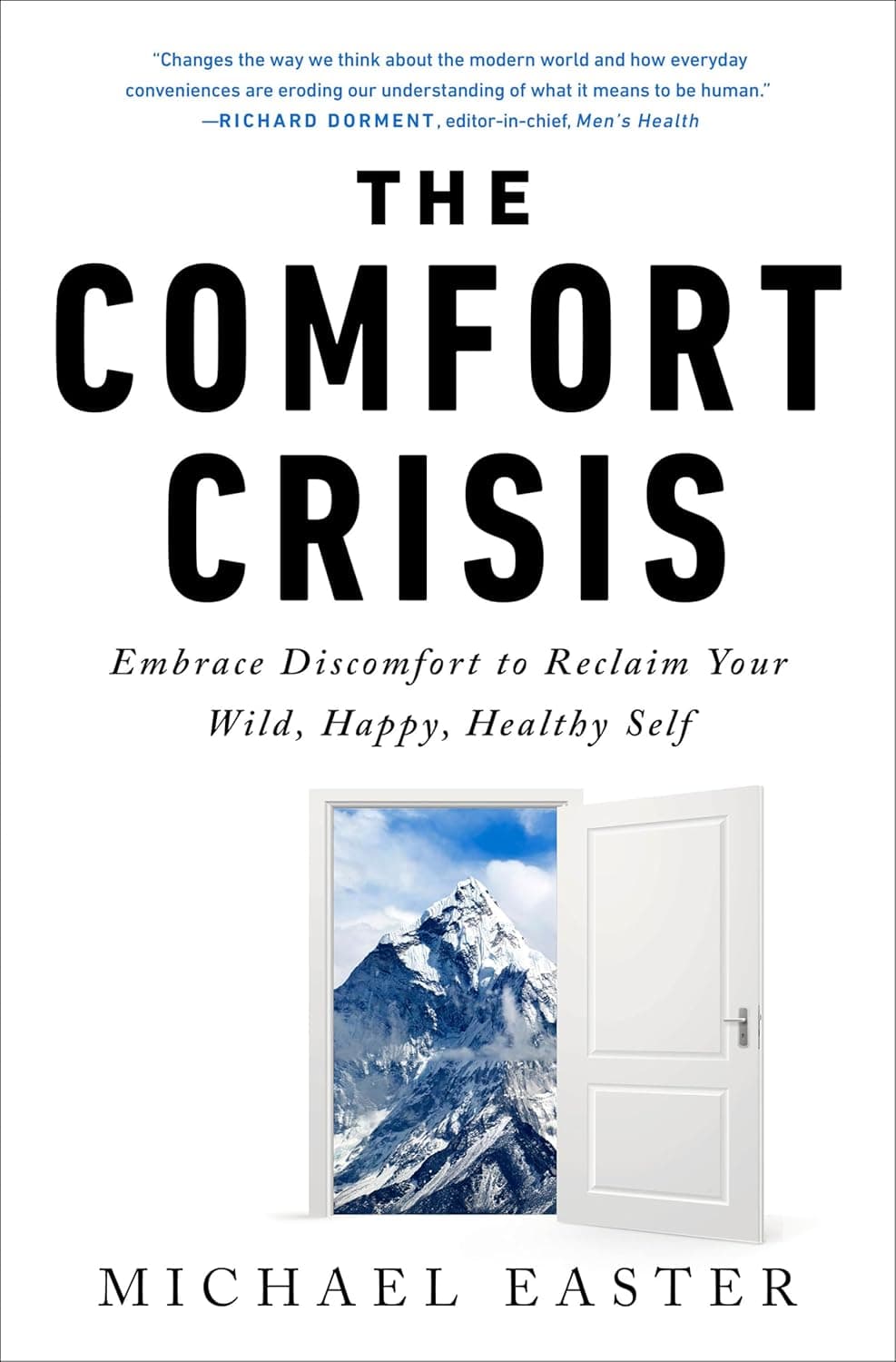
What This Theme Explores
The Power of Boredom and Solitude asks whether a life smoothed by constant stimulation actually leaves the mind undernourished. Michael Easter argues that boredom is not a void to be filled, but a signal that ushers the brain into its unfocused, restorative mode—where creativity, problem-solving, and self-reflection flourish. Solitude, especially outdoors, becomes the laboratory where that signal can be heard, free from the psychic drag of social feeds and background noise. The theme ultimately challenges modern habits that numb discomfort in favor of shallow engagement, claiming that mental resilience and meaning grow in the quiet we now avoid.
How It Develops
The book opens with Easter diagnosing his own overstimulated life: the reflexive phone checks, the hazy attention, the impulse to swat away every idle moment. His first rupture with that pattern arrives in the field with Donnie Vincent, glassing for elk for hours with nothing to do. The early discomfort—itchy, restless, a bit absurd—plants the idea that enforced stillness might be a teacher rather than a tormentor.
Part Two formalizes the inquiry. In Chapter 11, Easter quantifies his media intake and consults James Danckert, who reframes boredom as a motivational state that, if heeded rather than numbed, transitions the brain from narrow focus to the default mode network’s generative drift. The Arctic becomes a proving ground: with little to do and less to see, his mind wanders, ideas surface, and his attention widens to the textures of the tundra.
Chapter 12 deepens the theme with true solitude. When the bush plane leaves, terror loosens into freedom, and Easter links his experience to the broader “loneliness epidemic,” distinguishing isolation from the “capacity to be alone.” Research from Rachel Hopman—the “nature pyramid” and “three-day effect”—gives practical contours to that capacity, showing how time in nature reliably restores attention and mood.
In Chapter 13, auditory silence becomes its own form of solitude. Freed from mechanical hums, Easter hears his heartbeat and the whoosh of a raven’s wings, discovering that quiet is not emptiness but a fuller bandwidth for perception. By the Epilogue, the experiment has reshaped his habits: he treats his phone like a tool, not a tether, and deliberately seeks boredom—rucking in the desert—to maintain the presence and mental clarity the Arctic revealed.
Key Examples
-
The modern condition of overstimulation:
The average American each day touches his phone 2,617 times... My own habits? I typically average three daily hours... I’ll have spent seven and a half years of the rest of my life looking at my phone. Easter’s arithmetic turns attention into a stark measure of life spent. The example reframes distraction as an existential trade—years exchanged for small-screen novelty—clarifying why boredom now feels threatening rather than useful.
-
The discomfort and creativity of boredom in the Arctic: Easter passes time by reading gear labels, doing push-ups, and planning Christmas shopping—and unexpectedly generates seventeen story ideas. When he studies a single square inch of tundra, “soft fascination” draws him into rich detail. The sequence shows boredom’s arc: from agitation to free association to deep presence.
-
The science of boredom: With Danckert’s model, boredom becomes a cue, not a character flaw—an invitation to shift from narrow, task-focused attention to the default mode network’s integrative processing. Calling doomscrolling “junk food for your mind” captures how easy relief starves longer-term creativity and meaning. The science fortifies Easter’s intuition with a mechanism for why unfilled time heals.
-
The experience of true solitude:
This is the farthest away I’ve ever been from other people... The realization that I am in a state of supreme solitude is both unnerving and freeing... I’m uncomfortable but untethered. The fear-to-freedom pivot dramatizes the difference between loneliness (craving others) and solitude (anchoring in oneself). As external inputs drop, self-regulation and self-knowledge rise.
-
The power of silence: Hearing a raven’s wings as a “whoosh” that feels huge shows how noise masks not just nature but inner signal. Silence recalibrates thresholds of perception, making the world—and one’s own mind—more vivid. In that quiet, attention stops scattering and begins to root.
Character Connections
Easter’s arc embodies the theme’s wager: that the very sensations he tries to avoid—idleness, quiet, being alone—are the conditions for his best thinking and steadier mood. As he replaces reflexive scrolling with intentional boredom, his creativity and presence expand, and minor modern irritants lose their power over him.
Vincent models practiced solitude—the hunter’s patience that is never empty because observation fills it. His attunement to the subtleties of animal behavior (even the “language” of ravens) demonstrates how time spent quietly with nature trains attention to be curious rather than craving novelty.
Danckert anchors the theme in neuroscience, granting boredom moral neutrality and practical utility. His framing takes shame out of idleness and replaces it with responsibility: the quality of our response to boredom—reach for a screen or reach deeper—shapes the mind we build.
Hopman translates the theme into a prescription: a “nature pyramid” of 20 minutes daily, 5 hours weekly, and 3 days quarterly, culminating in the “three-day effect.” Her work shows that solitude and boredom are not luxuries but dosage-dependent inputs for cognitive restoration and emotional balance.
Symbolic Elements
The smartphone symbolizes frictionless escape—the chief saboteur of the mind’s restorative drift. As Easter learns to use it intentionally rather than compulsively, the device shifts from master to servant, mapping his internal pivot from avoidance to engagement.
The Arctic tundra stands for a pre-distraction world: vast, quiet, and unaccommodating. Its severity forces a mental cleanse, stripping away noise until attention relearns how to notice and the self relearns how to be alone.
Silence is the book’s purest symbol of mental clarity. More than absence, it is a medium that reveals both the fine-grained soundscape of the natural world and the contours of one’s own thought.
Contemporary Relevance
In an “always-on” culture, boredom is pathologized and solitude mislabeled as loneliness—yet burnout, anxiety, and distraction soar. This theme offers a countercultural remedy: schedule idleness, seek quiet, and dose nature to let the brain cycle into its unfocused mode. The promise is not asceticism but sufficiency: less jitter, more depth; less reactive scrolling, more reflective living. As “digital detox” trends proliferate, Easter’s blend of story and science explains why subtracting stimulation often adds back a sense of time, creativity, and control.
Essential Quote
“Boredom is neither good nor bad,” Danckert said. “How you respond to it is what can make it good or bad.”
This line reframes boredom from a problem to be solved into a threshold to be crossed. It crystallizes the book’s argument that our choices at that threshold—reach for distraction or for depth—determine whether idleness erodes us or restores us.