Opening
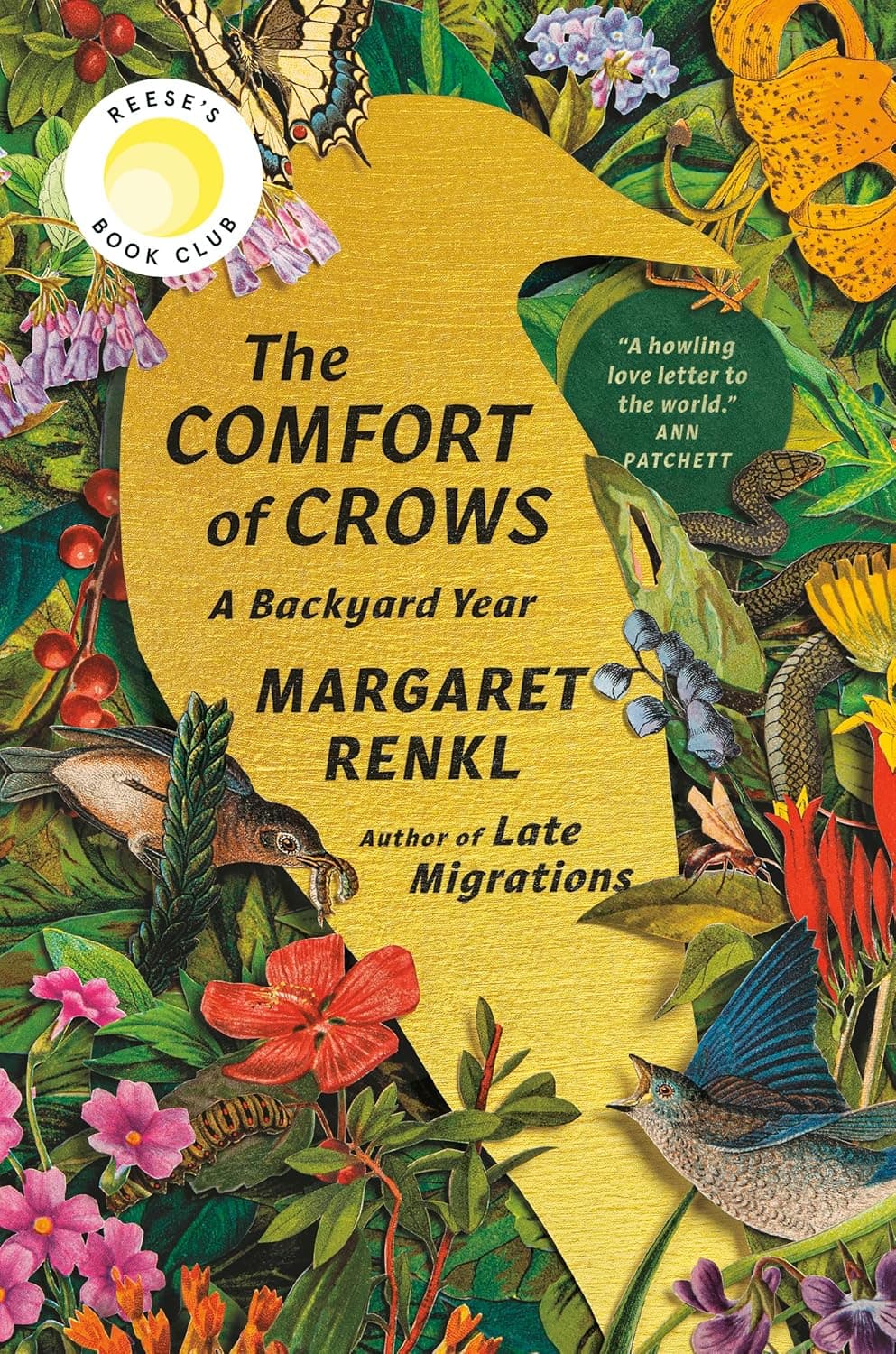
In these late-summer and early-fall chapters, Margaret Renkl balances private dread and public witness: the fear of losing her sight, the awe of animal senses, storms and wildfires, and small daily mercies. As summer fades, she turns to readiness and care—of self, of creatures, of the fragile world held together like collage.
What Happens
Chapter 56: The World Is a Collage (Summer Week 12)
On a late-night walk with Haywood and their dog Rascal, Renkl spots a large obscure bird grasshopper on the dark road and scoops it to safety. The rescue triggers a reckoning with her own eyes: amblyopia from childhood, drusen in the optic nerves that link her to a family history of macular degeneration and glaucoma, and now cataracts. The possibility of blindness rises like a tide—quieter and nearer, to her mind, than inherited cancer risk.
She contrasts human limitation with other creatures’ sensory power, a living demonstration of The Human-Nature Connection. Hawks see the twitch of a mouse, raccoons read the world with their hands, Rascal maps reality by scent. Birds detect ultraviolet light; rattlesnakes sense infrared; bats echolocate space. The world, she imagines, looks like “collage art, patched together but whole,” and her narrowing view becomes a symbol of how every species perceives only a sliver of the real—an idea folded into Aging, Family, and the Passage of Time.
Chapter 57: Praise Song for the Holes in Pawpaw Leaves
Renkl offers a brief hymn to future life. She tends young pawpaw saplings years away from fruit that will feed animals like the foxes and raccoons, yet their leaves already stand ready for zebra swallowtail caterpillars. She has not seen the butterfly in her yard, but she knows to read leaves: pokeweed holes betray giant leopard moth caterpillars. When pawpaw leaves show that same script, she vows to shout with “delight” and “rejoicing.” The poem is a promise to notice and to wait.
Chapter 58: Imagination (Summer Week 13)
After a hurricane remnant drenches Tennessee and spins off tornadoes, Renkl watches a juvenile ruby-throated hummingbird cling to its feeder and guard it in the storm. The bird trains for a migration it has never taken. She wants to make the moment a lesson in resilience—“flexible, adaptable, untraumatized by change”—then stops herself: “Nature is not a sermon.”
A news story on East Tennessee wildfires shifts her stance. A federal review finds the disaster’s scale partly rooted in a “calamitous failure of imagination” among responders who could not envision how bad conditions might become. Imagination, she realizes, is not mere projection onto animals; it is a necessary tool for empathy and foresight in crisis, and a means of honoring Grief, Hope, and Environmental Change. She returns to the hummingbird with this revised understanding.
Chapter 59: Praise Song for Fingers That Do Not Form a Fist
At the sink, an insect struggles in the basin. Renkl narrates the gentler choice: instead of washing it away, slide a hand beneath, lift, and carry it outside. The only rule is to keep the thumb from closing into a fist. An open palm becomes a sanctuary, a passageway. The gesture asks almost nothing and means everything.
Chapter 60: The Season of Making Ready (Fall Week 1)
The book tips into fall, a season Renkl says she must “work to love.” September hangs between worlds: heat lingers; Gulf storms bring cool air and danger to migrating hummingbirds and butterflies. The garden fades—zinnias still stand, dusted with mildew, shabby but generous—feeding bees, butterflies, and birds on their way. Everyone is “making ready” for the sparse months ahead, a quiet ritual in the cycle of Cycles of Life, Death, and Renewal. Even the panting crows on the power lines wait for true autumn to arrive.
Character Development
Renkl faces bodily fragility and doubles down on care. Her vision fears open into a meditation on perception; her restraint about anthropomorphism matures into a defense of imagination as ethical foresight. Small rescues become a daily creed.
- Names her diagnoses—amblyopia, drusen, cataracts—and traces them through family history.
- Reframes sensory limits as a source of humility and wonder.
- Revises a strict “Nature is not a sermon” stance to embrace imagination as duty in environmental crisis.
- Enacts compassion through micro-interventions: saving a grasshopper, ferrying a bug to safety.
- Leans into seasonal ambivalence while practicing readiness and endurance.
She also places her fears within the line of the parents and grandparents, turning inheritance into insight rather than inevitability.
Themes & Symbols
Renkl’s meditations braid inner limitation with outer abundance. The Human-Nature Connection appears not as harmony but as adjacency: humans and animals live in overlapping but distinct sensory worlds. By honoring other creatures’ perception—and by intervening gently when she can—she accepts a role of witness and protector.
Aging, Family, and the Passage of Time grounds these pages in the body. Failing eyesight becomes a symbol of human finitude; acknowledging what she cannot see enlarges what she can love. As summer yields to fall, Cycles of Life, Death, and Renewal ties garden, migration, and household together in acts of “making ready.” Within climate volatility, Grief, Hope, and Environmental Change reframes imagination as a civic and ecological instrument—necessary to foresee danger and to act.
Key symbols:
- Failing eyesight: the limit and the lens; perception as precious and partial.
- The open hand: a portable sanctuary; compassion as technique.
- The hummingbird: instinctive endurance, beyond metaphor yet instructive in its steadfastness.
- Mildewed zinnias: shabby abundance; usefulness past beauty’s peak.
Key Quotes
“Nature is not a sermon.”
Renkl polices her own impulse to turn animals into metaphors. The line affirms nature’s otherness and insists that meaning must not overwrite reality—a restraint she later complicates by reclaiming imagination as ethical foresight.
“A calamitous failure of imagination.”
This official finding reframes imagination from indulgence to necessity. The phrase indicts narrow thinking in an age of extremes and legitimizes the kind of anticipatory empathy Renkl practices.
“Collage art, patched together but whole and hopelessly, extravagantly beautiful.”
Her image of the fly’s compound eye becomes a master metaphor for perception: fragmentary yet sufficient, partial yet beautiful. It validates the book’s mosaic form—brief pieces assembling a coherent world.
“The harder path,” which is “not very hard,” and “make of your hand a sanctuary” with “safe passage to the world.”
These paired instructions translate ecological ethics into muscle memory. By keeping the hand open, she literalizes nonviolence and teaches a replicable ritual of care.
She will shout with “delight” and “rejoicing” at holes in pawpaw leaves.
Joy arrives as evidence, not spectacle. The absent butterfly is present through what it eats, and Renkl models a way of reading the world’s margins for life.
Why This Matters and Section Significance
This sequence marks a seasonal and philosophical pivot. Summer’s plentitude gives way to fall’s preparation, and Renkl’s private fear—losing her sight—deepens her inquiry into how humans know the world at all. “Imagination” serves as a cornerstone essay, defending imaginative reach as a tool for empathy, planning, and collective survival amid environmental upheaval.
The “Praise Songs” convert reflection into practice, showing how ethics live in the hand as much as in the mind. Together, these chapters argue that attention, readiness, and small rescues are not minor; they are the way we meet a changing world—piece by piece, like collage.