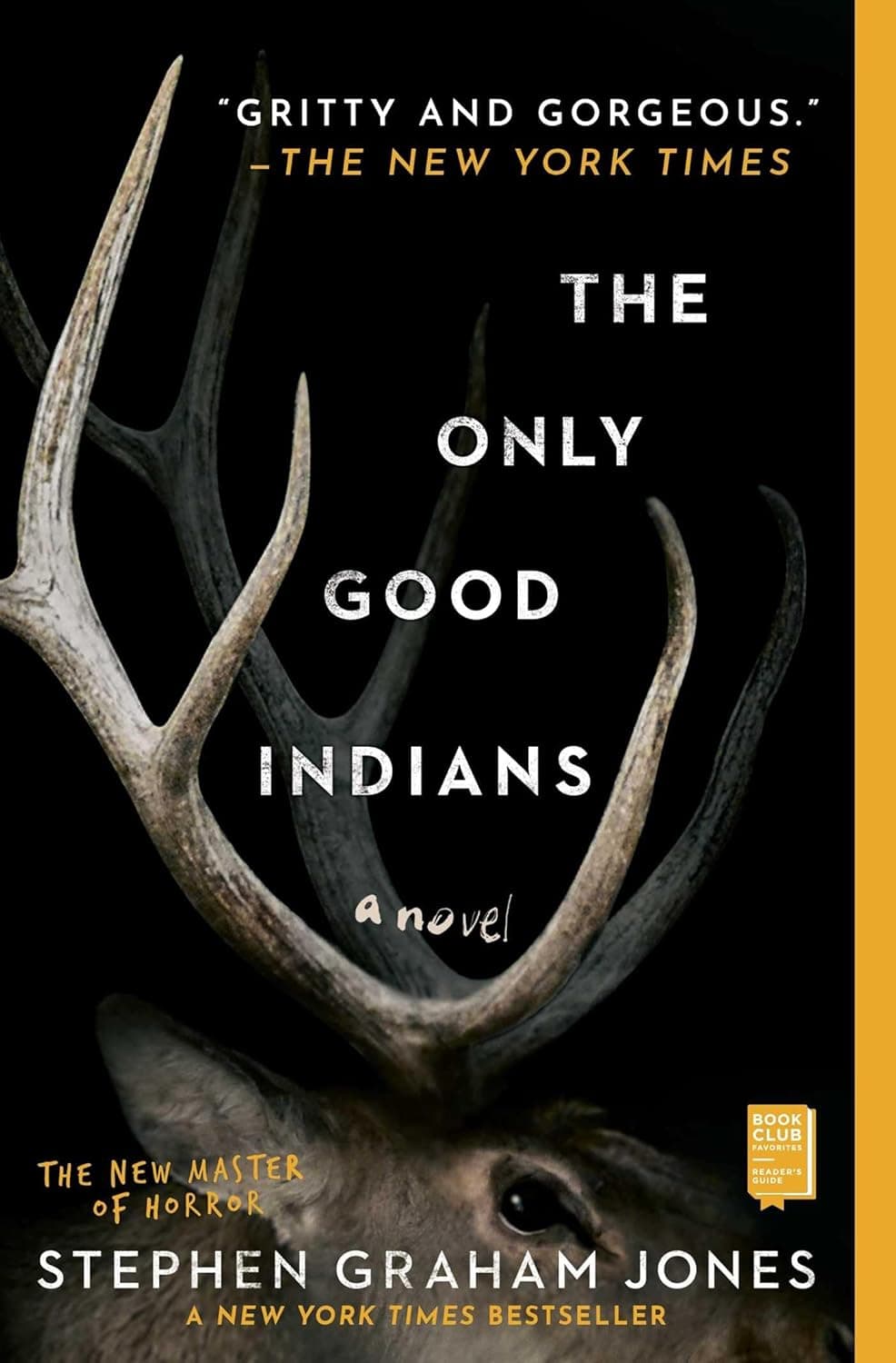
Opening
A decade-old transgression crashes into domestic life as Lewis Clarke, a Blackfeet man living off-reservation, tries to keep his assimilated world intact. A single, impossible vision—an elk on his carpet—opens the door to a haunting that fuses memory, guilt, and something older and angrier than either Guilt and Atonement or The Supernatural and the Unseen can contain.
What Happens
Chapter 1: Friday, “The House That Ran Red”
In Great Falls, Montana, Lewis lives with his white wife, Peta, proud of having dodged the reservation’s traps even as he feels exiled from his own people. While Peta’s out, he climbs a ladder to fix a high ceiling spotlight. Through the spinning fan blades below, he sees the impossible: a young cow elk lying dead on the living room carpet, snow-blood and all—the same elk he killed ten years ago on an illicit hunt.
The elk’s eye blinks. Lewis slips. He plummets toward the brick hearth until Peta, just home, rockets across the room and body-checks him into the wall, bruising him but saving his life. As dust sifts down like ash and the spotlight flickers to life, Lewis knows this isn’t just nerves or a trick of light. His past has stepped into the room, and it isn’t done with him. From the first pages, the novel roots itself in Guilt and Atonement and The Supernatural and the Unseen: a crime demands a reckoning, and that reckoning already has a body.
Chapter 2: Saturday
Rattled, Lewis phones his old hunting buddies on the reservation—Cassidy Sees Elk and Gabriel Cross Guns—and learns their fourth, Richard Boss Ribs, is dead. As Lewis talks, his long-flattened accent slides back into its reservation cadence, exposing the strain of Cultural Identity and Assimilation. He asks, carefully, whether they ever think about “those elk.” Cass dodges, jokes, then seethes about Denny Pease, the game warden who caught them, his anger curdling into Revenge and Retribution.
Gabe brags about his basketball-star daughter, Denorah Cross Guns, and laughs off Lewis’s worry: elk don’t hold grudges. The calls confirm the hunt was illegal—on elder land—and that the fallout cracked their bond, setting up a bitter pattern of Friendship and Betrayal. At work, Lewis trains a young Crow woman, Shaney Holds. When she asks about his jittery phone calls, he lies—“an electrician”—because “elk ghosts” is a truth he can’t voice.
Chapter 3: Monday
The haunting spills into the physical world. Lewis’s dog Harley keeps clearing their six-foot fence, and Lewis suspects he isn’t trying to get out but to get away—from something in the yard that doesn’t belong. To prove the dog’s new “trick,” Lewis invites biker coworkers over; Shaney hops on the back of his motorcycle and comes too. They arrive to horror: Harley dangling by his chain after another desperate jump.
As the men rush him, Harley’s leg jerks—a gruesome echo of the elk’s blinking eye. A freight train screams by, rattling the neighborhood. In a panic-spasm, Harley lunges and tears open Silas’s cheek with his teeth. A mundane afternoon detonates into blood and sirens, and the curse widens its circle, pulling bystanders into a mounting Cycle of Violence.
Chapter 4: Tuesday
With Silas hospitalized and Harley barely alive in the garage, Lewis barricades himself in the living room and tries to solve the supernatural with tape and logic. He outlines the elk’s body on the carpet, determined to prove it couldn’t have fit there. Peta, patient but baffled, helps—until Lewis carries out the elk’s frozen hide he’s kept for a decade and lays it inside the taped silhouette. His thoughts snag on the children he and Peta never have, a choice that suddenly feels like a failure of lineage and a wound tied to Parenthood, Legacy, and Intergenerational Trauma.
He climbs the ladder, recreates every detail of the fall, stares through the fan—nothing. He looks away and sees it instead on the wall: a woman’s shadow with a head too long, too heavy, unmistakably not human. It turns toward him. The haunting has a face and a purpose: Elk Head Woman is here, and she hunts.
Chapter 5: Wednesday
At dawn, Shaney shows up in Lewis’s driveway, shooting hoops, her presence a mix of flirtation and recognition. She calls Harley an “old warrior” and, when she lifts her shirt to show a long, ragged scar, shares a wordless pact of pain. Inside, she stops at the elk hide on the table and the tape body on the floor, reading them instantly as sacred, not crazy. She picks up the tape and draws a single line from the elk’s mouth to its chest: the heart line, the breath line.
That one gesture names what’s happening. Where Peta can only comfort, Shaney can interpret. Because she understands, Lewis finally speaks. He begins the confession he’s avoided for ten years: the full story of the hunt and why it won’t stay buried.
Character Development
The opening arc locks characters into collision courses—between cultures, loyalties, and the living and the dead.
- Lewis Clarke: A man caught between worlds. He prides himself on stability yet carries a hidden offense that leaks into his present. He shifts from denial (fixing the light, rationalizing with a tape outline) to acknowledgment (seeing the shadow, beginning his confession), driven by fear and a need to be believed.
- Peta: Fiercely protective and loving—she literally saves Lewis mid-fall and nurses Harley—yet ultimately outside the cultural frame that gives his terror meaning, revealing a limit to what love can translate.
- Shaney Holds: Introduced as a playful coworker with grit and scars of her own. She becomes a cultural interlocutor whose instinctive respect for the elk hide and her addition of the heart line break Lewis’s isolation and catalyze his confession.
- Elk Head Woman: Emerges in stages—memory, blink, shadow—until she stands as a deliberate, targeted avenger whose presence reframes the “elk” as a grieving mother and a wrong that demands repayment.
Themes & Symbols
The story roots its horror in personal culpability and communal law. The haunting isn’t random; it answers a broken promise with ritual precision. As Lewis tries to “measure” the impossible—lighting fixes, tape outlines, freezer trophies—the book insists that the crime’s meaning lives in a shared spiritual grammar, not in rational proofs. Assimilation buys comfort but not absolution, and it estranges Lewis from the very language that could help him survive.
Symbols do the heavy lifting. The ceiling fan becomes a lens that slices the present to expose a bloodstained past, while the elk hide is guilt made flesh—preserved, transported, and unavoidable. The tape outline starts as control and becomes ceremony when Shaney adds the heart line, shifting the scene from a domestic crisis to a communal and spiritual reckoning.
Key Quotes
“Those elk.”
- A small, loaded phrase that collapses a decade of silence into two words. It shows how the men’s bond, and the harm they did, can only be approached sideways, through euphemism and shared memory.
“The four butchers of Duck Lake.”
- Gabe’s joke masks liability as legend. The bravado is a defense mechanism, rebranding a violation of elder land as a dark in-joke to keep fear—and responsibility—at bay.
“Old warrior.”
- Shaney’s name for Harley reframes his death throes as a fight, not an accident. She reads meaning where others see chaos, signaling her role as interpreter of suffering and sign.
“Cultural dance card.”
- Lewis’s imagined headline language turns stereotype into a grim checklist he’s dodged. It captures how he experiences assimilation as both accomplishment and estrangement.
The “heart line” or “breath line.”
- By adding this to the tape elk, Shaney converts Lewis’s denial ritual into a spiritual diagram. Life force, breath, and accountability enter the room—now the outline speaks.
Why This Matters and Section Significance
These chapters set the novel’s engine: a single bad hunt—illegal, disrespectful, unatoned—spawns a precision haunting that refuses to be rationalized away. They map the targets of that revenge (Lewis and the other hunters), establish the limits of assimilation through Peta, and introduce Shaney as the necessary bridge back to meaning. The tone locks into slow-burn dread, where everyday objects—fans, tape, freezer-burned hide—become thresholds.
Most importantly, this section ties private guilt to communal law. The haunting isn’t just about Lewis’s conscience; it is about a breach that ripples through friends, family, and bystanders, promising that the cost of the past will be paid—one life, one confession, one reckoning at a time.