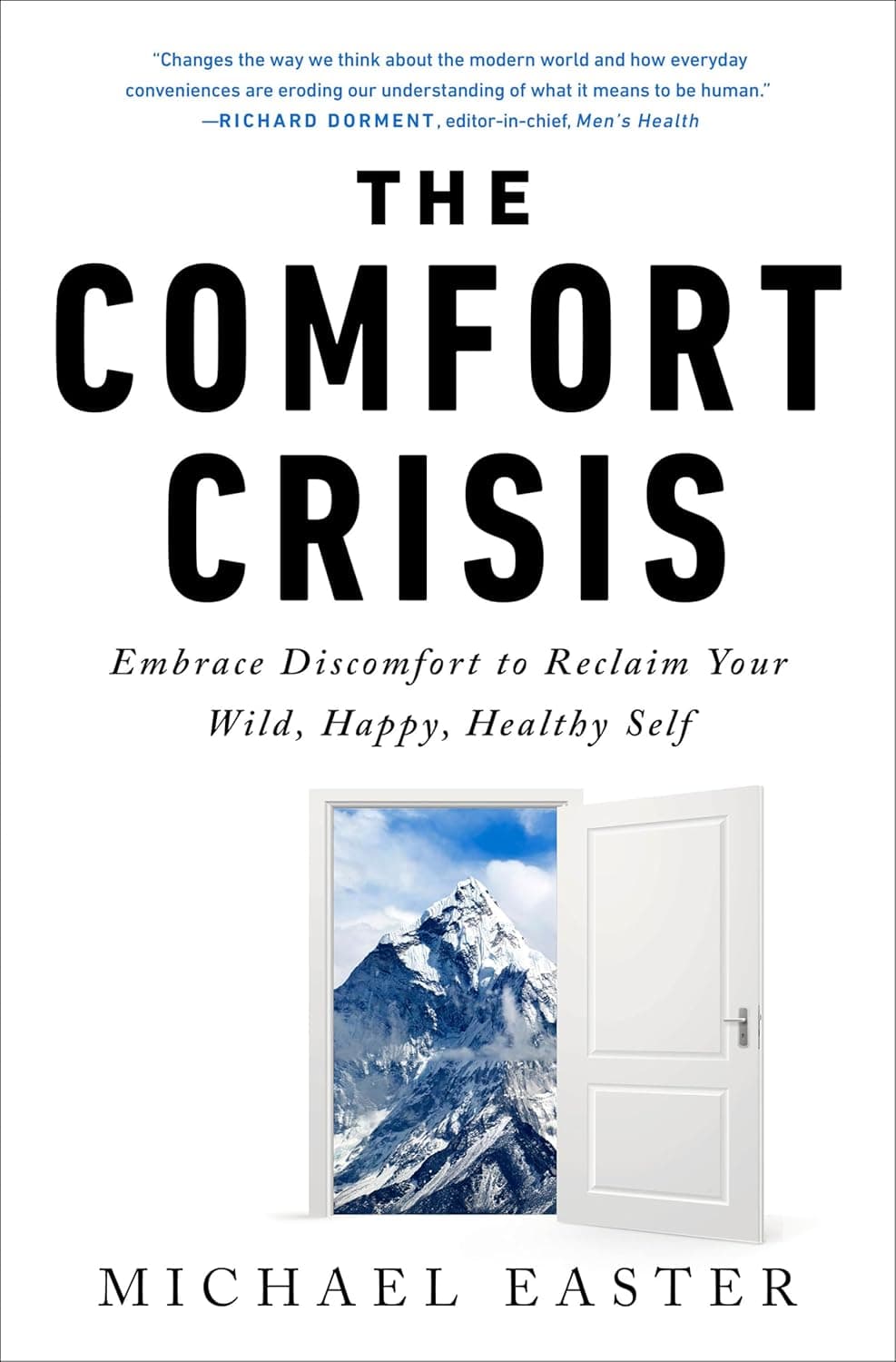
Most Important Quotes
The Definition of the Comfort Crisis
"Most people today rarely step outside their comfort zones. We are living progressively sheltered, sterile, temperature-controlled, overfed, underchallenged, safety-netted lives. And it’s limiting the degree to which we experience our 'one wild and precious life,' as poet Mary Oliver put it."
Speaker: Michael Easter (Narrator) | Context: Opening chapter (Chapter 1: 33 Days), as Easter stands on an Alaskan tarmac before a 33-day backcountry hunt that anchors the narrative.
Analysis: This line functions as the book’s thesis, naming the core problem of The Crisis of Comfort. Easter’s cascading list—“sheltered, sterile, temperature-controlled, overfed, underchallenged”—is a rhetorical catalog that vividly contrasts modern ease with a more rugged human past. Invoking Mary Oliver’s “one wild and precious life” sharpens the tension between safety and vitality, suggesting comfort can smother meaning. It frames the hunt—and the book—as a test case for how embracing voluntary discomfort might restore depth, purpose, and presence.
The Misogi Philosophy
"In misogi we’re using the artificial, contrived concept of going out and doing a hard task to mimic these challenges that humans used to face all the time. These challenges that our environment used to naturally show us that we’re so removed from now. Then when we return to the Wild West of our everyday lives we are better for it. We have the right tools for the job."
Speaker: Dr. Marcus Elliott | Context: Chapter 6: 50/50, during a punishing Santa Barbara hike where Elliott outlines modern misogi.
Analysis: Elliott reframes extreme challenge as a deliberate, constructive simulation of ancestral trials, not adrenaline-chasing. His “Wild West” metaphor flips expectations: ordinary life is the chaotic frontier, and misogi is training that arms us with “the right tools.” The contrast between “artificial” and “natural” underscores how far our environment has drifted from conditions that once forged resilience. As the book’s practical antidote to the comfort crisis, misogi becomes both a philosophy and a field lab for transforming stress into strength.
The Mechanism of Comfort Creep
"When a new comfort is introduced, we adapt to it and our old comforts become unacceptable. Today’s comfort is tomorrow’s discomfort. This leads to a new level of what’s considered comfortable."
Speaker: David Levari | Context: Chapter 4: 800 Faces, where Harvard psychologist David Levari explains “prevalence-induced concept change,” applied here to comfort.
Analysis: Levari identifies the self-accelerating loop at the heart of The Crisis of Comfort: improvement begets intolerance. The aphoristic “Today’s comfort is tomorrow’s discomfort” captures the hedonic treadmill in a line, exposing why relief slides so quickly into entitlement. As our baseline rises, our tolerance shrinks, and even minor friction feels unacceptable. This mechanism explains why more convenience can produce less satisfaction—and why deliberately reintroducing difficulty can reset perception.
The Power of Confronting Mortality
"When you start to understand that death is coming, that the cliff is coming, you see things differently. You change your mental course—you naturally become more compassionate and mindful."
Speaker: Khenpo Phuntsho Tashi | Context: Chapter 17: 12/31, 11:59:33 p.m., in Bhutan, discussing death contemplation as a practice for fuller living.
Analysis: The khenpo’s “cliff” metaphor renders mortality immediate and concrete, turning an abstract inevitability into a guiding force. Rather than morbid, the frame is liberating: awareness of time’s edge clarifies values and softens the ego, prompting compassion and presence. As a pillar of Confronting Mortality for a Fuller Life, it parallels the book’s physical hardships with a spiritual discomfort that also refines us. The quote broadens the thesis beyond muscles and miles to include the mind’s orientation toward finitude.
Thematic Quotes
The Crisis of Comfort
A Radically New Normal
"Constant comfort is a radically new thing for us humans."
Speaker: Michael Easter (Narrator) | Context: Chapter 3: 0.004 Percent, summarizing human evolution versus the last century of ease.
Analysis: With clinical simplicity, this line zooms out to evolutionary timescales to show how abnormal our lifestyles are. The statistic that modern comfort occupies a mere sliver of human history reframes convenience as an environmental mismatch rather than progress’s inevitable end point. The claim undergirds the book’s argument that bodies and minds calibrated for scarcity and strain struggle in abundance. Its force lies in how it shifts blame from individuals to context—and suggests changing conditions can change outcomes.
Hollow Problems
"As we experience fewer problems, we don’t become more satisfied. We just lower our threshold for what we consider a problem. We end up with the same number of troubles. Except our new problems are progressively more hollow."
Speaker: Michael Easter (Narrator) | Context: Chapter 4: 800 Faces, distilling David Levari’s research on “problem creep.”
Analysis: Easter diagnoses a paradox of progress: solving problems can thin them, not remove them. The word “hollow” is pointed, implying that modern irritants lack the existential weight that once organized human effort. The passage explains why comfort can breed anxiety—attention seeks friction, and without meaningful friction, it latches onto trivia. It’s a call to reintroduce substance by choosing better challenges rather than chasing total ease.
Embracing Voluntary Discomfort
Switch On the Ancestral Machinery
"I believe people have innate evolutionary machinery that gets triggered when they go out and do really fucking hard things. When they explore those edges of their comfort zone."
Speaker: Dr. Marcus Elliott | Context: Chapter 6: 50/50, outlining the biological logic of misogi.
Analysis: Elliott casts hardship as a stimulus that activates dormant systems designed for survival and growth. The phrase “evolutionary machinery” fuses science and metaphor, suggesting a mechanism waiting for a key. His plainspoken intensity (“really fucking hard”) strips away performative toughness, emphasizing honest difficulty over spectacle. The claim binds ancient pressures to modern potential, arguing we can reclaim vitality by courting demanding thresholds.
The Two-Rule Blueprint
"In our model of misogi, there are only two rules... Rule number one is that it has to be really fucking hard. Rule number two is that you can’t die."
Speaker: Dr. Marcus Elliott | Context: Chapter 6: 50/50, presenting the misogi guidelines.
Analysis: The stark rules compress a philosophy into a checklist: maximal challenge bounded by non-negotiable safety. The implied 50/50 success odds make failure an intentional possibility, redefining it as data, not defeat. The blunt diction functions like a mantra—memorable, portable, and disarming. This clarity turns an abstract ideal into a practice anyone can attempt, scaling the book’s ethos from narrative to everyday life.
Reconnection with Nature and Wildness
Put Yourself Where Awe Can Find You
"If you want to have amazing experiences, you have to put yourself in amazing places."
Speaker: Donnie Vincent | Context: Chapter 5: 20 Yards, during a Nevada hunt as Vincent explains his devotion to remote landscapes.
Analysis: Vincent’s line is both maxim and map: experience is not random luck but the predictable yield of place. The alliteration (“amazing…amazing”) and parallel structure lend it proverb-like cadence, easy to remember and hard to ignore. It rebukes passive, screen-mediated living by insisting that environment engineers attention, awe, and meaning. As a blueprint for the book’s wilderness arc, it makes geography a lever for transformation.
Nature as Human Nutrient
"Nature holds the key to our aesthetic, intellectual, cognitive, and even spiritual satisfaction."
Speaker: E. O. Wilson (quoted by the Narrator) | Context: Chapter 12: 20 Minutes, 5 Hours, 3 Days, during a discussion of biophilia.
Analysis: Wilson’s sweeping list elevates nature from leisure backdrop to essential input. By spanning “aesthetic” to “spiritual,” the line suggests a full-spectrum deficiency when we’re cut off from the wild. Its authority anchors anecdotes—like the “three-day effect”—in a broader scientific frame. The implication is nutritional: if nature feeds multiple faculties, deprivation predictably dulls them.
The Power of Boredom and Solitude
Junk Food for the Mind
"The way we now deal with [boredom] is ‘like junk food for your mind.’"
Speaker: James Danckert | Context: Chapter 11: 11 Hours, 6 Minutes, as Danckert critiques digital quick fixes.
Analysis: The metaphor is intuitive and indicting: cheap stimuli sate the urge to do something without nourishing creativity or rest. By comparing scrolling to empty calories, Danckert reframes boredom as a hunger cue for richer mental work. The analogy also explains the crash—why constant micro-stimulation leaves us mentally listless. It invites a rebrand of boredom from defect to doorway.
The Skill of Being Alone
"Building ‘the capacity to be alone’ may be just as important for you as forging good relationships."
Speaker: Matthew Bowker (quoted by the Narrator) | Context: Chapter 10: 101 Miles, reflecting on an Arctic stretch of total aloneness.
Analysis: Bowker balances a cultural emphasis on connection with a neglected complement: solitude competence. Calling it a “capacity” makes aloneness trainable, not a personality trait or punishment. The line hints at reciprocity—self-sufficiency deepens togetherness—by reducing neediness and clarifying identity. In a hyperconnected world, it’s a countercultural prescription for sturdier inner scaffolding.
Character-Defining Quotes
Michael Easter
The Experimenter’s Question
"What could cleansing myself of all these other comforts do for me?"
Speaker: Michael Easter | Context: Chapter 2: 35, 55, Or 75, after sobriety prompts a broader audit of comfort.
Analysis: This question is the engine of the narrative, converting a personal recovery into a general hypothesis. It reveals Easter’s shift from crisis management to curiosity-driven experimentation, with himself as subject. The phrasing “all these other comforts” spotlights the subtlety of the target—not vices, but normalized ease. It sets his arc from skeptic to practitioner and frames the book as inquiry, not sermon.
Donnie Vincent
Closer to the Original Form
"I’m a hunter. When you peel back all the layers, I think humans basically evolved from single-celled organisms, into apes, into humans. We are animals. And we are fundamentally hunting and gathering animals... I think I’m just closer to our original form compared to most people."
Speaker: Donnie Vincent | Context: Chapter 5: 20 Yards, articulating a philosophy of hunting rooted in evolution.
Analysis: Vincent’s self-definition situates identity in deep time, treating hunting as continuity, not hobby. The layered imagery—“peel back all the layers”—suggests stripping away cultural varnish to reveal biological truth. Claiming closeness to the “original form” positions him as a guide to instincts modernity muffles. As a living argument for wildness, he personifies the book’s appeal to embodied, ancestral modes.
Dr. Marcus Elliott
The Big Circle of Potential
"Let’s say your potential is this big circle... Well, most of us live in this small space right here. We have no idea what exists on the edges of our potential. And by not having any idea what it’s like out on the edge…man, we really miss something vital."
Speaker: Dr. Marcus Elliott | Context: Chapter 6: 50/50, using a visual metaphor to argue for limit-testing.
Analysis: Elliott’s diagrammatic metaphor translates an abstract idea—untapped potential—into a picture anyone can “see.” The contrast between big circle and small space dramatizes self-constriction, making comfort feel like a literal shrunken life. Calling the edge “vital” elevates exploration from optional optimization to existential necessity. It encapsulates his role as scientist-philosopher: data-informed, meaning-seeking.
Trevor Kashey
The Why Behind the Bite
"I would much rather address the question ‘Why are you eating?’ versus ‘Eat this food at this time.’"
Speaker: Trevor Kashey | Context: Chapter 14: -4,000 Calories, outlining a behavior-first approach to nutrition.
Analysis: Kashey rejects prescriptive rigidity for causal clarity, shifting focus from menu to motive. The juxtaposition of “why” versus “what/when” exposes how diets ignore drivers like stress and boredom—the very comforts the book interrogates. His stance is both scientific and humane, promising durability by addressing root cause. It reframes eating as a psychological pattern to be understood before it’s engineered.
Memorable Lines
The Cycle of Comfort
"Today’s comfort is tomorrow’s discomfort."
Speaker: David Levari (paraphrased by the Narrator) | Context: Chapter 4: 800 Faces, summarizing comfort creep.
Analysis: This paradox-in-a-sentence distills hedonic adaptation into a memorable warning. Its chiasmus-like reversal gives it mnemonic snap, suitable as a mental guardrail. The irony bites: seeking relief now can heighten sensitivity later, compounding unease. As a mantra, it encourages deliberate friction to keep thresholds healthy.
The Sound of Silence
"We have in fact become so used to living with noise that most of us now find comfort in constant blare."
Speaker: Michael Easter (Narrator) | Context: Chapter 12: 20 Minutes, 5 Hours, 3 Days, on the modern aversion to quiet.
Analysis: The oxymoron “comfort in constant blare” captures a sensory inversion—silence, once baseline, now feels threatening. The line widens the comfort critique from temperature and food to stimulus level, indicting our dependence on perpetual input. Its observation helps explain why quiet feels like withdrawal and why rediscovering it can be medicinal. It suggests that learning to inhabit silence is part of repairing the comfort imbalance.
Opening and Closing Lines
Opening Line
"I’M STANDING ON a windy tarmac in Kotzebue, Alaska, a 3,000-person village 20 miles above the Arctic Circle on the Chukchi Sea."
Context: Chapter 1: 33 Days, plunging the reader into the harsh setting that will test the book’s ideas.
Analysis: Dropping us in media res onto a frozen threshold, the line announces a departure from climate control to climatic reality. The precise geography grounds the abstract thesis in concrete stakes and weather. It signals that the argument will be lived, not merely asserted. As a frame, it primes the reader for exposure—literal, psychological, and thematic.
Closing Line
"I’m already planning the next misogi."
Context: Epilogue: 81.2 Years, after reflecting on the hunt’s lessons and longevity math.
Analysis: The ending turns a story into a cycle, transforming insight into ongoing practice. Planning “the next” misogi implies the antidote to the comfort crisis isn’t a one-off feat but a habit of chosen difficulty. It affirms that the book’s philosophy has moved from experiment to identity. The forward tilt leaves readers with momentum—and a model for their own next step.