Opening
In Chapters 6–10, Brian Tracy turns big ideas into a daily playbook. He gives you crisp tools for ruthless Prioritization and Focus, a system for evaluating your work, and habits that pull you into action—today.
What Happens
Chapter 6: Practice the ABCDE Method Continually
Tracy lays out a simple daily ritual: list every task for the day, then label each with A, B, C, D, or E before you touch anything else. An A task is mission-critical with serious consequences if it’s not done—these are your Frog tasks. If you have multiple As, rank them A‑1, A‑2, A‑3, with A‑1 as the biggest, ugliest challenge. B tasks are things you should do but with only mild consequences; Tracy calls them tadpoles. C tasks are pleasant but inconsequential. D tasks belong on someone else’s plate. E tasks no longer matter and get deleted.
He writes a nonnegotiable rule into the system: you never do a B when an A remains. You start immediately on A‑1 and stay with it until it’s 100% complete. This is how You (The Reader) stop nibbling and start finishing. The engine behind the method is Self-Discipline and Habit Formation: practice the sequence daily until focusing on A‑1 becomes automatic and self-esteem rises with every win.
Chapter 7: Focus on Key Result Areas
Tracy zooms out from daily tasks to job performance and asks, “Why am I on the payroll?” He answers with Key Result Areas (KRAs): the five to seven outcomes you must deliver to succeed. You identify yours—ideally with your boss—then grade yourself 1–10 in each area. A single weak KRA drags down everything else; people often procrastinate precisely where they feel least competent.
The fix is blunt and empowering: find the weakest KRA and build a plan to raise it. Use the career-defining prompt, “What one skill, if I developed and did it in an excellent fashion, would have the greatest positive impact on my career?” That question becomes your compass for Overcoming Procrastination and Taking Action because it turns vague unease into a targeted growth goal.
Chapter 8: Obey the Law of Forced Efficiency
Tracy states the Law of Forced Efficiency: there is never enough time to do everything, but there is always enough time for the most important thing. Most people already operate at 110–130% capacity and never completely “catch up,” so the game is choosing impact, not doing it all. He rejects the myth that pressure improves performance, noting rushed work breeds stress, mistakes, and rework.
To steer your day, he offers three ongoing questions. First: What are my highest-value activities? Second, from Peter Drucker: What can I and only I do that, if done well, will make a real difference? Third: What is the most valuable use of my time right now? Answering these with rigor drives the Clarity, Goal Setting, and Planning that keeps you on your true priorities.
Chapter 9: Prepare Thoroughly Before You Begin
Preparation becomes a lever against procrastination. Tracy argues that when everything you need is ready and visible, starting feels like releasing a “cocked gun.” You clear your desk so only the single task sits in front of you, then gather every resource—reports, tools, materials, logins, contact info, and reference files—before you begin.
Environment matters. He recommends a comfortable, attractive setup that supports long, focused stretches: a proper chair, good lighting, and minimal clutter. He points to stalled projects (like would-be screenwriters perpetually “almost done”) as evidence that many people simply never start. The chapter closes with a crisp activation ritual: sit up straight, tell yourself “Let’s get to work!”, and begin—then keep going until the job is done.
Chapter 10: Do Your Homework
Tracy links procrastination to feeling unprepared or under-skilled. The remedy is continuous education: “Continuous learning is the minimum requirement for success in any field.” As competence rises, so do motivation, energy, and follow-through. He prescribes practical routines—read in your field for at least an hour daily, take targeted courses and seminars, and attend industry conventions.
He also turns “driving time into learning time” by listening to educational audio for the 500–1,000 hours many people spend behind the wheel each year. A personal example—teaching himself touch-typing to write his books—proves critical skills are learnable at any stage. Commit to becoming a lifelong student; that investment compounds into durable Productivity and Personal Effectiveness.
Character Development
Tracy casts the reader as an operator who upgrades systems, skills, and standards to produce results.
- You move from reacting to a long to-do list to executing an A‑1-first plan.
- You define KRAs, accept that one weak area caps performance, and design practice to raise it.
- You filter work through high-value questions and stop pretending you can “catch up.”
- You reduce friction with organized materials, a clean workspace, and a start ritual.
- You build confidence through daily study, courses, and learning on the move.
Tracy himself stands as a direct, rule-setting coach whose personal touch-typing anecdote underscores that he practices what he teaches. Drucker functions as a trusted outside voice whose focusing question sharpens responsibility and leverage.
Themes & Symbols
Prioritization and Focus anchor every chapter. The ABCDE method creates a visible hierarchy (A before all else), KRAs define what truly counts in your role, and the Law of Forced Efficiency reframes productivity as choosing the vital few over the trivial many. Together they turn attention into a system.
Overcoming Procrastination and Taking Action emerges from clarity and competence. Identifying KRAs and weak skills eliminates vague dread; thorough preparation lowers the activation energy of starting; continuous learning boosts confidence so the hardest tasks feel doable. Clarity, Goal Setting, and Planning provide the scaffolding; Self-Discipline and Habit Formation keep you on track long enough to see compounding gains.
Symbols:
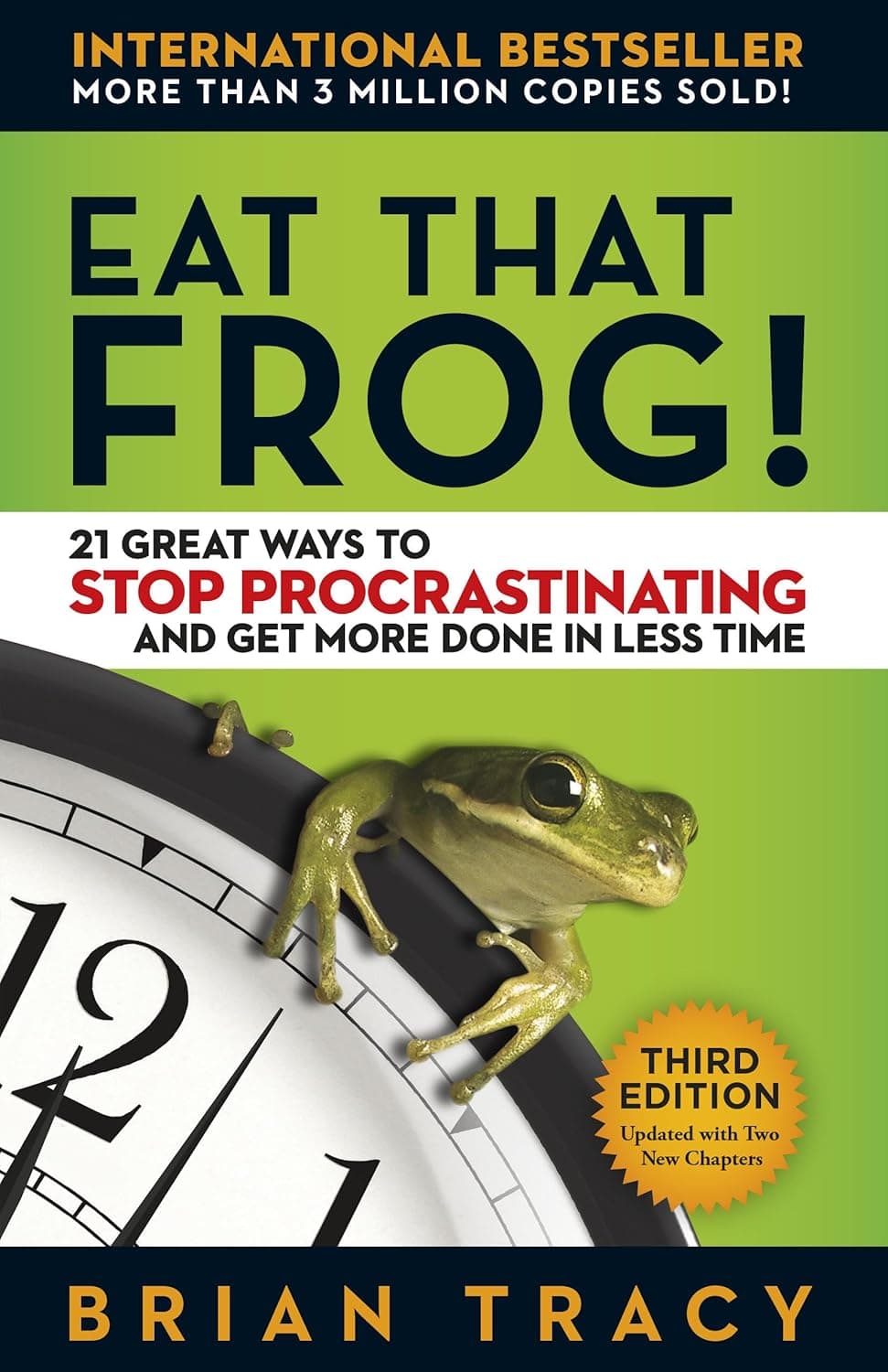
- The Frog stands for the most consequential task (A‑1), reinforcing the book’s central metaphor: eat it first.
- Tadpoles embody B-level work—tempting but low-stakes tasks that siphon energy from what matters.
Key Quotes
“You should never do a ‘B’ task when there is an ‘A’ task left undone.”
This rule makes prioritization binary. It prevents displacement activity and forces you to face consequences head-on, which accelerates meaningful progress.
“Your weakest key result area sets the height at which you can use all your other skills and abilities.”
A bottleneck principle for careers: excellence elsewhere cannot compensate for a single critical gap. The quote directs your learning plan to the one place that will lift everything.
“There is never enough time to do everything, but there is always enough time to do the most important thing.”
The Law of Forced Efficiency replaces busyness with intentionality. It grants permission to ignore the trivial and concentrate on leverage.
“What can I and only I do that, if done well, will make a real difference?”
Drucker’s question separates unique responsibility from generic activity. It becomes a daily filter for delegation, deletion, and deep work.
“Continuous learning is the minimum requirement for success in any field.”
This turns improvement from a nice-to-have into table stakes. When learning is nonnegotiable, procrastination fades because competence and confidence rise together.
“What one skill, if I developed and did it in an excellent fashion, would have the greatest positive impact on my career?”
A north star for development. It converts scattered efforts into a focused mastery path that compounds results over time.
Why This Matters and Section Significance
These chapters form the operating system of Eat That Frog!: a flow from strategy to execution. You define what counts (KRAs), choose the vital task (A‑1), protect focus (Forced Efficiency and preparation), and expand capacity (continuous learning). The pieces interlock so that clarity drives action, action builds skill, and skill makes the next action easier.
By turning a metaphor into a repeatable routine, this section delivers the book’s most practical value. It equips you to stop managing time and start managing priority—so the most important work actually gets done.