Opening
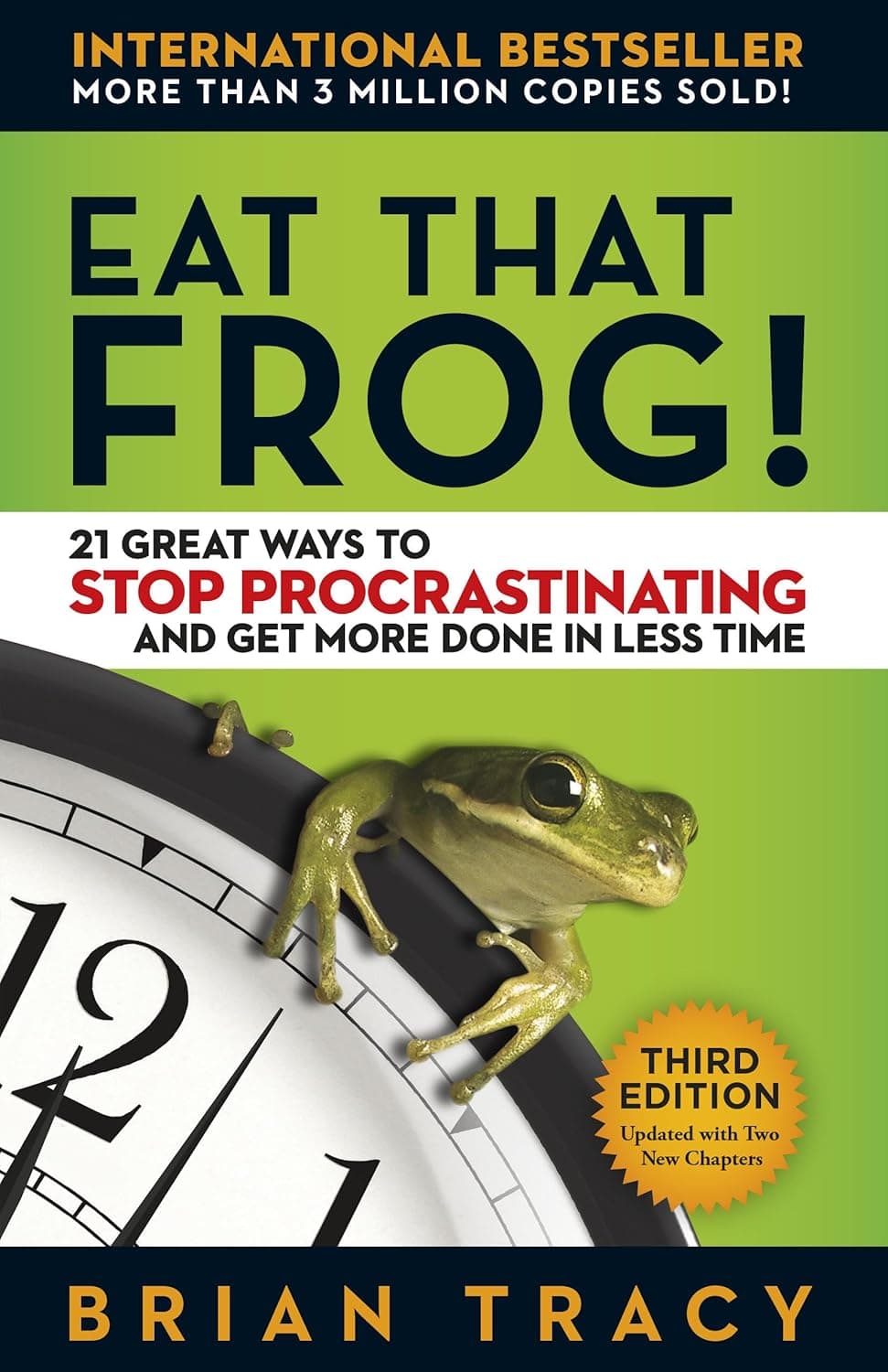
Brian Tracy opens by arguing that success hinges on choosing and completing the most important task—your largest “frog.” He urges readers to tackle The Frog first each day, a move that fuels momentum and anchors a life of Prioritization and Focus.
What Happens
Introduction: Eat That Frog
Tracy frames modern life as a flood of options and obligations. The decisive advantage, he insists, is the habit of action—choosing the hardest, highest-impact task and dispatching it immediately. He sharpens the metaphor with two rules: if there are two frogs, eat the ugliest first; if the frog is live, don’t stare—act.
He contrasts “activity” with accomplishment, highlighting the action-first mindset of Successful People. Building this instinct requires Self-Discipline and Habit Formation: decision, discipline, and determination. Finishing meaningful work triggers a neurochemical reward—an endorphin “high” that turns Overcoming Procrastination and Taking Action into a “positive addiction” for You (The Reader). He closes the setup with visualization—seeing yourself as a decisive producer to shape performance.
Chapter 1: Set the Table
Tracy anchors productivity in Clarity, Goal Setting, and Planning. Vague aims breed procrastination; clear targets convert energy into execution. His rule of thumb—“think on paper”—turns intentions into commitments. He notes that only a small minority write goals, and they outperform dramatically.
He offers a seven-step formula that moves a goal from idea to action:
- Decide exactly what you want
- Write it down
- Set a deadline
- Make a list of steps
- Organize by priority and sequence
- Take action immediately
- Do something every day that advances the goal
Reviewing written aims daily “stokes the furnace” of energy and motivation, making it easier to face the day’s frog.
Chapter 2: Plan Every Day in Advance
Tracy zooms in on execution planning—break a giant task into bites, then take the first. He calls thinking time the lever that multiplies Productivity and Personal Effectiveness: 10–12 minutes of planning can save up to two hours of waste. His 10/90 Rule captures it: the first 10% spent organizing saves up to 90% in execution.
He pairs this with the six “P” formula—“Proper Prior Planning Prevents Poor Performance”—and insists on living by lists: a master list (everything), a monthly list, a weekly list, and a prioritized daily list prepared the night before. Checking items off creates visible progress and momentum, making the next push easier.
Chapter 3: Apply the 80/20 Rule to Everything
Tracy introduces the Pareto Principle: a vital 20% of activities, customers, or efforts produce 80% of results—a pattern studied by Vilfredo Pareto. On any to-do list, two items often dwarf the rest in value. Those two are your frogs.
Most people drift toward the trivial many, confusing busyness with impact. Tracy’s directive is to resist clearing the small stuff first. Start with the high-value tasks—even when they’re tough—and satisfaction and output soar.
Chapter 4: Consider the Consequences
Tracy offers a test for importance: long-term consequences. Drawing on Dr. Edward Banfield’s research, he argues that a “long-time perspective” best predicts upward mobility; thinking five, ten, twenty years out improves today’s choices. The rule: long-term thinking sharpens short-term decision-making.
He invites a simple question before any task: What are the consequences of doing—or not doing—this? This lens isolates true priorities. He contrasts “tension-relieving” habits (socializing, drifting in late) with “goal-achieving” investments (deep work, learning your field). Choose the tasks that compound into a better future and motivation rises naturally.
Character Development
Tracy casts the reader’s day as a duel with a single, decisive challenge and equips a system to win it.
- You evolve from scattered to strategic—writing goals, planning days, and attacking the hardest task first.
- Brian Tracy steps in as a no-nonsense mentor—research-backed, rule-driven, and relentlessly practical.
- “Successful People” serve as the model: action-oriented, long-term thinkers who protect time for high-value work.
- The frog functions as a daily antagonist: ugly, unavoidable, and liberating once conquered.
Themes & Symbols
The frog symbolizes the day’s highest-impact task and the discipline it demands. Eating it first reframes productivity as courage: choose discomfort now to unlock clarity, momentum, and confidence later.
The book advances a toolkit that turns intention into impact. [Clarity, Goal Setting, and Planning] makes priorities visible. The 80/20 lens and [Prioritization and Focus] separate “vital few” from “trivial many.” Planning rituals translate priorities into sequence and time. And the endorphin feedback loop under [Overcoming Procrastination and Taking Action] and [Self-Discipline and Habit Formation] reinforces the identity of a finisher.
Key Quotes
“If you have to eat two frogs, eat the ugliest one first.” This rule hardwires courage into prioritization. When both options are difficult, starting with the harder one neutralizes dread and frees attention for everything that follows.
“If you have to eat a live frog, it doesn’t pay to sit and look at it for very long.” Speed prevents ruminating your way into avoidance. Acting quickly turns anxiety into momentum and builds the habit of execution.
“Action without planning is the cause of every failure.” By foregrounding planning, Tracy links success to forethought. A few minutes of design prevents hours of drift.
“Proper Prior Planning Prevents Poor Performance.” The six Ps translate strategy into ritual. Checklists and pre-made plans remove friction at the moment of action.
“Long-term thinking improves short-term decision making.” This rule reframes importance: not by urgency, but by future impact. With this lens, the true frog becomes obvious.
“Failures do what is tension relieving while winners do what is goal achieving.” The line exposes the emotional trap behind procrastination. Choosing compounding tasks over comfort becomes a daily identity choice.
Why This Matters and Section Significance
These chapters build the operating system for the rest of the book. First, define the work that matters most (clarity). Then, design your day (planning). Next, choose impact over activity (80/20). Finally, judge importance by future consequences (long-term vision). Together, they move the reader from overwhelm to a repeatable flow: identify the frog, plan the bite-sized steps, and finish it first. This foundation primes every later technique to work—not as theory, but as a daily practice.