Most Important Quotes
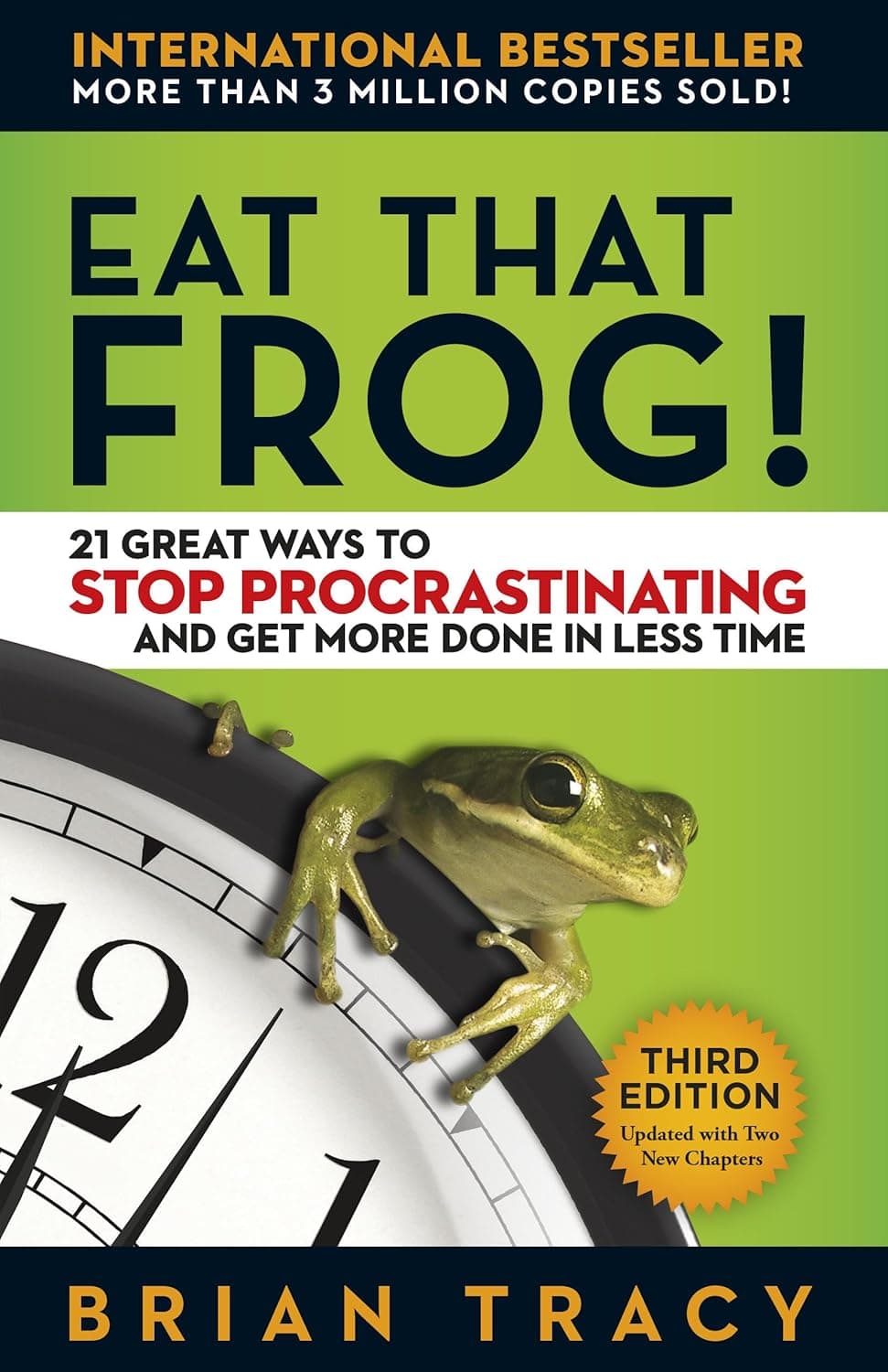
The Central Metaphor of the Frog
"It has been said for many years that if the first thing you do each morning is to eat a live frog, you can go through the day with the satisfaction of knowing that that is probably the worst thing that is going to happen to you all day long."
Speaker: Brian Tracy | Context: Introduction, p. 2; Tracy launches the book with a saying often attributed to Mark Twain
Analysis: This line unveils the book’s governing image: the dreaded task as The Frog. The vivid, slightly shocking imagery compresses the emotional discomfort of hard work into a single, concrete action, turning revulsion into a ritual of empowerment. By promising psychological relief for the rest of the day, the quote reframes difficulty as a strategic first move rather than a looming threat. It anchors the book’s ethic of decisive action and sets up its core theme of Overcoming Procrastination and Taking Action, making the metaphor both memorable and motivational.
The Key to Success
"The ability to concentrate single-mindedly on your most important task, to do it well and to finish it completely, is the key to great success, achievement, respect, status, and happiness in life."
Speaker: Brian Tracy | Context: Preface, pp. xii–xiii; Tracy’s “heart and soul” of the book distilled to one principle
Analysis: Tracy collapses his toolkit into one master skill: sustained, undistracted attention applied to high-value work. The sentence escalates from technique to life outcome, linking work habits to identity and fulfillment, which elevates productivity from a tactic to a philosophy. Stylistically, the parallel phrasing (“to do it well and to finish it completely”) underscores completeness as a moral and practical imperative. It ties together Prioritization and Focus and Self-Discipline and Habit Formation, positioning them as the engine of a successful, satisfying life.
The 10/90 Rule of Planning
"This rule says that the first 10 percent of time that you spend planning and organizing your work, before you begin, will save you as much as 90 percent of the time in getting the job done once you get started."
Speaker: Brian Tracy | Context: Chapter 2, p. 17; Tracy argues for planning your day in advance
Analysis: The “10/90 Rule” uses a clean numerical contrast to argue that forethought is the ultimate force multiplier. By quantifying the payoff, Tracy dismantles the impulse to plunge into tasks without preparation and reframes planning as a time-saver rather than a delay. The line supports the theme of Clarity, Goal Setting, and Planning and justifies lists, priorities, and schedules as essential tools. Ultimately, it advances a practical philosophy of leverage at the core of Productivity and Personal Effectiveness.
Thematic Quotes
Overcoming Procrastination and Taking Action
The Danger of Hesitation
"If you have to eat a live frog, it doesn't pay to sit and look at it for very long."
Speaker: Brian Tracy | Context: Introduction, p. 3; a final nudge tied to the central metaphor
Analysis: This brisk aphorism captures how delay magnifies dread and saps willpower. By returning to the frog image, Tracy shows that rumination intensifies resistance while action dissolves it. The sentence’s clipped rhythm mimics the snap decision it prescribes, urging You (The Reader) to move before fear congeals. Its memorability lies in its plain-spoken irony: the longer you stare, the harder the swallow—and the less likely the win.
Execution Over Perfection
"An average plan vigorously executed is far better than a brilliant plan on which nothing is done. For you to achieve any kind of success, execution is everything."
Speaker: Brian Tracy | Context: Chapter 1, p. 10; the sixth step of his goal-setting method urges immediate action
Analysis: Tracy confronts analysis paralysis by flipping conventional wisdom: strategic elegance without motion is failure by another name. The contrast between “average” and “brilliant” exposes our perfectionist bias and redirects attention to outcomes. His insistence that “execution is everything” foregrounds momentum as a metric, not polish or complexity. It grants readers permission to start imperfectly and learn forward, a practical antidote to stalling.
Prioritization and Focus
The Worst Use of Time
"One of the very worst uses of time is to do something very well that need not be done at all."
Speaker: Brian Tracy | Context: Chapter 1, p. 9; a rule emphasizing clarity before effort
Analysis: Here Tracy separates effort from value, exposing “busywork” as a seductive trap. The maxim channels the spirit of the 80/20 principle popularized by Vilfredo Pareto: most outputs come from a vital few inputs. Its sting is the indictment of “productive procrastination,” in which competence masks avoidance. The lesson is ruthless: effectiveness demands not just ranking tasks, but eliminating the ones that should never be done.
The Power of "No"
"You can get your time and your life under control only to the degree to which you discontinue lower value activities."
Speaker: Brian Tracy | Context: Chapter 16, p. 86; the foundation of “creative procrastination”
Analysis: Tracy reframes control as subtraction: freedom is reclaimed by pruning what doesn’t matter. The counsel is paradoxical yet liberating—procrastinate on the trivial to protect the essential. By emphasizing discontinuation, he turns “no” into a strategic habit, a guardrail for focus and discipline. The result is a leaner schedule that matches ambition, not a fuller one that drowns it.
Clarity, Goal Setting, and Planning
The Foundation of Productivity
"Clarity is the most important concept in personal productivity. The number one reason why some people get more work done faster is because they are absolutely clear about their goals and objectives and they don't deviate from them."
Speaker: Brian Tracy | Context: Chapter 1, p. 7; the chapter’s opening thesis
Analysis: Tracy identifies confusion—not laziness—as the hidden fuel of procrastination. By tying speed and volume of output to goal-definition, he elevates thinking work to parity with doing work. The portrait of Successful People as unwavering in purpose reframes success as a function of chosen constraints. This line undergirds the book’s seven-step process and the scaffolding summarized in the Chapter 1-5 Summary, making clarity the keystone of execution.
The Magic of Writing
"Think on paper. Only about 3 percent of adults have clear, written goals. These people accomplish five and ten times as much as people of equal or better education and ability..."
Speaker: Brian Tracy | Context: Chapter 1, p. 8; step two of the goal-setting formula
Analysis: “Think on paper” turns intention into artifact—a portable commitment that sharpens priorities and invites review. The “3 percent” statistic functions as a rhetorical dare, moving readers from vague desire to measurable action. By implying that writing converts potential into leverage, Tracy makes the pen a productivity technology. The ellipsis hints at compounding gains, suggesting a long tail of advantages that begin with a simple, concrete habit.
Character-Defining Quotes
Brian Tracy
"Just find out what successful people do and do the same things until you get the same results. Wow! What an idea."
Speaker: Brian Tracy | Context: Preface, p. xi; a formative insight from his early sales career
Analysis: Tracy’s persona is pragmatic and imitative rather than mystical—he treats success as a reproducible pattern. The ingenuous “Wow!” softens the principle while underscoring his empirical bent: observe, model, repeat. This approach explains the book’s methodical tone and its reliance on proven practices over novel theory. It frames the entire text as a distillation of best behaviors applied relentlessly.
The Frog
"Your 'frog' is your biggest, most important task, the one you are most likely to procrastinate on if you don't do something about it now. It is also the one task that can have the greatest positive impact on your life and results at the moment."
Speaker: Brian Tracy | Context: Introduction, p. 2; the official definition of the central metaphor
Analysis: The definition gives the metaphor a powerful dual edge: the frog is both most avoided and most valuable. That tension explains why avoidance is so costly—each delay postpones disproportionate benefits. By fusing urgency (“now”) with impact (“greatest positive impact”), Tracy makes prioritization visceral, not abstract. This lens orients every tactic in the book toward identifying and devouring this specific class of task.
Successful People
"Successful, effective people are those who launch directly into their major tasks and then discipline themselves to work steadily and single-mindedly until those tasks are complete."
Speaker: Brian Tracy | Context: Introduction, p. 3; defining the action orientation of high achievers
Analysis: The verbs—“launch,” “discipline,” “work steadily”—build a kinetic portrait of achievement as an act of will sustained over time. By emphasizing single-mindedness, Tracy contrasts purposeful depth with scattered effort. The line democratizes success: it hinges on habits, not gifts. It also foreshadows the book’s insistence on starting strong and finishing clean, the two critical beats of execution.
Memorable Lines
The Cause of Failure
"Action without planning is the cause of every failure."
Speaker: Brian Tracy (quoting Alex MacKenzie) | Context: Chapter 2, p. 14; a stark warning against directionless busyness
Analysis: The absolutism of “every failure” shocks the reader into reconsidering motion as progress. Positioned against the 10/90 Rule, it supplies the necessary counterweight to action-first advice. The aphorism’s severity spotlights the hidden cost of improvisation: wasted cycles, misaligned effort, and preventable mistakes. It’s a crisp credo for pre-commitment—think first, then move with confidence.
Winners vs. Failures
"Failures do what is tension relieving while winners do what is goal achieving."
Speaker: Brian Tracy (quoting Dennis Waitley) | Context: Chapter 4, p. 27; contrasting short-term relief with long-term reward
Analysis: The rhyme and antithesis make the line stick, but its force lies in the moral contrast it draws. It names the daily fork in the road: comfort behaviors that soothe anxiety versus disciplined actions that advance aims. By recasting micro-choices as identity statements, it invites readers to align habits with outcomes. The sentence becomes a litmus test for priorities in moments of temptation.
Opening and Closing Lines
Opening Line
"This is a wonderful time to be alive. There have never been more possibilities and opportunities for you to achieve more of your goals than exist today."
Speaker: Brian Tracy | Context: Introduction, p. 1; the book’s first sentence
Analysis: Tracy frames the problem of overwhelm as a privilege of abundance, not a deficit of capacity. The buoyant diction—“wonderful,” “possibilities,” “opportunities”—creates an expansive mood that primes readers for growth. This optimism repositions productivity as a means to harness plenty, not survive scarcity. It’s an invitation: the world is open; your methods must be worthy of it.
Closing Lines
"Make a decision to practice these principles every day until they become second nature to you. With these habits of personal management as a permanent part of your personality, your future will be unlimited. Just do it! Eat that frog."
Speaker: Brian Tracy | Context: Conclusion, p. 113; final directive to the reader
Analysis: The cadence moves from choice (“make a decision”) to identity (“permanent part of your personality”), capturing habit formation as self-making. The promise of an “unlimited” future translates daily discipline into existential hope. The last two imperatives strip away nuance to deliver a rallying cry—short, punchy, performative. Ending where it began—with the frog—Tracy turns metaphor into mantra and advice into action.